Stewart Island Ferry Wharf – Bluff
Saturday 22 February 2020
The day began at 2:00am. The time we had planned to rise, up-anchor and head away down the coast to our final destination of Stewart Island around 60 miles to our south.
Well, we all got out of bed as agreed, but after analysing the latest weather forecast – still blowing hard from the south west – our chosen course – to the soundtrack of howling wind in the rigging, we all agreed that this was NOT the time to head away. Warm beds were luring us back
“Maybe we get up at 6:00am, and reassess things then” … I suggested, to which John and Carsten hastily agreed.
“Robert. Robert. Robert ! …” I’m not sure how many times John had to say my name through the half opened cabin door, but finally something broke through my deep, dreamy sleep … and it was John’s ever-louder voice.
Dressed for action, the wind playing a softer, gentler tune in the rigging, we did all the last minute “putting away tasks” before we retrieved the 60 metres of chain we’d laid the day before and made our way out of the bay.
We would have hoisted a double-reefed mainsail, but we noticed that a “car” that attaches the mainsail to the mast and which allows the sail to be raised and lowered smoothly, had broken. Not just one, but three in fact, This was a big set back, because our day’s sail would be into the wind and it was the mainsail that, when hauled in tight, would be giving us the main form of propulsion; allowing us to sail closer to the wind than either of the headsails; the jib and the staysail.
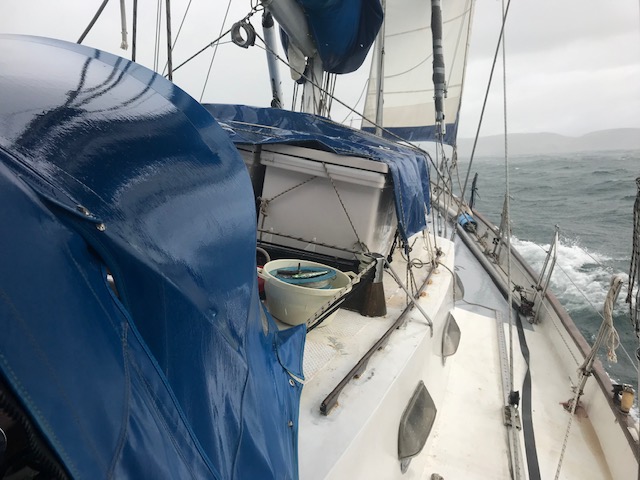
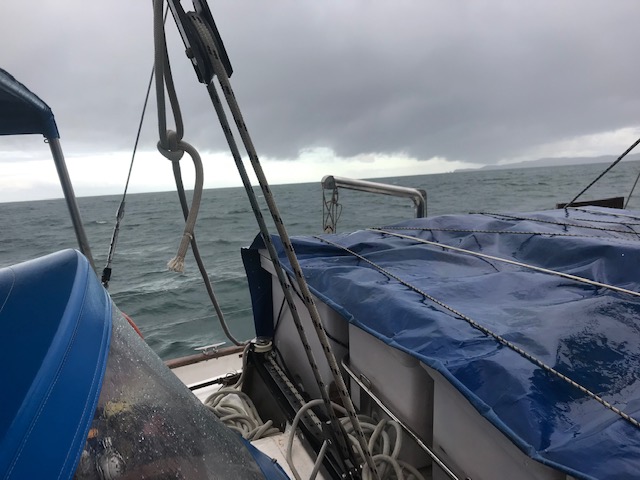
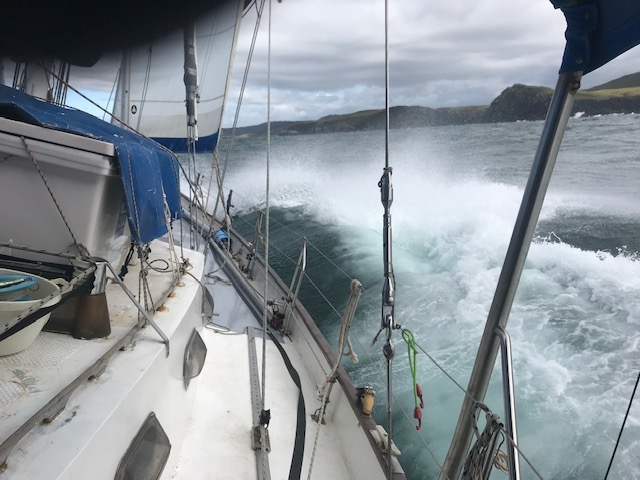
Normally, I have spare parts for nearly everything onboard. In the case of the mainsail batten-cars, I had just one spare. But it would take some time, in relatively still conditions, to remove the mainsail and make the necessary repairs. For now, we had to get underway, as quick as possible, if we were to have any chance of making Stewart Island in daylight.
In the end, we set new lines to the third reefing points of the mainsail (a sail-setting I don’t think I’ve ever done in the 14 years I’ve had Chimere) and hoisted away. In addition, we set the staysail, winched in very tight, and a small jib; maybe 25% of it’s usual size. The three sails worked well together, but after more than 20 tacks and 15 hours of sailing, we were extremely pleased to tied up our lines at the Bluff Ferry Terminal – our allotted temporary berth – and relax.
It’s said that the shortest distance between two points is a straight line. And in the case of sailing, we like to draw a straight line between the start and the finish, and after allowing for common obstacle like headlands, islands and other hard objects, we set sail.
All bets are off, however, when the wind is coming from where you want to go. Often referred to as “on the nose”. Unless of course you’ve got a massive engine, leave the sails furled and just plough through. That’s not an option for us … so inevitably, our only option was to plug away, tacking first this way, then that, either side of the wind, towards our ultimate goal.
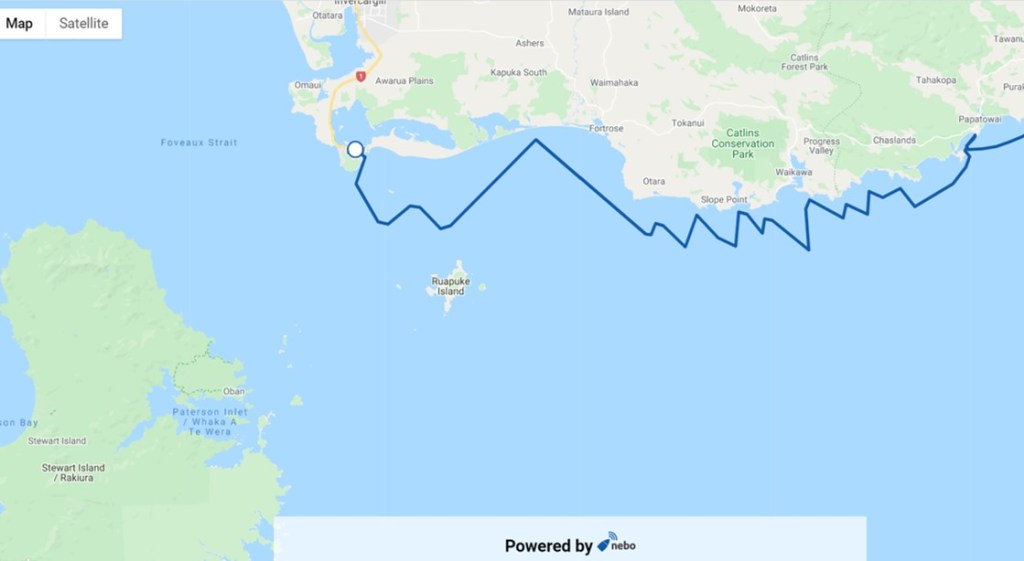
With wind expected from the SW for the next few days, one option was to simply remain at anchor in Tautuku Bay for the duration. However, the forecast appeared “milder” for the next 24 hours and our theory was that if we hugged the coast, the going might be manageable? In the end, this partly worked – the first part of around 2 hours being relatively OK, the other 13 hours being just a constant slog.
The record of our sailing track tells the story, with each individual zig and zag revealing a unique combination of factors. Such as … maximising the shelter of the land and any available wind shifts – while staying in sufficiently deep water, plus (if you look close enough) also highlighting particularly crooked sections where we’d stuffed up a tack, wandered off the wrong way for a time, or battled to keep a straight line in the face of mounting seas – we mostly blame these on equipment failure.
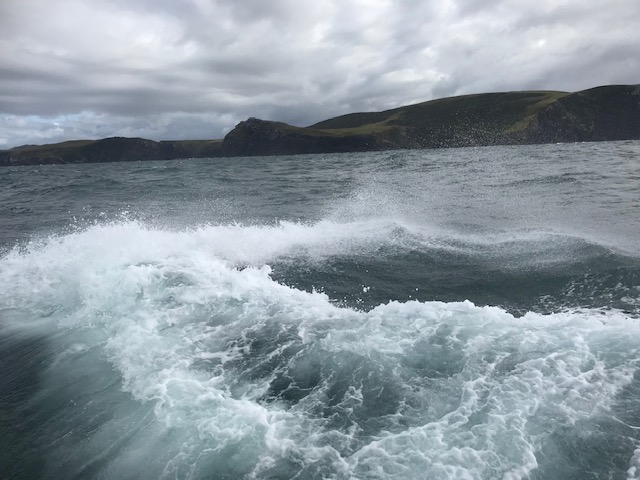
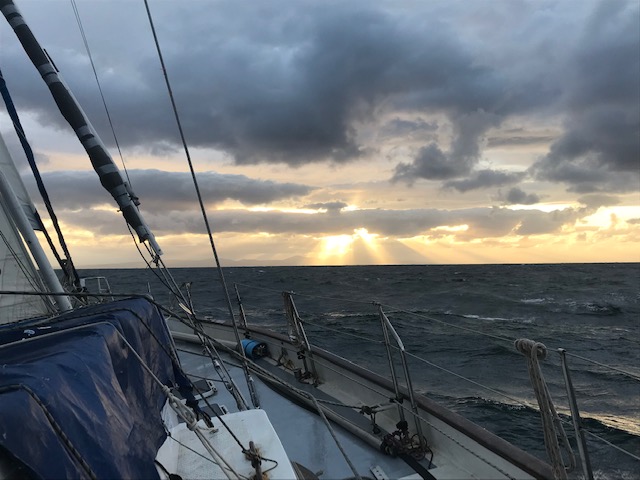
As the day wore on, rain squalls were replaced with sunshine, which in turn were replaced again with rain showers, it had very much a Bass Strait “vibe” about it, made even more so with the appearance of mutton birds soaring and diving on the wind. It occurred to us that we were NOT going to make it to Stewart Island – at least not today. Our focus now turned to going straight for Bluff, as we were anxious to arrive, somewhere, before dark.
Once the decision was made to head for the (closer) harbour-town of Bluff, I called ahead to Bluff Harbour Radio on VHF Channel 16 to inquire about the availability of a berth. They received my call and suggested I contact Bluff Fishermen’s Radio on VHF Channel 61. This I did and who should come on the air waves but a woman by the name of Mary.
Now I’d heard about Mary from a fellow-sailor I’d met before leaving Westernport. The well-known, life-time sailor and well-known international author Lyn Pardy; who just happened to be at Westernport with a man called David aboard his yacht called Sahulu.
“Mary … she knows everyone down in the Bluff area”, said Lyn in her distinctive Californian accent, “She was so helpful when we sailed down that way a year ago. We were on the radio to her regularly, and she is an institution”
So, this was THE Mary I was now talking with …
“Is there any chance of a berth? We are a 53-foot yacht, 3 people onboard, (POBs) we expect to be arriving in Bluff, around 8:00pm – before dark – over”, I inquired.
“Leave it with me. There are a couple of options. I’ll get back to you. Do you have a pen handy … this is my phone number. If you can call me after the radio schedule and weather report I’m going to do shortly, I’ll have more details for you, over”
“Roger that Mary. Many thanks. Will do. Chimere out” … I responded, just amazed at how cheerful, efficient and helpful this person was to me, a total stranger announcing my arrival in a few hours time.
We then listened to Mary give the 5:30pm national weather-situation report, with particular focus on this region. Followed by scheduled cheerios and call-ups, to a dozen or more yachts and other vessels, spread across Stewart Island and Fiordland. Each reporting their current position, revised POBs (after all, it might have changed from last night’s scheduled call-up) intentions and other necessary information.
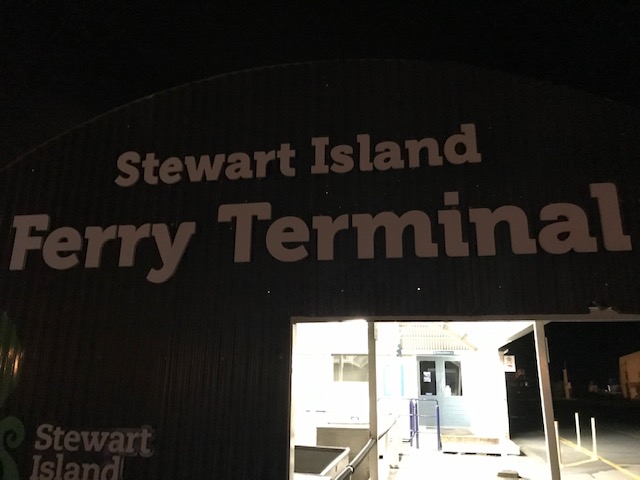
My conversation with Mary a short later, led to a new contact “Chris” … “… here’s his phone number, but don’t give it out to anyone. Call Chris because he should be able to give you a berth behind where the Stewart Island ferry comes in. Call me back when you’ve spoken with him, because if that doesn’t work out, I’ve got another option”
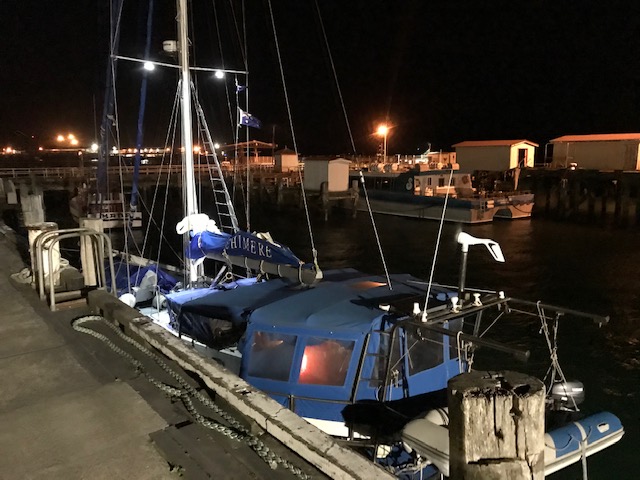
Chris confirmed that we could pull up behind the ferry docking point, just behind a fishing boat called Mana, and stay there a few days. Chris provided further details about the exact location of the berth, how to enter, what side of the boat to have the fenders etc etc, all of which I wrote down as quickly as possible.
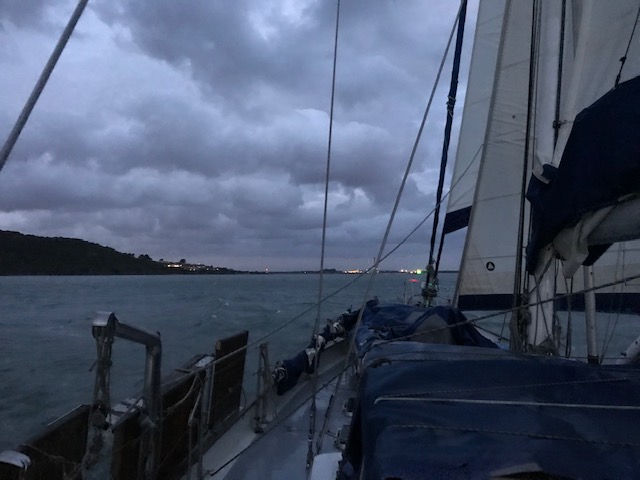
A bit after 8:00pm, we were still miles from the port, tacking our way across Toetoes Bay into ever-stronger winds and mounting seas, making sure to keep well clear of the shallow waters close in to Dog Island (as advised week ago in Lyttleton by a Bluff-local)
“Hello Mary, we are taking longer than expected. We will probably be in a bit after 9:00pm now” I said. Hoping to keep her up to date on our movements.
“No problems. Give me a call as you make your approach and I’ll come down and help you with the lines”, responded Mary, in her now familiar cheerful, no-nonsense way.
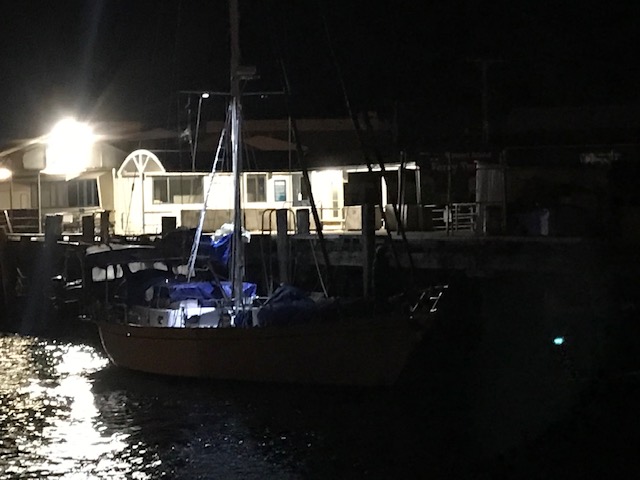
So it was that around 10:00pm we finally tied up, with Mary waving a torch to show us where to go, and then looping our lines over the bollards on the dark, cold wharf. “Make sure you put a loop in it before you throw it at me”, she said, standing high up on the dock, the tide well out.
“So, you’re all set for the night. I saw you coming up the channel. I can see you from my home. Make yourself comfortable and I’ll pop back down in the morning (that’s Sunday) to check on you and see if you have any problems or questions. See you then”.
Our amazing arrival and welcome to Bluff complete, the lines securely fastened, the wind above whistling a higher pitch tune in the rigging, John, Carsten and I retreated to the warm saloon and after a brief convening of the “Catering Committee” agreed that a beer was definitely in order..
Hunger and sleep, mixed with significant amounts of exhaustion had us knocking up some toasted cheese and ham sandwiches before retreating to our respective cabins.
We had arrived. We’d tied up safely, in the dark and the adventures of tomorrow, in a new town beckoned.
Right now though, sleep was the next and only thing to do.
Smooth seas, fair breeze and zig zag – every tack tells a story
Rob Latimer
 NZ2020