Port Adventure, (Kaka Point, Heron River) Stewart Island
Wednesday 26 February 2020
Despite getting up bright and early, it wasn’t until around 9:45am that we finally up-anchored and headed away from our delightful anchorage at Crayfish Island, Paterson Inlet.
With no wind and oily-flat seas we made good time under motor, our destination being SOUTH … down the coast, in order to explore some of the many bays and inlets on offer.
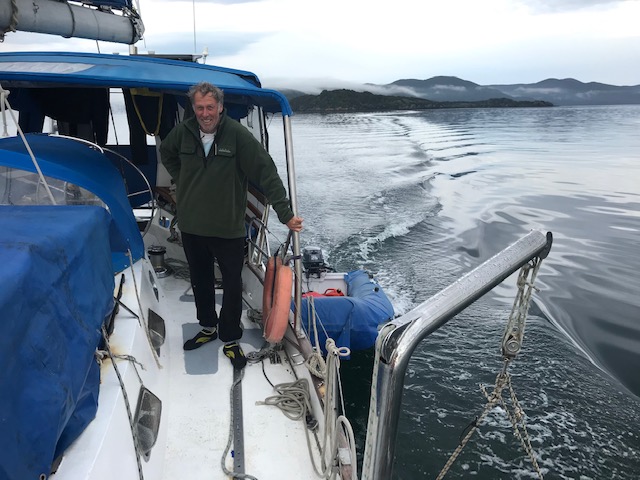
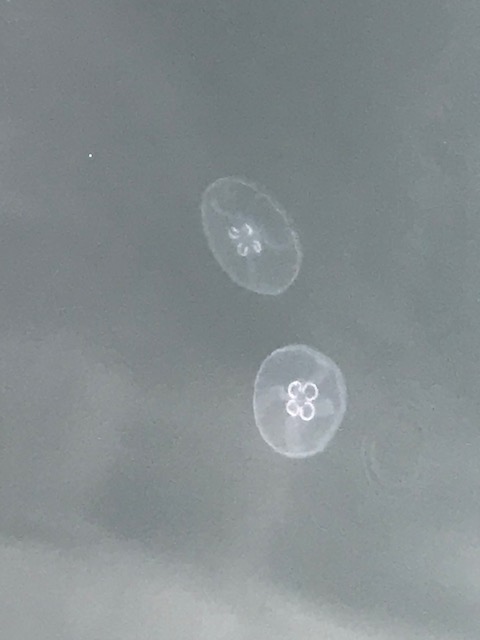
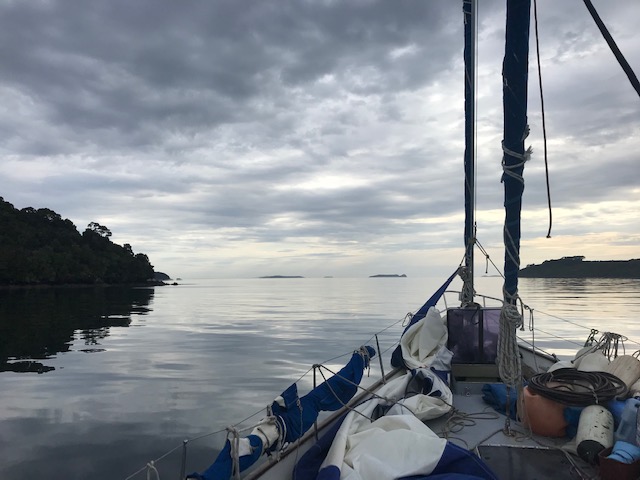
Knowing that internet coverage was scarce at best and totally non-existent out of sight of the main tower on the hill above the town of Oban, we decided to sneak back close to town in order to finish off some computer work that required an online connection.
A temporary anchor-drop – with 4-bars showing on the iPhone – was made, over the hill from Oban in Golden Bay. Still in Paterson Inlet and within sight of the “other” Sydney Cove” across on Ulva Island and the wee islands of Faith, Hope and Charity; not to mention Iona Island off our port beam. As so often happens, 15 minutes checking emails, paying bills and organising spare parts turned into 30, then 60. Lunch came and went and apparently, we ended up being there nearly 2 hours after blogs and photos were upload and several outstanding phone calls made … these young people and their smart phones?!
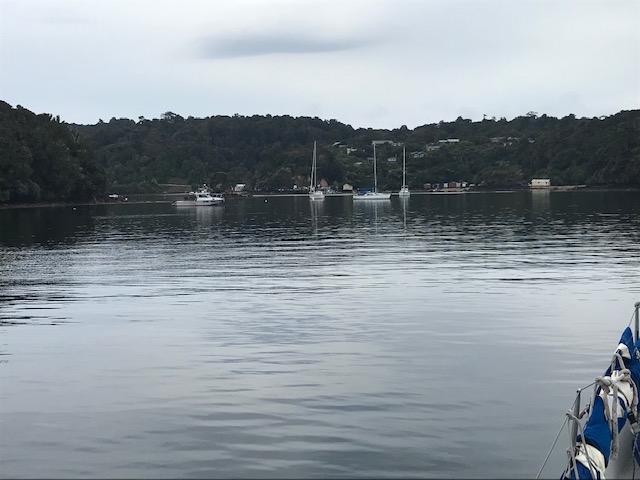
Finally, we were away. South, under motor, with the warm sun, calm sea and almost tropical conditions, giving us a rather false sense of how things really can be down here. Certainly, the cruising guide was upfront in pointing out the dangers of wind, tide and severe weather events. But today, it was definitely shorts and t-shirts all-round, as we had fun pointing out the “rafts” of Little Blue Penguins, floating here and there, gathered together for security no doubt. We figured these must have been baby penguins going through their moulting phase because they mostly sat high in the water; more buoyant than normal on account of their fluffy feathers.
The cruising guide made mention of New Zealand penguins. Informing us that New Zealand was home to 14 of the world’s 18 species of penguins, with the Yellow Eyed penguin being the rarest.
Whilst you might think YOU have a busy year planned for 2020, spare a thought for the penguin. The Stewart Island Cruising Guide tells us their calendar looks like this – every year …
September Nest building
October Egg Laying
November Hatching
December Rearing
January End of guarding
February Chick moults, develops juvenile plumage
March Fledgling, juvenile migration
April Pre-moult conditioning
May Moulting
June Post-moult conditioning
July Winter feeding, pair formation, territorial establishment
Strangely, the publication leaves out the month of August. But since it lies between “Pair Formation” in July and “Nest Building” in September – and the book is for an all-age readership – we figured the local penguins devote the month of August to being amorous and more?! Since “Mating” was omitted from all the other activities listed.
The short chug down the coast to Port Adventure took a couple of hours and it was on this trek that we passed over the 47 degree (south) parallel; the furthest south any of us have travelled to date. As a benchmark, Melbourne is at 37 degrees south and Hobart is at 42 degrees. At around 69 miles, or 111 kilometres for each degree of latitude, this means that we are around 350 miles, or 555 kilometres further south than Hobart.
Once in Port Adventure, we set about driving into and out of, the many small coves and bolt-holes that dot the coast. First of these was tiny Kaika Bay behind Thief Point, which was headed by a classic curve of white sand, book-ended on each side by rocky headlands, behind which bush grew uninterrupted to the ridge tops of the backing hills. To this point we had seen no one. Sure, there were the very occasional huts and small holiday-shacks clustered here and there along the coast, but apart from a small dinghy pulled up in the corner of the bay, we had the place totally to ourselves.
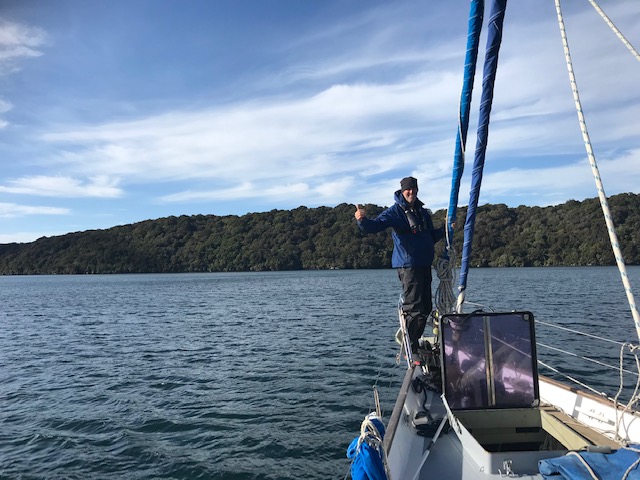
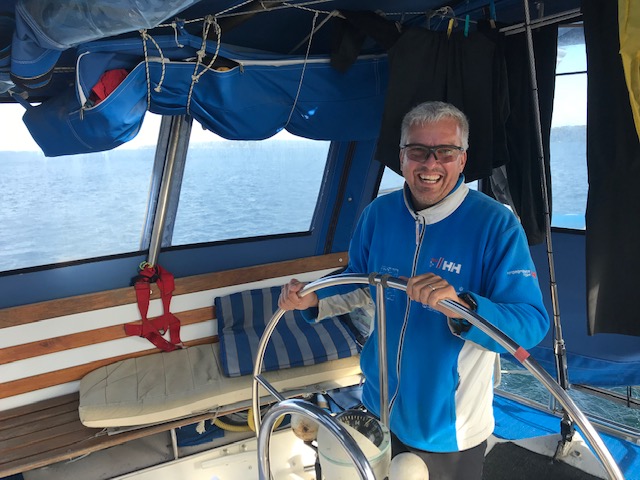
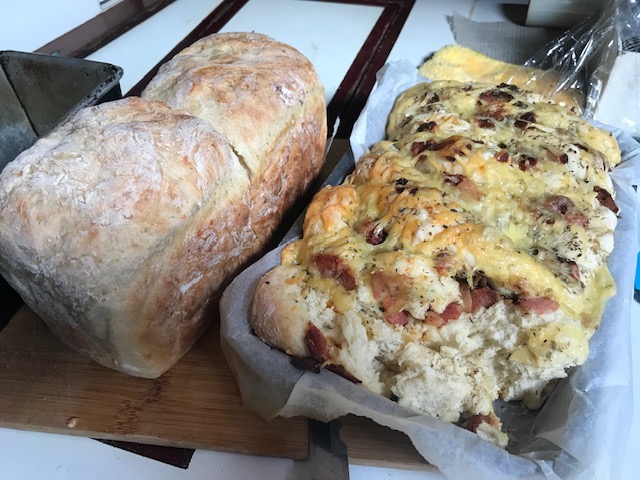
John and I were ready to go fishing and exploring in the dinghy, but first there was the important task of waiting for the bread and rolls – bacon, herb and cheese flavoured – to finish in the oven. “There’s an engine throbbing somewhere in the distance … sounds like a boat”, someone thought out loud.
Soon enough, the source of the noise was revealed as this extremely large aluminium charter boat came around the headland, aiming straight for us. “Is he coming in here?!” we all exclaimed. Yep. He was coming in here. Where there was barely room for us alone, he snuck past our bow, dropping anchor between us and the beach. Our initial speculation at 50 tourists lining the railing taking photos and video of us, like exhibits in the zoo, were allayed when all we could spy were maybe 5 or 6 people on deck, obviously excited by their arrival at this picture-book location.
“They’re taking a group ashore with all their gear” observed John. No sooner had the boat dropped anchor, than they were heading off again, leaving their passengers, and us, to enjoy this pristine serenity.
John and I raced off in the dinghy to try our hand at fishing, leaving Carsten with the big responsibility of emptying the oven of its treasures “in 10 minutes”.
First, we checked the rocky headlands for mussels … maybe oysters … what about abalone (paua) … nothing. Or at least nothing we could see.
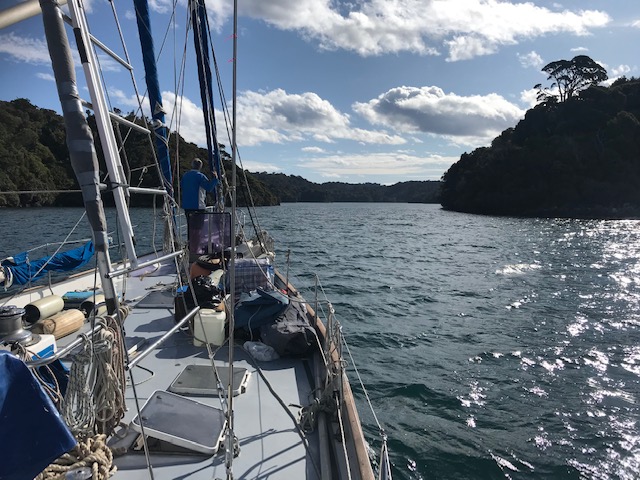
Then out in the bay we saw a large flock of circling terns, supported by masses of mutton birds, all diving and crashing into the sea, obviously finding something of worth. “We want the big fish that are chasing the little fish those birds are after,” called John, over the sound of the outboard, while quickly swapping the rig on his line to a trolling set-up.
Trouble was, the birds were not stationary. Clearly, whatever was happening below the surface of the sea was on the move because it took us some effort to catch up to them, and then keep pace with them. The birds all the while, gliding just above our heads and around us as we sped along in the dinghy at around 15-20 knots.
Eventually we slowed enough to be able to troll at a respectably slow speed, right through the middle of the feathery-fishy chaos that was going on around us.
And in conclusion, … I’d like to be able to say we landed 5 large tuna and 3 Spanish mackerel … but all we got was a lot of fun and the excitement of bouncing over the waves in close-company with the birds… and we presume, some fish. Be good to have a photo, but sometimes it IS two hands for the ship and no hands for the camera.
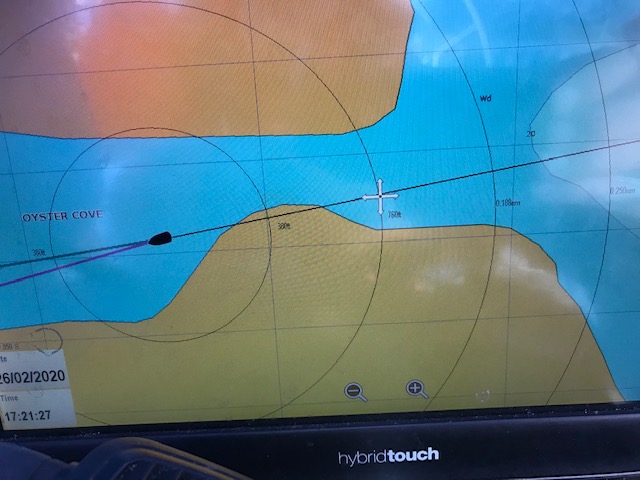
One instructive thing that happened while entering and exiting one particular inlet, was that the chart plotter didn’t quite line up with reality. We’ve had this in Vanuatu, where at times the chart plotter can have you travelling over land, even anchored in the middle of the nearby village, when in fact you are very much still at sea. In this case, as the photo shows, our chart plotter-track took us through the “Yellow”, which is definitely land; a good 25-50 metres out of whack. It was a good reminder, that no matter where you are, it doesn’t pay to rely too much on technology – and avoid travelling at night or solely “on instruments”
After entering some of these small coves, John and Carsten had a go at manoeuvring Chimere in a confined space, in particular the “spin on the spot” strategy, which uses high revs and the throw of the prop in both reverse and forward gears, to first push the stern to port, quickly followed by turning the bow to starboard. The net result being that you spin the boat, almost on it’s own length. It seemed a good place to get some practise in.
After dropping anchor in the calmer than calm entrance to the Heron River we took the opportunity to do some “river exploring” … taking the large dinghy up as far as we could; maybe 1 mile or so. As the watercourse narrowed and the trees and foliage closed in, visions of the Amazon and scenes from the film The Mission came to mind – minus the inquisitive natives, monkeys and the steaming humidity.
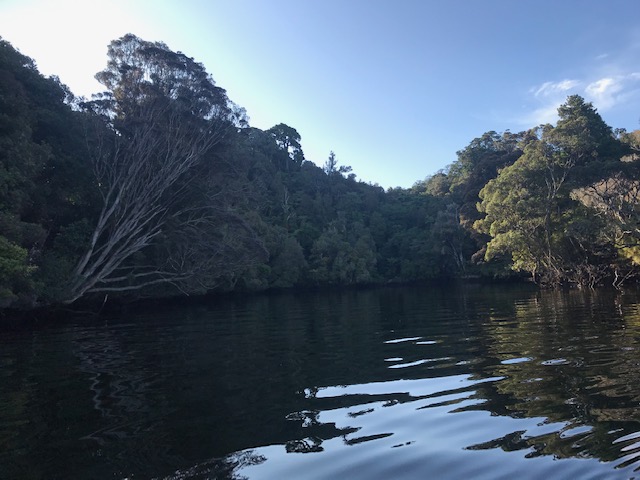
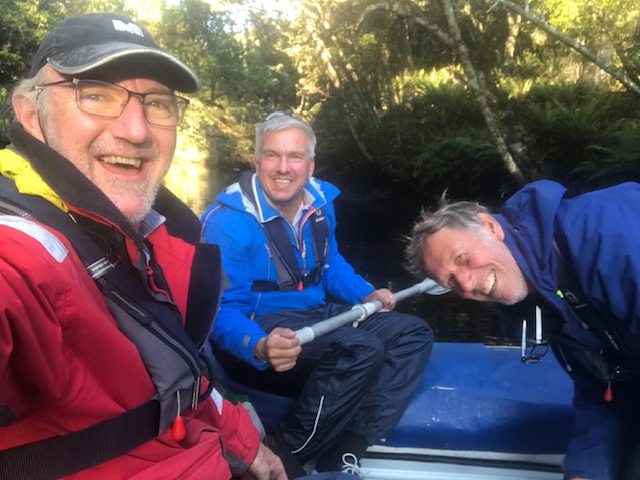
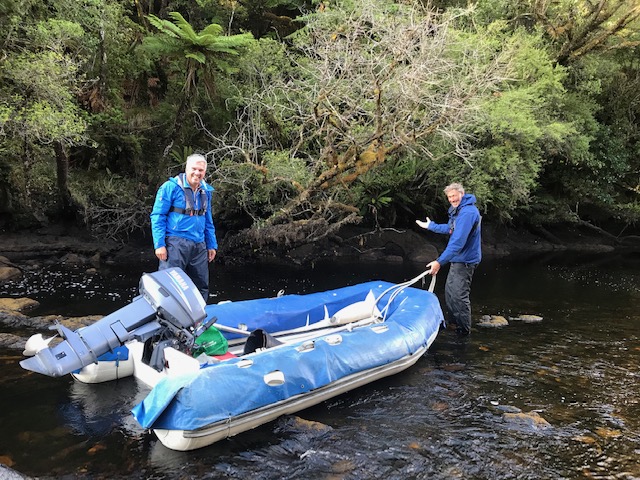
Conditions remained settled, even balmy, as the sun went down, disguising the fact that the forecast for tomorrow would be a very different story; 20-30 knots from the West and North West where we are, but 55 knots plus, further out at the western entrance to the Foveaux Strait.
For now, it was time to enjoy the stillness and a good night’s sleep.
Smooth seas, fair breeze and Crossing The 47th Parallel (South)
Rob Latimer
 NZ2020
Another top notch report and very impressive bread Carsten . Well done. Pleased to report the sailing video has begun to take shape… I’ll get you preview asap.
LikeLike