Otago’s Retreat, Preservation Inlet, FIORDLAND !
Wednesday 4 March 2020
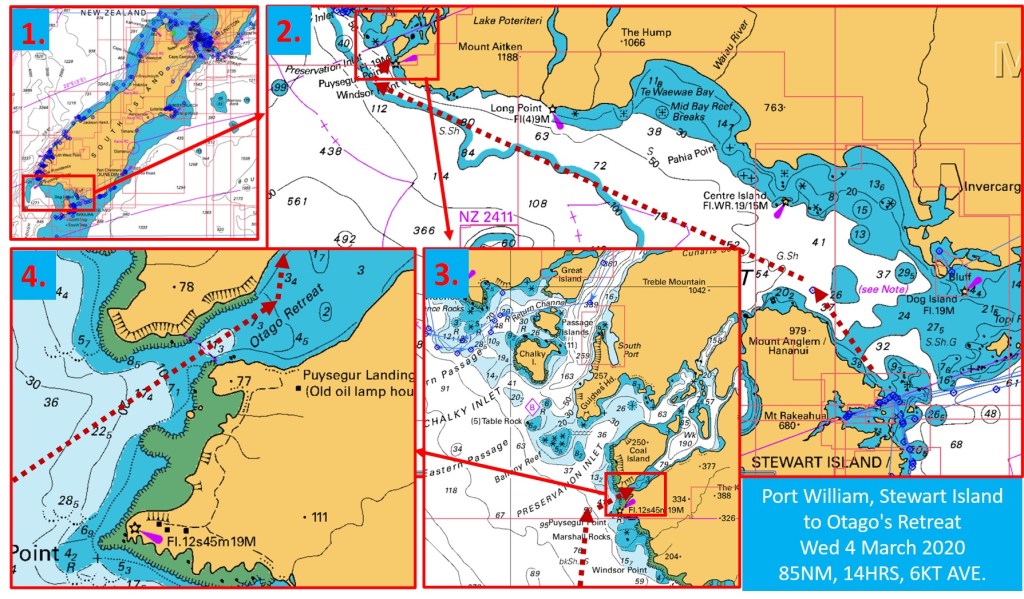
It was always going to be a close-run thing. Sailing from Port William on Stewart Island to Preservation Inlet in Fiordland – a distance of roughly 80 miles – in daylight hours.
The worst of the 40-50 knot gale had passed overnight. We’d had a still and secure night at anchor, with only the wind in the rigging and the sound of passing showers on the deck, to remind us that we were anchored in a rather remote corner of the world.
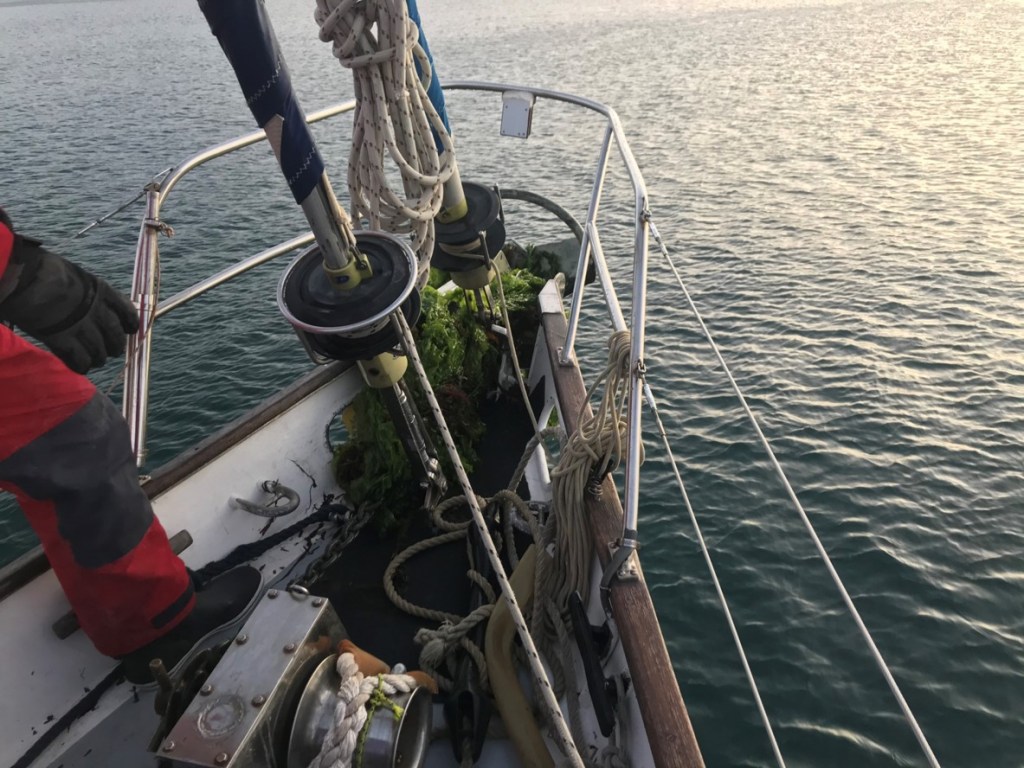
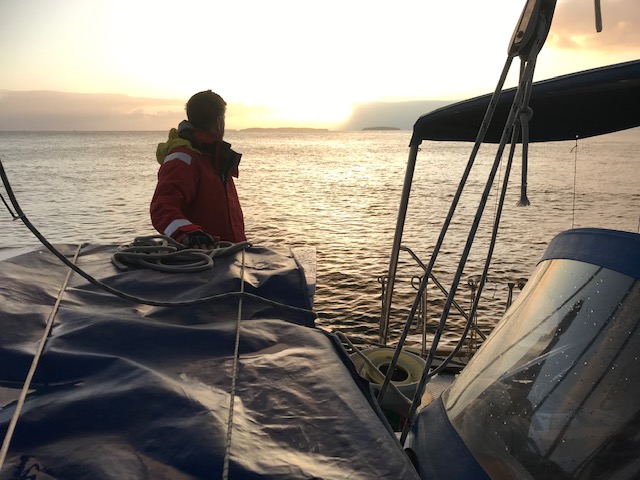
By 7am the wind was down to only 20-30 knots out at the western entrance to Foveaux Strait, but predicted to diminish throughout the day. And if everything went to plan, we wouldn’t have to tack. The southwest wind was sufficiently off-the-bow to enable us to hold a direct course – to Windsor Point (next to Puysegur Point) at the SW corner of the South Island.
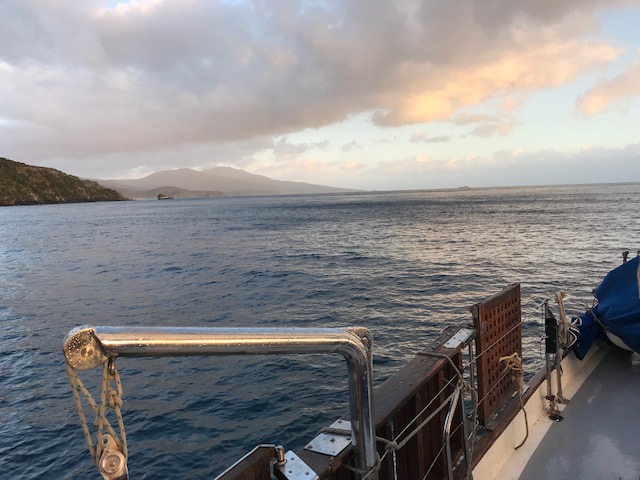
Out of necessity, we needed to get away early, and in retrospect we should have got away in the dark, at around 5 or 6 o’clock, but in fact , it was closer to 7:30am that we headed out of the bay, with the morning-light already giving us a day-time view of our surroundings.
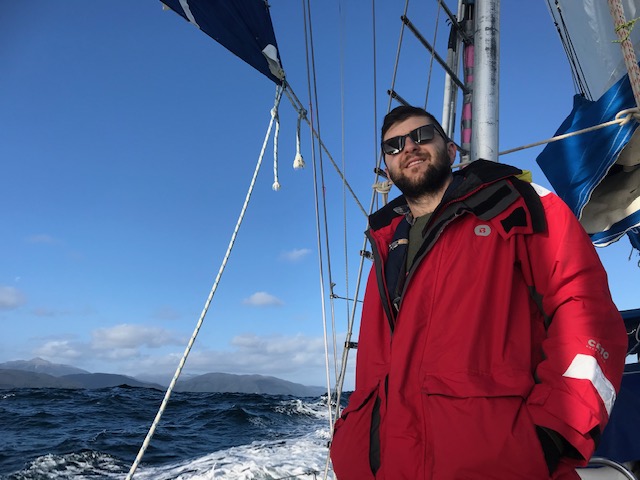
Along the north coast of Stewart Island, things were flat calm – as they say in the classics, TOO clam – with the light steady winds off the beam punctuated by regular “bullets” that came down from Mount Anglem (the 1000 metre hill – or mountain in Australia – on the north-side of the island), hitting us on the port bow and causing us to ease the sheets for a time, to ensure we weren’t over-powered.
We started the day with minimal sail hoisted … a double reefed mainsail, the small staysail, and a very small jib … in anticipation of the conditions to come. Particularly once we’d cleared the northern tip of Stewart Island and we were exposed to the full force of the southwest conditions.
We’d already notified Mary at Bluff Fisherman’s Radio last night of our location and intentions, but after her early morning weather report, I called up as we made our way out of the bay … “Bluff Fisherman’s Radio, this is Chimere, do you copy?”, the reply was fast in coming … “Chimere, good morning, Bluff Fisherman’s Radio, roger roger, good to hear from you, over”.
I replied, “Bluff Fisherman’s Radio, Chimere, we are leaving Port William now, headed for Preservation Inlet, 5 POB (people on board), hope to reach there by 7 or 8 this evening: over”.
“Roger that, Chimere, 5 POB, headed for Preservation Inlet. Still a bit windy out there as you would have head in the report, I’ll ask around some of the fishermen out there on conditions and feed it back to you as you go along if I can, good as gold: over”, came Mary in her helpful, cheery way.
“Many thanks Mary. Be good to get some current observations. We’ll keep you informed along the way and when we arrive. Chimere out”.
For now, the task before us was to get from point A to point B, as quick, and as painlessly, as possible.

It’s rare that all factors are going your way when sailing. Much like farmers, there’s always something that could have been better – more rain, less rain, rain at the wrong time, greater warmth … etc. Back to sailing, and the key factors seem to be – wind strength, wind direction, tides, currents and sea conditions. (Rain? … you just put up with that) Each factor having greater or lesser bearing on the final result, but rarely do you score a 5 out of 5 … maybe a 3 out of 5 … or a 4 out of 5, but a “5 out of 5 day” is one to remember.
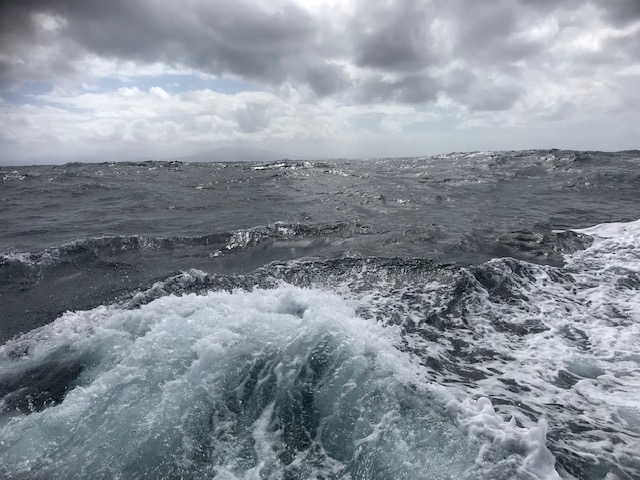
Well, today was definitely NOT a perfect score. Wind, tides and currents were OK … although that said, the forecasted “wind dying off in the late afternoon”, was a little TOO accurate for my liking … it was the sea conditions that turned out to be somewhere between average and horrible.
The remnant southwest swells of 4-6 metres, (but some much larger) from the earlier storm, were not a problem. We just, kind of, ride up and over them. It was the 1-2 metre counter north east swell, plus the regular “chop” thrown in for good measure, that led to a painfully confused sea that tested even the most seasoned stomachs, not to mention patience.
Perversely, when the wind was filling the sails with an energetic 20-30 knots of wind, things weren’t so bad. The big problem arose when the wind died down to 10-15 knots. Despite having all sail hoisted and the constant companion of the motor ticking away in the background, our 6-7 knots of forward motion was always accompanied by gyrations in every directions – left, right, up, down … you name it.
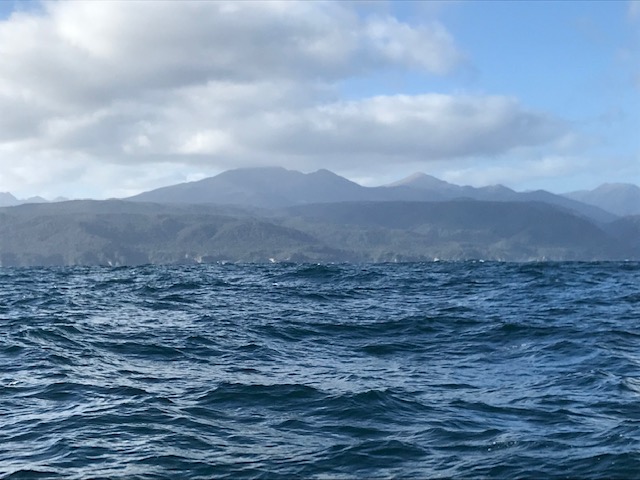
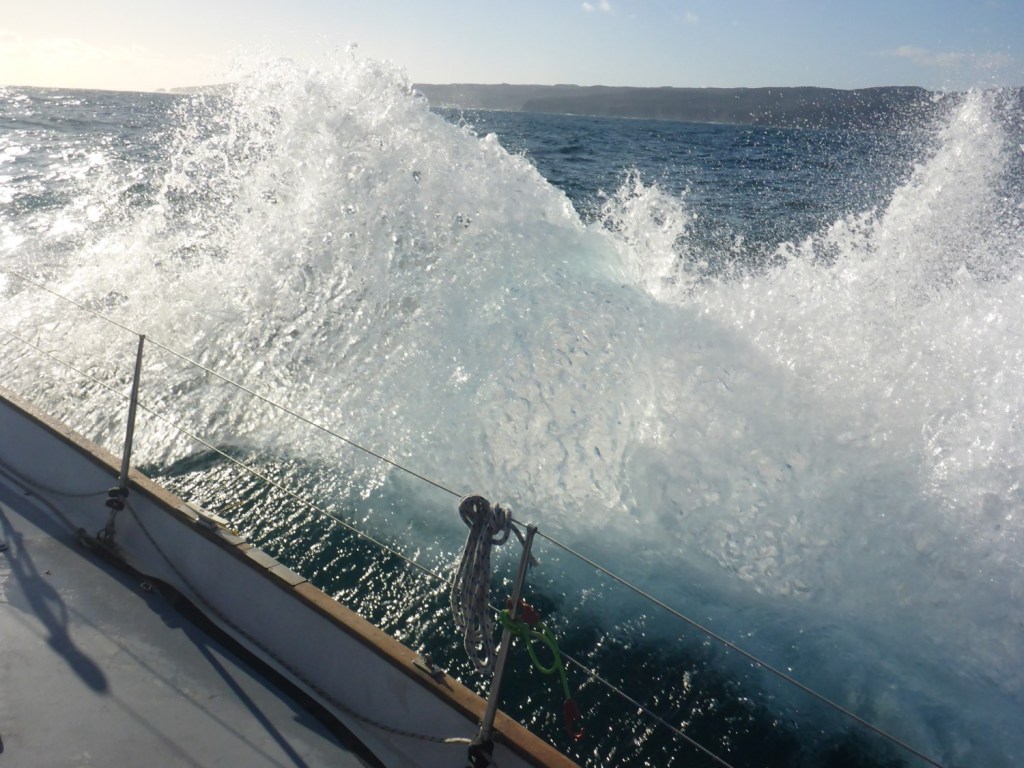
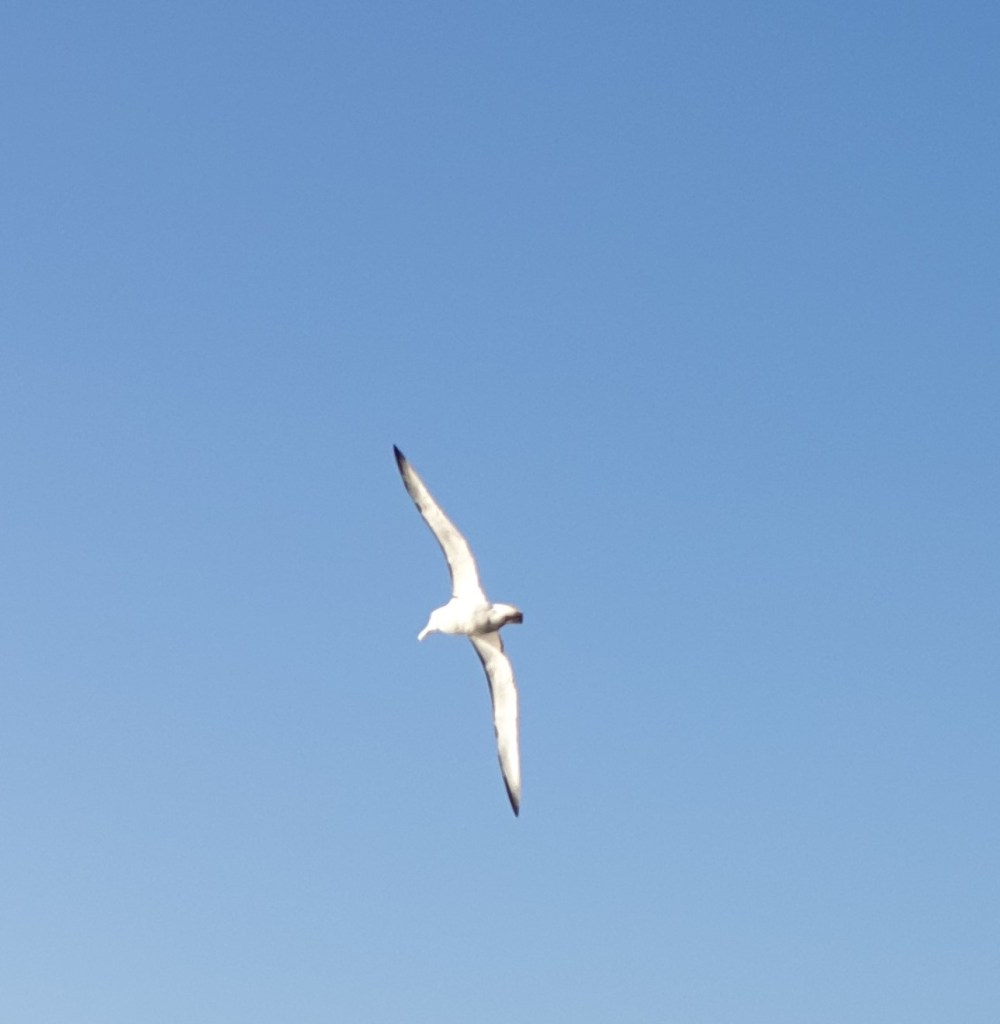
On the plus side … the sun was shining, the sea was as blue as blue … and the albatrosses were even greater in number and soared even closer to the boat … like the aerial equivalent of dolphins, appearing to just have fun, cruising and banking on the breeze; often just appearing to tip their wings and bellies on the crest of the waves as they passed across our stern and bow.
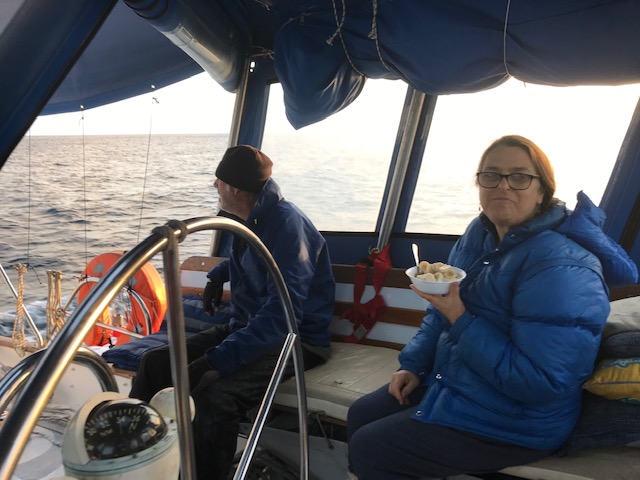
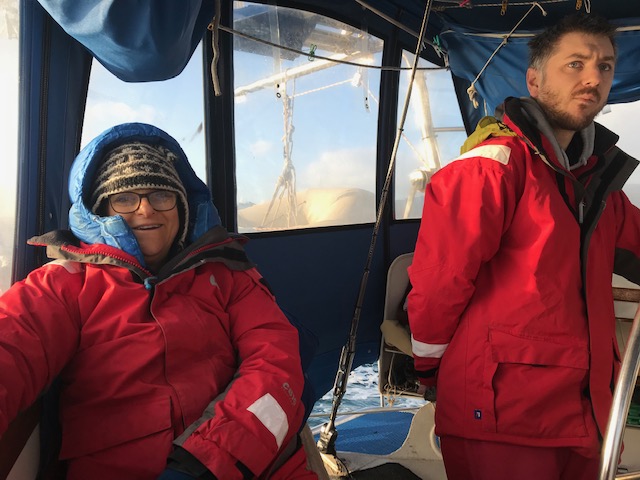
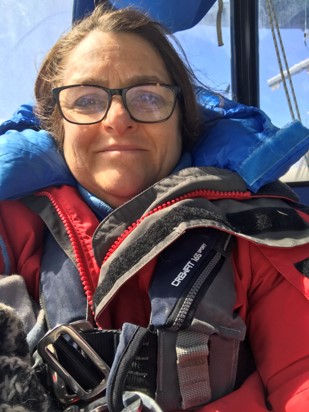
Around 7:30pm I announced to Linda … my cockpit companion for the day – not to mention extremely well rugged up and strapped in travelling buddy … “we’ve been sailing 12 hours now” …
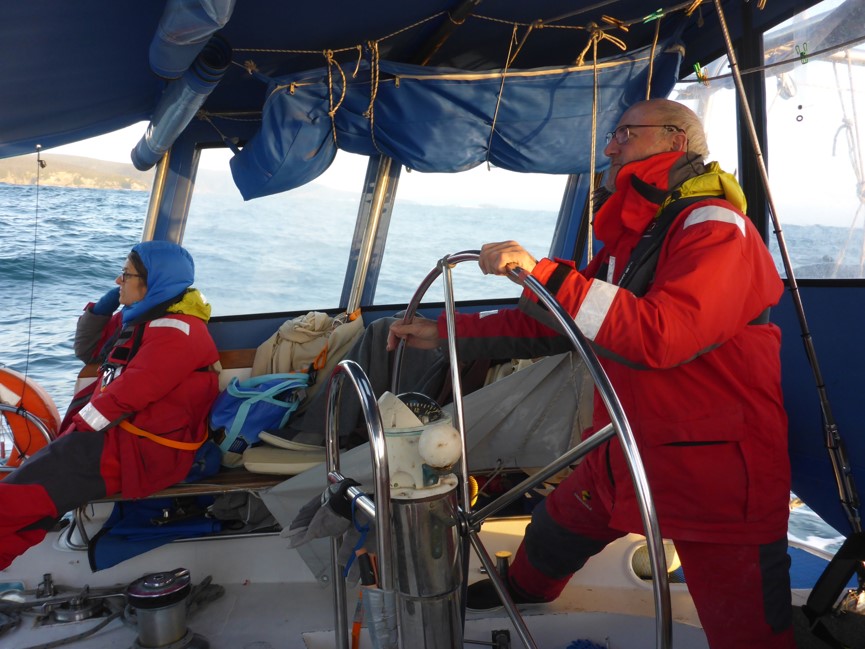
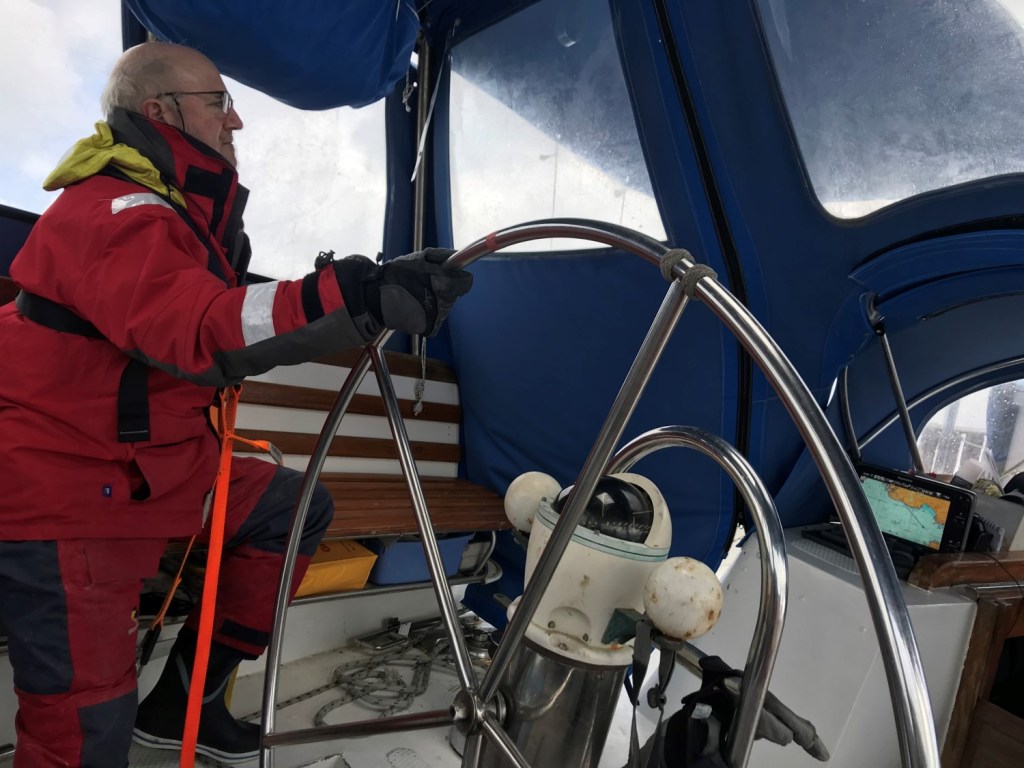
Linda had also been a very good “debris spotter”, as we’d made our way up and down, over the waves. Whilst our steel hull could withstand a direct hit from most solid objects … the recent torrential rains that had devastated Fiordland, had washed tons of logs and miscellaneous rubbish out to sea. Some of which Linda spotted, including a wooden park bench … just floating, its solid legs occasionally bobbing above the waves.
Fortunately, we were fast closing-in on our intended destination. But the lack of daylight on arrival, was looming as our biggest concern, the absence of any serious wind and the slopping, uncomfortable seas, being things we had grown to tolerate.
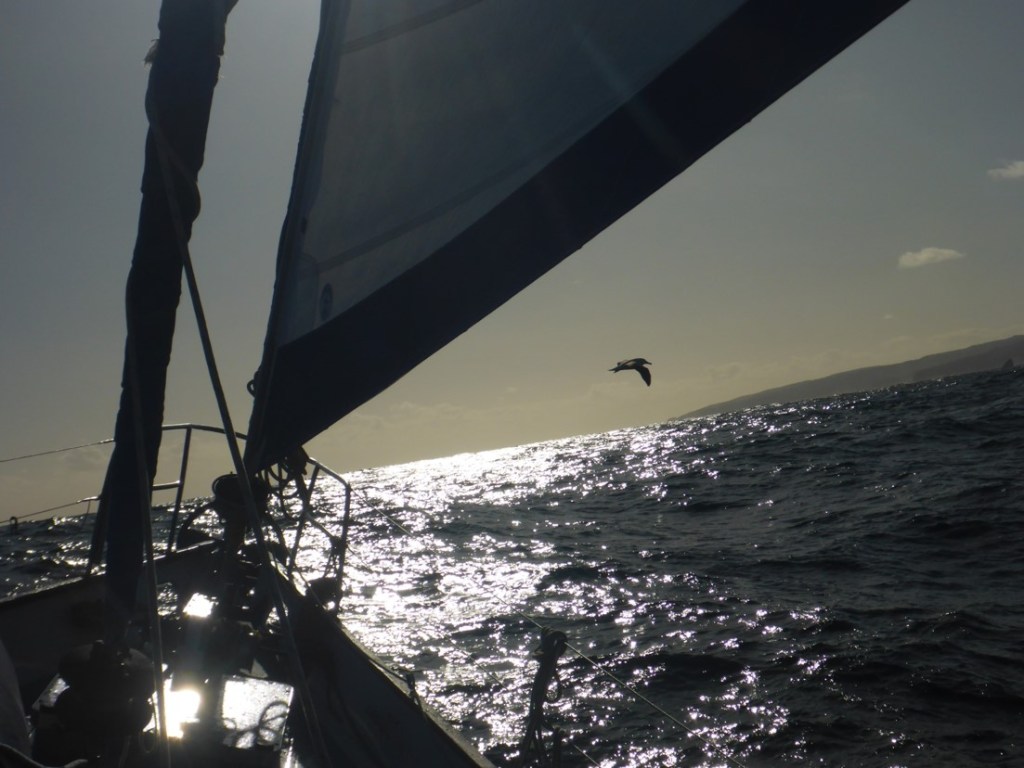
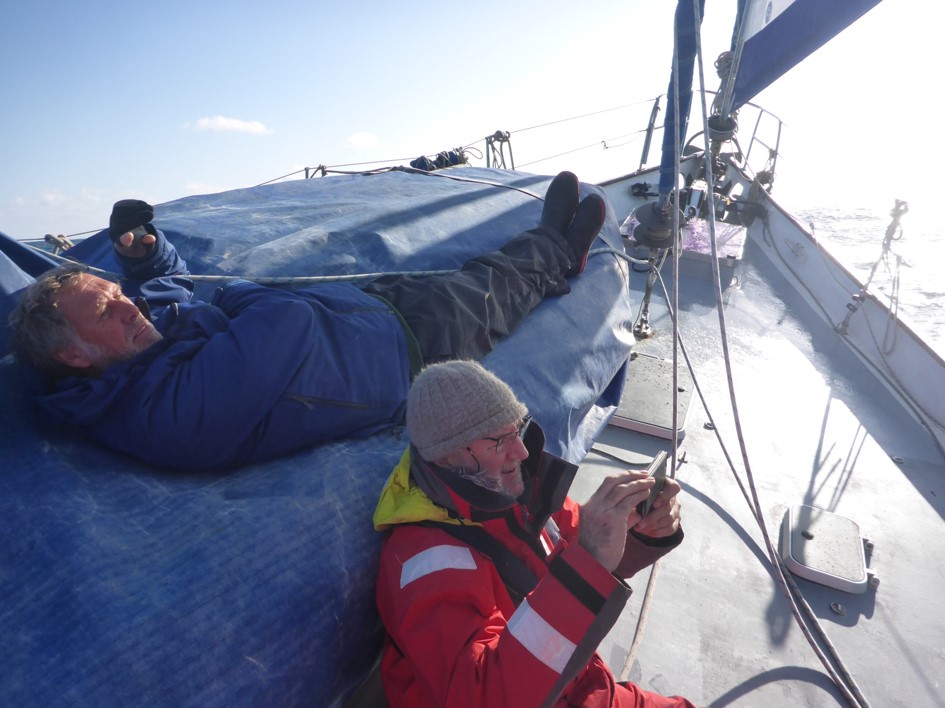
The sun seemed to be speeding up as it inched ever-closer to the horizon on our left side. Our course now curving us up the coast, with the narrow entrance to Otago’s Retreat in view on the far side of Puysegur Point.
“Is that where we are going in?”, inquired Linda. A mix of concern and panic in her voice, as she suddenly observed the breaking white rollers hitting the rocks to our right … and left!
“It’s behind the breaking sea. It opens up to an entrance … close to Coal Island in front of us. We keep close to Coal Island, where it’s deeper”, I tried to explain, as reassuringly as possible, repeating what I’d read in the cruising guide and what I could see on the chart plotter.
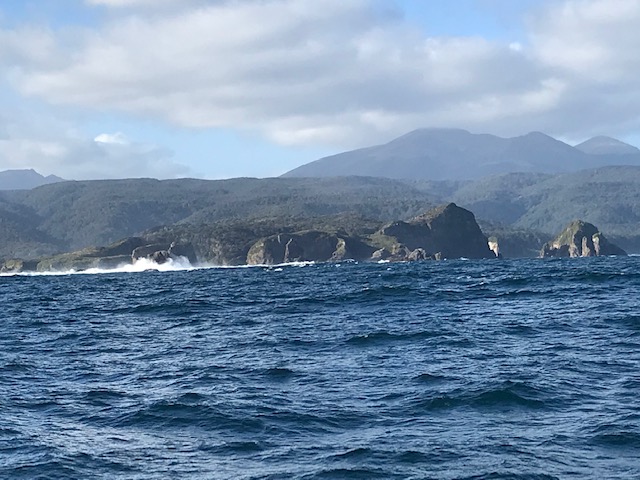
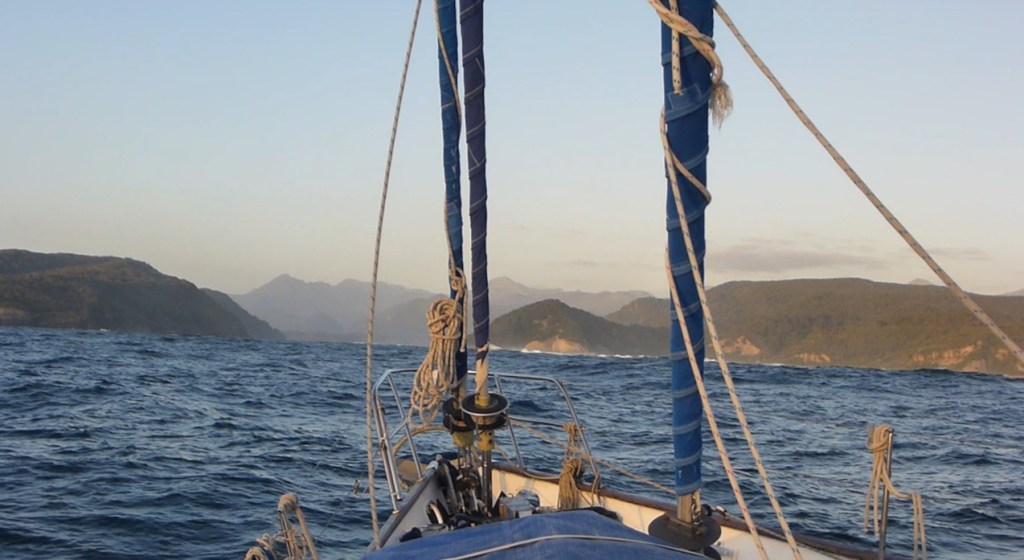
The sails were now down, and it was time to make the final approach. Sure enough, the large southwest rollers that were breaking like a big day at Bells Beach, maybe a quarter of a mile to our right, were progressively diminishing in strength as we approach Coal Island. The breaking sea ahead of us, on the sheer rocky coast of the island, to which we were aiming for a time, until we curved gently to the right as the 180-metre-wide entrance drew in sight. The flat, calm of the long narrow entrance appearing as a distinct line, now visible in the distance – our intended destination and anchorage for the night.
Holding our course through the centre of the opening, after maybe half a mile, we were now officially inside Fiordland. The sea was … “still-as bro” … with the last of the setting sun visible on the high peaks of the mountain range – one of dozens of mountain ranges in these parts – in the distance ahead of us.
“The anchorage is to our left, in about 3-4 metres, with a float hanging in a tree” called James, reading from the Fiordland Cruising Guide
Pretty soon we were at anchor. The still-calmness of the surroundings – the multi-green forest to the water’s edge and the blue-purple coloured mountains far off – in stark contrast to much of the previous 13-14 hours of motion.
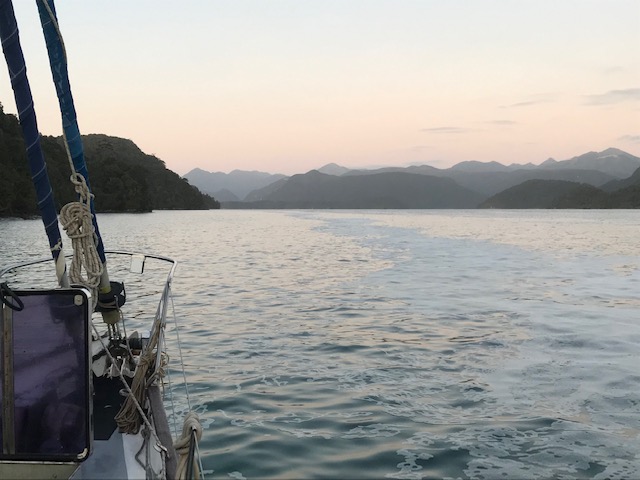
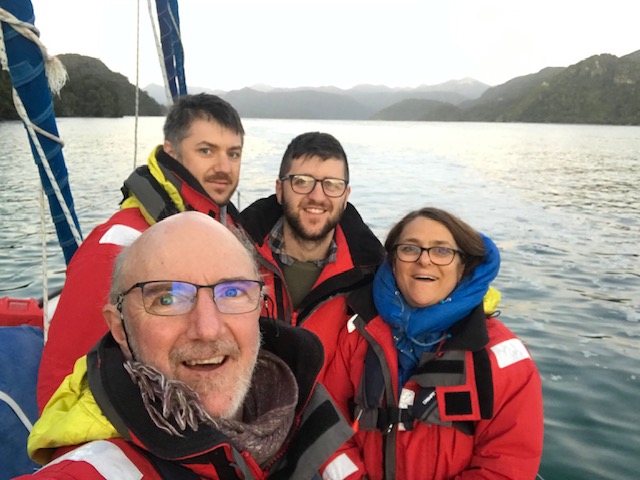
The solid roar of the breaking seas at the entrance was a constant companion, as we started the process of tidying up, preparing dinner and getting ready for bed.
The weather for the next couple of days would be calm, but for now, we were just happy to soak in the “vibe” and re-charge our batteries with a good night’s sleep.
Smooth seas, fair breeze and A Big Day!
Rob Latimer
* Linda thinks “Big” does not sufficiently describe the day and would prefer to replace it with the words “Marathon”, or “Swell”. Also, James emerged from his cabin at 5:00pm, due to him having a very bad cold, and so his “day” extended over only 3-4 hours, tops!
PS I’m still looking for extra crew to assist with the 8-day voyage, from Milford Sound to Wellington, starting on 14 March. If you or a friend want to join us, please sing out ASAP. Email me on the satphone at … msm1@clientsatmail.com.au and latimerfamily4@gmail.com but remember, no file attachments)
 NZ2020