Mana Marina (near Wellington)
Saturday 21 March 2020
John and I woke to the restful calm of the marina berth.
We’d successfully made it to Mana, ahead of time, despite having to wait out the weather for a day in Milford, and 18 hours at Westport. Must be something in that. Where there’s a choice, it’s better to wait for kindly weather before heading out, rather than forever bash into it; the difference between “Cruising” and “Racing”
Around 10:30 we were joined by our new crew … Annette, Martyn and Gary, plus Gary’s wife Theresa.
I’d first met, (wife & husband team) Annette and Martyn, while doing work with Medical Sailing Ministries Inc in Vanuatu. Annette had spent a month aboard Chimere in 2017, helping out with conducting the National Oral Health Survey. Travelling to some very remote places, under often trying conditions. At the time, Annette’s powers of endurance and resilience were sorely tested and all times her cheerful and capable personality shone through. Consequently, I was very happy to have her aboard. Whilst I didn’t know Martyn to the same extent, I figured he had to be a decent bloke, given Annette had chosen him to be her husband.
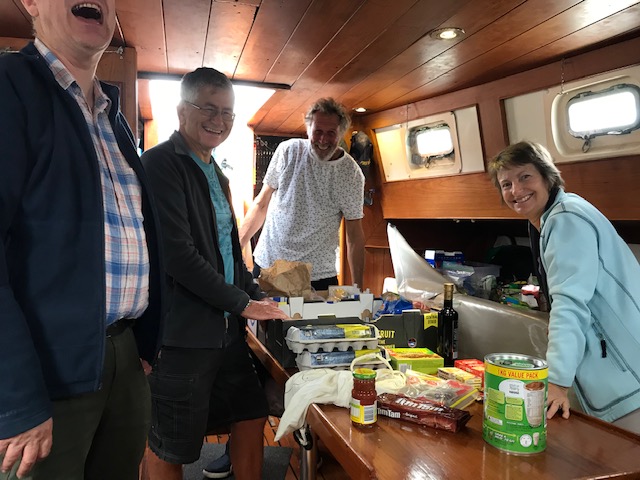
Gary, the older brother of Annette, on the other hand, was a complete unknown … a ring-in. I’d never met him, but again, by association with Annette, I figured … what could possibly go wrong. As a brother, he must at least have some of the same positive character traits. After a few emails, back and forth with Gary, I quickly established that he was keen, enthusiastic and available. What’s more, he lived in the suburb of Whitby … I kid you not … just down the road from the Mana Marina. And how more Captain Cookey can you get than Whitby Surely a “Sign” if ever there was one (… yes it is, but don’t call me Shirley)

For those less familiar with the history of Captain Cook … the original Whitby is a port village in England where in 1746 James Cook started his sailing apprenticeship. As described in Cook biography by Richard Hough …
“… starting out as an apprentice draper and grocer, James carried out his shop assistant duties before deciding he wanted to go to sea. His master, Sanderson, acted with remarkable speed and success to bring about this new change of course in James’s life. First, he obtained the permission of James’s father, then contacted a friend of his in the nearby port of Whitby, John Walker. Walker was introduced to James, fancied the cut of his jib, and agreed to take him on. James Cook was bound an apprentice for three years”
So, as a resident of the suburb of Whitby, Gary was always going to make it onboard.
After a considerable amount of rummaging and sorting, of the existing food stores, we had compiled a comprehensive shopping list for what additional items we thought we would need for our sail north to Opua.
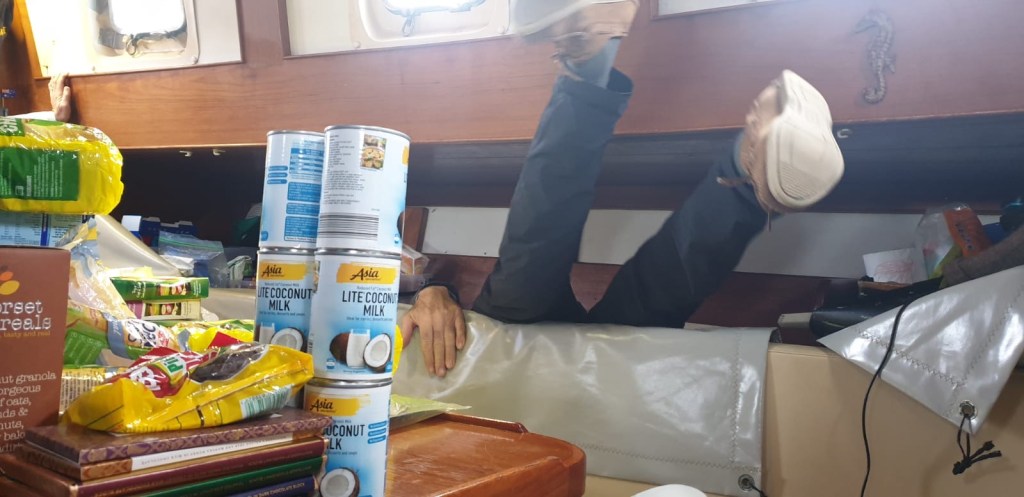
Gary, Annette, Martin and John then headed off to the supermarket, while I remained aboard to meet a chap by the name of Adam. A boating friend of my cousin Keith, who had agreed to come aboard around 1:00pm to have a look at a couple of 240 volt switches.
The switches control two water pumps – one, a low-pressure pump, the other a high – that drive our water-maker system. After operating for just 30 minutes down at Bluff, back on the 29th February it had suddenly stopped working. After checking whether the high pressure pump was the problem, Matt and I had kind-of agreed that it was probably an electrical issue; which would need to wait for another time. In the meantime we’d have to rely on the 1,000 litres in the tanks, and filling up in the Fiords somewhere.
In the late afternoon, I felt very spoilt to be picked up and taken home to dinner, with cousins Keith, Pearl and Pam (Judy would have been there too, but she is currently unwell – no, she just has a cold), plus their spouses … Christine, Murray and Mark – all of whom live nearby.
With my father, Bill, originally coming from Wellington, Keith, Pearl, Pam and Judy, were the core of what I’d always known– growing up – as … “the New Zealand family”. Their father Ted, was my father’s brother, who, through circumstances, had returned to New Zealand in 1958, around the time dad settled in Melbourne, following their respective decisions to no longer remain living in Zambia; what was then known as Northern Rhodesia.
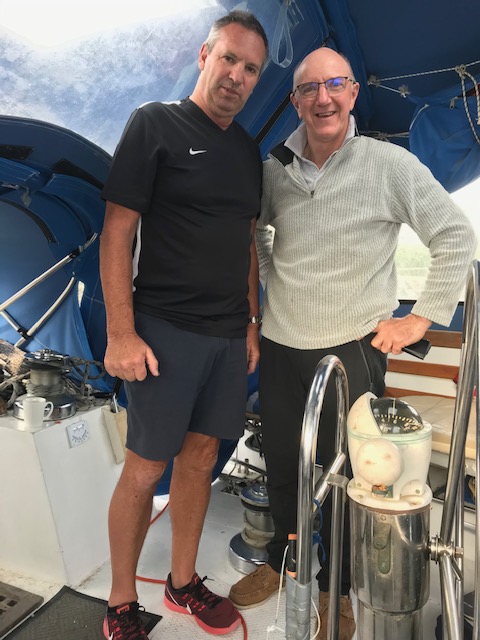
Consequently, we don’t often get to catch up with this part of the family and so it was great to be able to share time together.
It’s no surprise that the key topic of discussion was the spread of the coronavirus (COVID-19) worldwide, the impact on daily life, and just how far the impact might extend in the future. Anyone who made the slightest suggestion of a cough, was jokingly looked at sideways, with all of this being in stark contrast to life at sea for the past 2 months
John stayed the night at his sister’s place overnight, while Gary’s wife Theresa kindly volunteered to wash and dry all of our dirty clothes – that’s John’s, mine, and towels etc from Chimere – what a trooper, and a gesture that was greatly appreciated.
As news of the worldwide impact of the COVID-19 pandemic streamed in, it was clear that my plans would have to change. The blissful bubble of the past two months – where communication was minimal and news was scant – had certainly been burst and some serious decisions would need to be made, soon.
Back on board after a great dinner, it was quiet with John away … maybe he’s the noisy one … I was ready to fall asleep
Smooth seas, fair breeze and rest and reflection
Rob Latimer
PS Here’s an informative article written recently by a friend and MSM Vanuatu volunteer (2017) John Wright. John was to fly across to New Zealand (from Australia) next month, to assist me sail Chimere home. But of course, travel restrictions have put paid to that. As a former microbiologist, John wrote this brief article for a group in which he is involved in Tasmania…
Viruses and COVID-19
What are viruses?
Viruses are everywhere. A bucket of ocean water contains more virus particles than the earth’s human population. There are animal viruses, human viruses, plant virus, fungal virus and bacterial viruses. The general virus structure is a core of genetic material (DNA or RNA), surrounded by a protective coat/envelope. Part of the coat is used to attach specifically to cells. Once inside a cell, a virus multiplies and new particles are released to spread the infection. Viruses cannot multiply without cells.
Coronaviruses
Coronaviruses are a family of viruses whose members may infect birds, animals and humans – sometimes only one species, sometimes more. When viewed with a high-resolution electron microscope, the coat/envelope has projections that resemble a crown. The Latin word for crown is corona. Hence the name coronavirus. These projections are responsible for cell attachment prior to entry of the genetic material into the cell. Consequently, viral infectivity may be destroyed by disrupting the coat/envelope with disinfectants such as alcohol, detergent, or by heat and drying out. In humans, antibodies arising from immunization or previous infection may bind to the viral surface and prevent attachment and infection.
The formal name of the coronavirus currently of concern is SARS-CoV-2. In humans it causes COronaVIrus Disease, first detected in 2019 (COVID-19). There was an earlier outbreak of Severe Acute Respiratory Syndrome (SARS) in 2003, hence the new virus is number 2. Coronavirus are among the largest RNA-containing viruses. The particles are 120-160 nm in diameter (a nanometre is one millionth of a millimetre), and their genes are contained in one piece of RNA. It is this RNA which is detected in body fluids by the current ‘gold standard’ diagnostic test.
Infection by SARS-CoV-2
Humans are infected with this virus by the respiratory route – droplets in the air or virus remaining infectious on surfaces. There is preliminary evidence, yet to be confirmed, that children may excrete this virus in their faeces. Details of the human immune response to SARS-CoV-2 are being worked on. Specific immunity can be antibody-based to inactivate virus, or utilise specific T cells (white blood cells) to recognize and kill infected cells. To be immune to infection, one must have been previously infected by the same or a closely related virus, or immunised using molecules/particles that resemble the virus and induce a protective response. People with weaker immune systems, either through age or immunosuppressive drugs, are more vulnerable to severe disease. New diagnostic tests to detect anti-coronavirus antibodies are coming on the market. These tests will be simpler to do than RNA tests, but will only work after the patient has made antibodies.
Drugs and vaccines
Anti-viral drugs prevent virus attachment or virus multiplication in the cell directly. There are some drugs effective against RNA viruses e.g. HIV, influenza virus. None are known at present which are specifically directed against coronaviruses. There are certainly none commercially available. There are some drugs under development from work started during the earlier SARS and Middle East Respiratory Syndrome (MERS) outbreaks. Drugs directed against unrelated RNA viruses are also being tested.
Vaccines induce an immune response in potentially susceptible individuals. Their development has a long lead time. A candidate vaccine is initially evaluated in animals to see if it can stimulate an immune response. If it is successful, then a series of trials with increasing numbers of human patients is required to test the candidate. An immune response may not be protective i.e. antibody may be made, but not inactivate the virus. The experimental vaccine may have side effects. It may only protect a small proportion of recipients. In animals, but not humans, a virus can be administered directly back to vaccine recipients to test protection. This cannot be done for humans, so trials involving a large number of patients may have to wait for natural infections to occur before protective efficiency can be determined
Other respiratory viruses
A runny nose? It may be caused by a rhinovirus, adenovirus, influenza virus, paramyxovirus, or coronavirus. Most people are familiar with the common cold virus (rhinovirus) and influenza virus. The latter is sometimes compared with SARS-CoV-2. However, the mortality rate for SARS-CoV-2 is higher than for influenza virus. Also SARS-CoV-2 is a new virus, whereas for influenza there is some pre-existing cross immunity in the population, as well as available antiviral drugs and vaccines.
Origin of SARS-CoV-2
The gene sequence of the virus has approximately 90% similarity to those of bat coronaviruses so infected bats may be the virus source. There have been several nasty examples of animal viruses crossing to humans in recent years e.g. HIV, Marburg virus, Ebola virus, Hendra virus, Nipah virus, SARS and MERS. There will be more in the future. Australia does not have a Centre for Disease Control (CDC). Many would like to see an ACDC. However, we have one of the best biological secure facilities in the world at Geelong in the CSIRO Australian Animal Health Laboratory (known as AAHL), which is available in an emergency to help with diagnosis and investigation of human diseases.
Trusted sources of information
There are many active research areas now in diagnosis, disease progression, immunity, viral genetic stability, and dynamics of infection through the human population.
Nature magazine has daily updates https://www.nature.com
WHO https://www.who.int/emergencies/diseases/novel-coronavirus-2019
Australian Government Health Dept https://www.health.gov.au
US Centers for Disease Control and Prevention https://www.cdc.gov/
The newspaper The Guardian has well-researched and readable articles https://www.theguardian.com/au
How to protect yourself and others
Check the website of the Australian Government Health Department (listed above). Specifically https://www.health.gov.au/news/health-alerts/novel-coronavirus-2019-ncov-health-alert?utm_source=health.gov.au&utm_medium=redirect&utm_campaign=digital_transformation&utm_content=health-topics/novel-coronavirus-2019-ncov#how-to-protect-yourself-and-others
If necessary copy and paste the above link into your web browser.
Peter J Wright
(formerly Associate Professor of Microbiology, Department of Microbiology, Faculty of Medicine, Nursing and Health Sciences, Monash University)
March 2020
 NZ2020