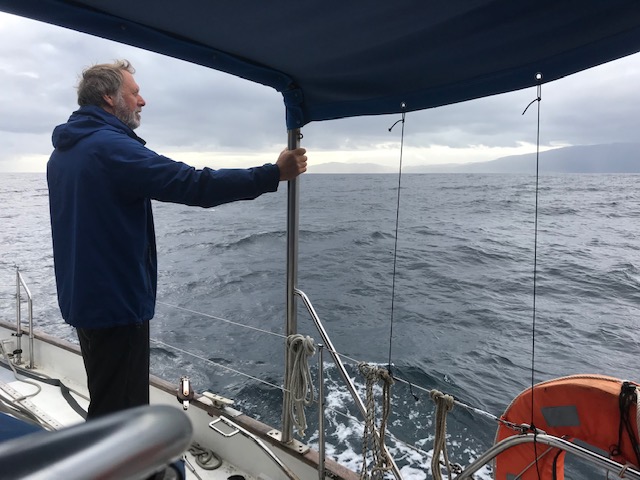
Like Someone Turned Off The Tap

Mana Marina (near Wellington)

Sunday 29 March 2020

After finishing off the last episode of the (DVD series) “The Kettering Incident” late last night … or was it early this morning, I excused myself for sleeping in, with the rain and wind keeping up their battle all night outside.  Mercifully, the halyards remained silent.  Or, perhaps I’m getting better at ignoring them, or was just too tired to care.  
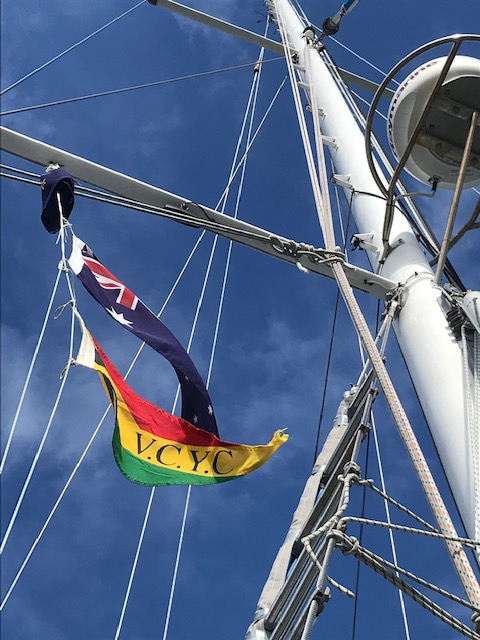
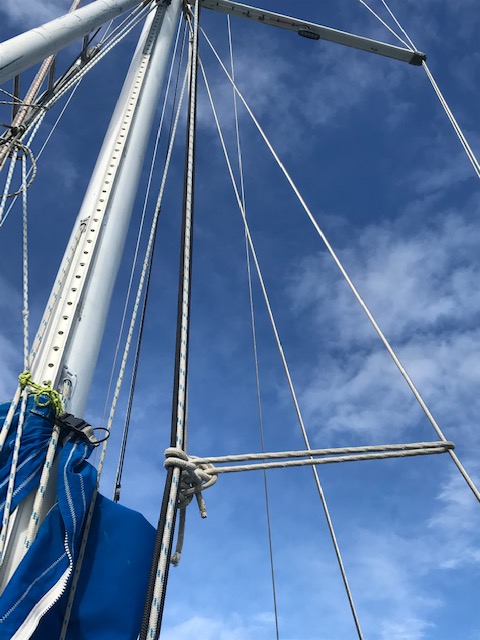
Noisy halyards silenced by being tied back from the mast
A strong wind can start the halyards flapping and finally it tips you over the edge so much …. it drives you out of bed to do something about it … for the benefit of all on board to be sure

As for The Kettering Incident … the Tassie-based, sci-fi thriller which is kind-of a cross between Rosehaven and Doctor Who … was really good and engaging, but that said …  I’m just hoping there’s another 8 additional episodes somewhere out there, because it’ll probably take that many to resolve all the loose ends.  But then again, I was getting a bit tired and maybe I was in need of some more, less-subtle, cues and clues, to draw everything into a coherent conclusion.   

Around lunch time, here in New Zealand, which coincided with the end of my breakfast, it occurred to me that it was Sunday – one day already starting to blur into the next.    And being two hours ahead of Melbourne I realised it was not too late to log into my home-church in North Ringwood, where instead of meeting in person, the clever folk … or a few of the clever tech-savvy ones … had set up the technology to Live Stream the service, pretty much as if you were there. 

It was really good, and a chance to re-connect with so many friends I haven’t communicated with since January, with Comments being posted down the side of the screen, throughout the proceedings.
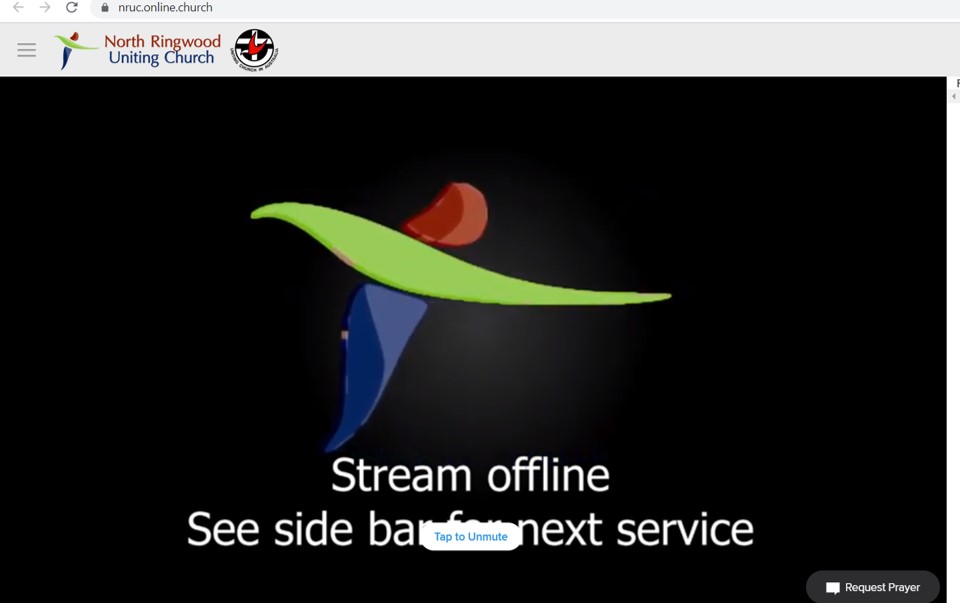
North Ringwood Uniting Church now has an online service in response to the COVID -19 global pandemic

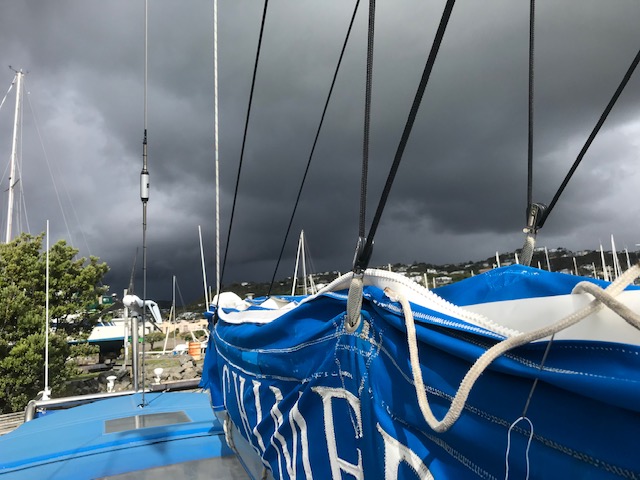
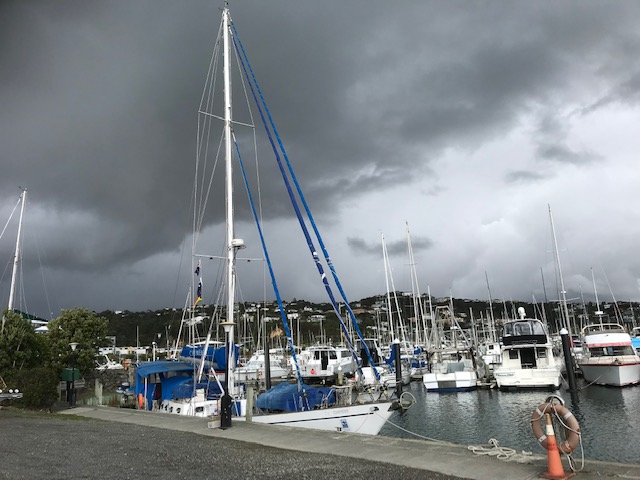
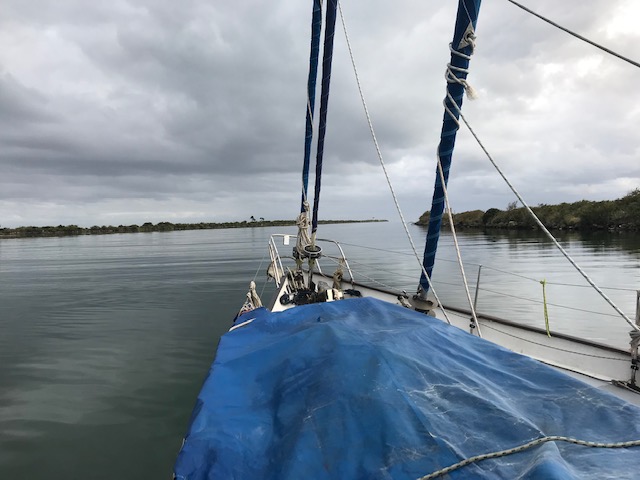
Then, in the early afternoon, all of a sudden it was like someone turned off a tap, or more correctly … a hydrant.  The boat resumed its upright position, the noise in Chimere’s rigging and every other boat in the marina fell silent and the sound of rain on the roof stopped.    It then came out sunny and warm, with the trees and water as still as still.

It wasn’t long before the walkers and cyclists made an appearance, on the nearby path, over on the playing fields and in the distance on the walking trails across the channel.  Like someone had sounded a starting gun, and off everyone went, released from two days of forced additional isolation, on account of the weather.

The calm conditions gave me a chance to re-attach a cockpit awning that had become unzipped as a result of the wind’s force.  The reattachment, this time, involving quite a bit of additional stitching of the zip itself, to ensure it can’t be forced open again; or at least reduce the chance of it being unzipped by the wind again.

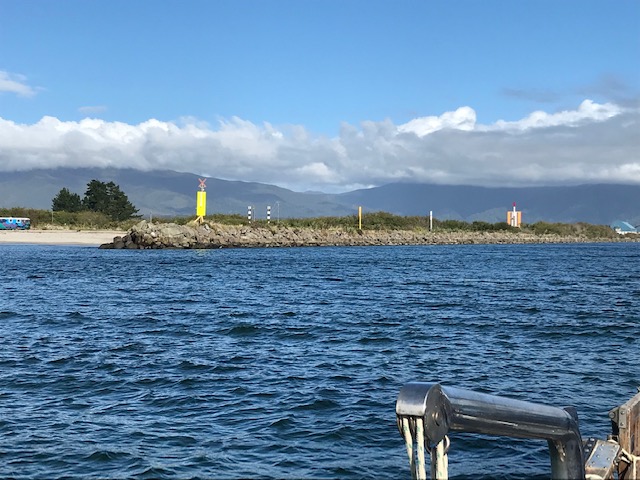
I too was tempted onto the pavement and dawdled off along the edge of the nearby channel that connects the open sea to the inside harbor and marina, and which we navigated on arrival back on the 20 March.  The tide was running out this afternoon and the short, steep waves indicated that the water was travelling at a reasonable speed, with the edges of the channel clearly very shallow, with expanses of sand appearing here and there.  The only deep water being the narrow strip of middle-turbulence extending, maybe a mile out towards the entrance
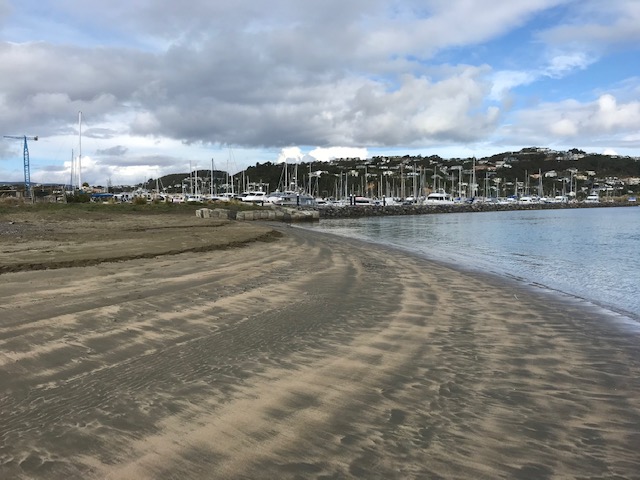
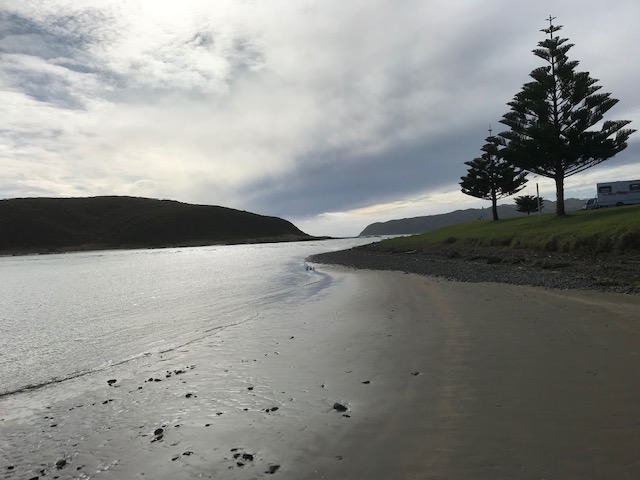
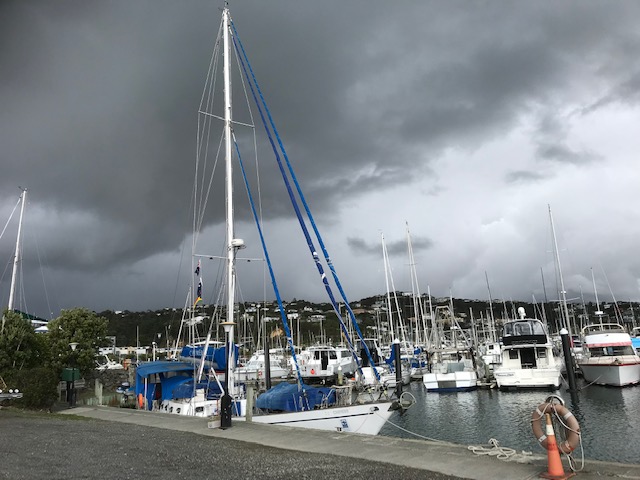
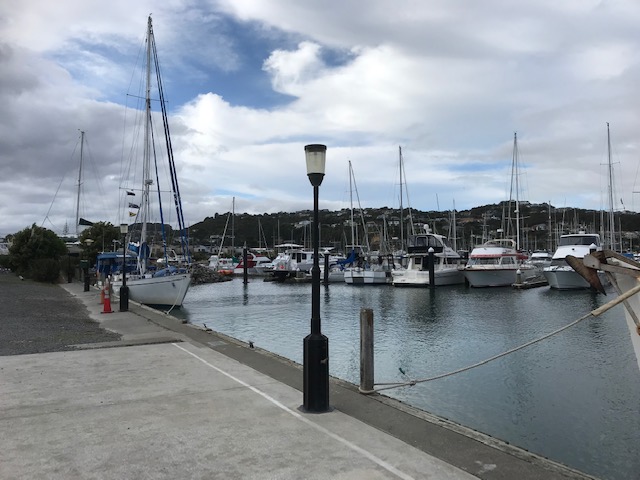
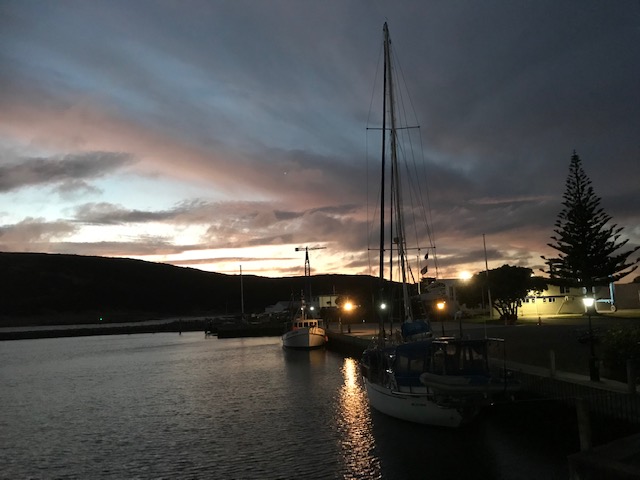
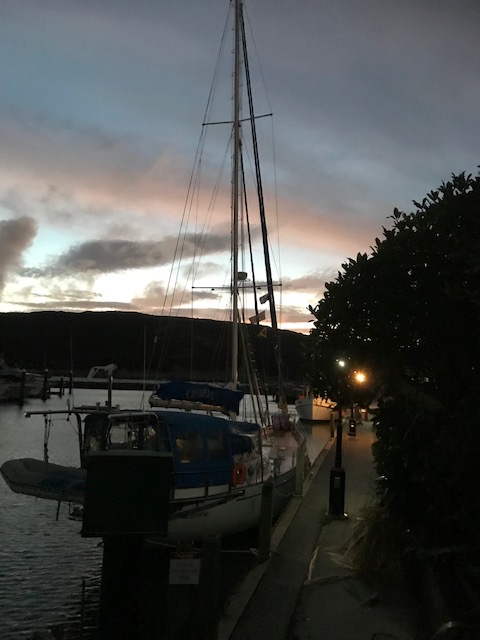
The Mana Marina behind the breakwater
Looking down the channel and out to sea

A short distance away I gained a glimpse of how some others are living out their isolation … in campervans, motor homes, cars and even a small hike tent.  These were all located on the raised grassy land that rises from the water’s edge.  The break in the weather seemed a welcome event for all, but in particular the occupants of the small tent, who looked like they needed the opportunity to dry out, with the nearby trees full of everything from undies to sleeping bags. 

Not a scene you can easily photograph, without naturally raising suspicions, but it was good to see people finding solutions.
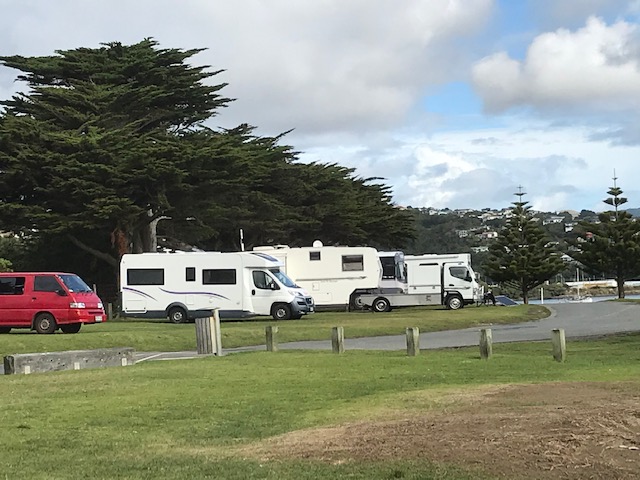
Making the most of their isolation, turning on the engine only to charge the batteries no doubt

It gave me the feeling that, in these serious times, maybe we have now crossed the line from a world that says, “… but the law says you can’t camp here” … to a more pragmatic world that says … “well, if you aren’t doing any harm … just do the best you can, and just clean up when you leave”

Which might seem like a step back to an earlier, less legalistic time, but in so many ways it seems a healthier step forward, into something of the past we have sadly left behind and should capture again; the absence of formal rules and their replacement with values, being more the measure of progress, than an ever-expanding statute. 

Maybe I’m just dream’n

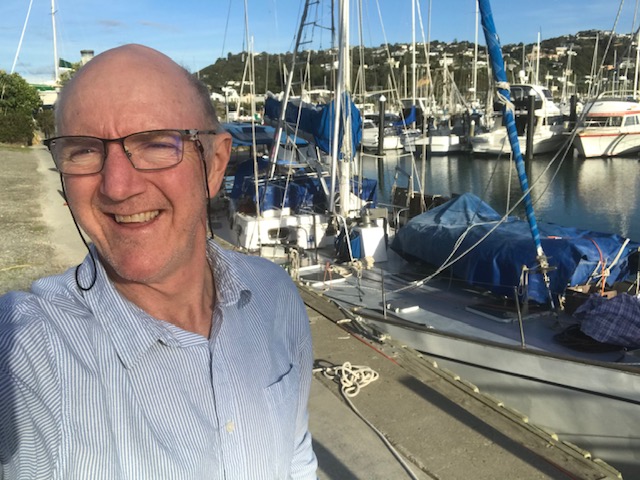
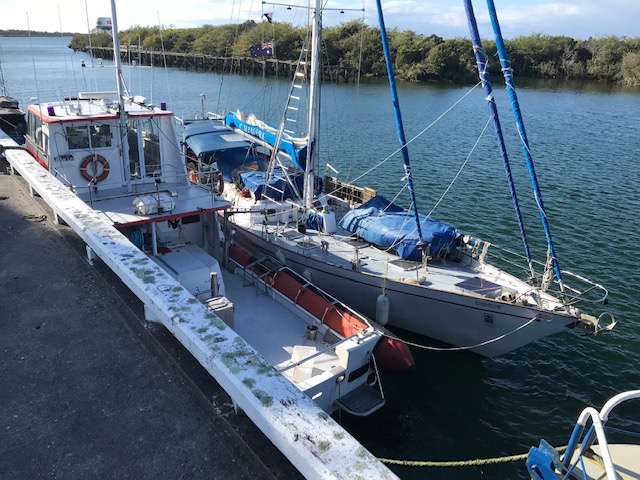
In some small way, I’m just thankful I’ve been allowed to “camp here” aboard Chimere, on the seawall at the Mana Cruising Club.  I’ve received instructions indirectly from the Commodore of the club, that approval for a temporary stay has been given, until I have a certain plan. So, in the meantime I’ll just keep quiet, here in the corner, right out of anyone’s way.
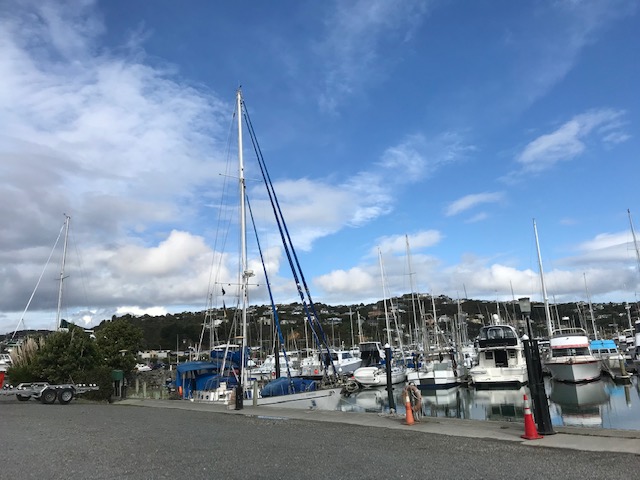
Dropped with the tide, but after two days of gales and driving rain, it suddenly stops … the sky turns blue, the sun comes out and there’s barely a breath of wind

Late afternoon and my regular “Howdy” call came in from cousin Keith, who, as I’ve mentioned before lives nearby.  He and Christine are making the most of their isolation time.  I asked about whether he was into board games and he suggested it wasn’t his thing, and I got the impression that also included jigsaws.  It reminded me of a picture of a “completed” jigsaw which my son James recently sent around on our family chat group, with the caption … “Nailed It”.   I’m not sure if the jigsaw was completed by him, or an accountant who reckoned financial statements just needed to be …  “within a few hundred bucks of it”.  But I thought it was very funny.    After all, jigsaws can be so confining and restrictive, what with all those pieces and edges, not to mention colours and contrasts.
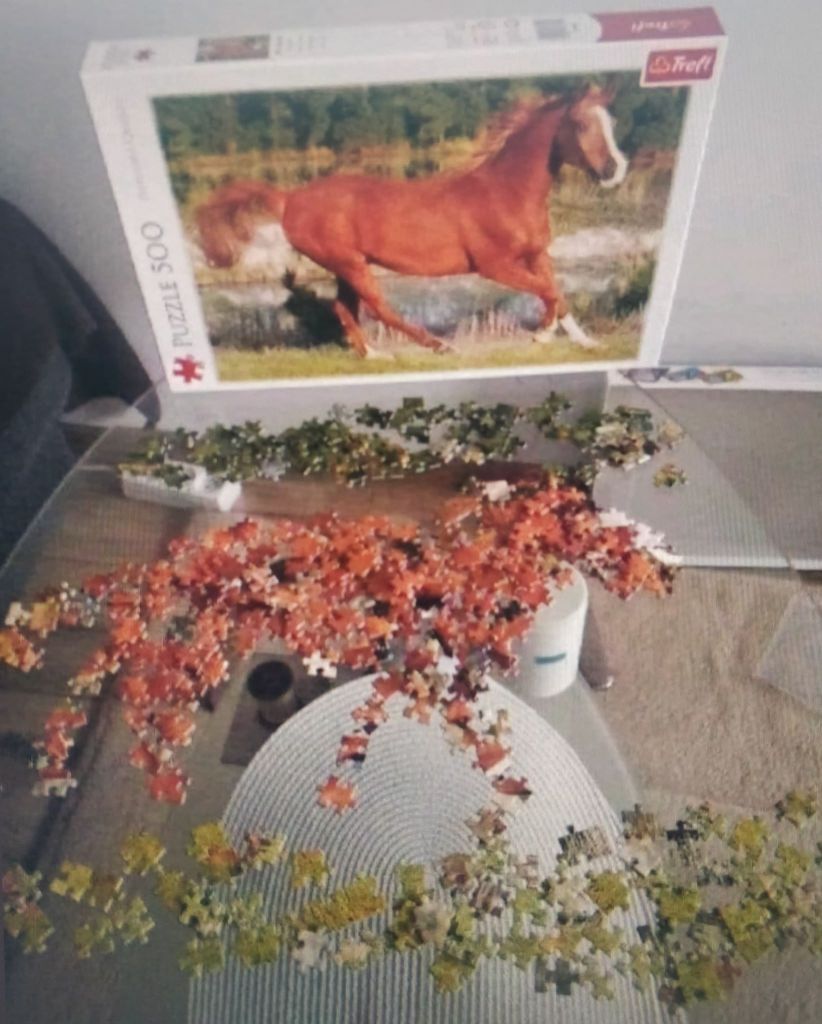
Nailed It !

Several years ago a self-contained, flat screen DVD player, on a swinging arm, was installed in Chimere’s saloon.  The theory being that in quiet times, we could watch movies from time to time.  In reality, it’s hardly been used.  It’s fun to have when the time is right, but usually, there is no time.  We are just so busy doing “stuff”, or so tired we need to sleep, to be able to sit around a TV.  Consequently, all the DVDs and CDs on board have been stored in a big plastic bag; stowed away.  That is, until now. 

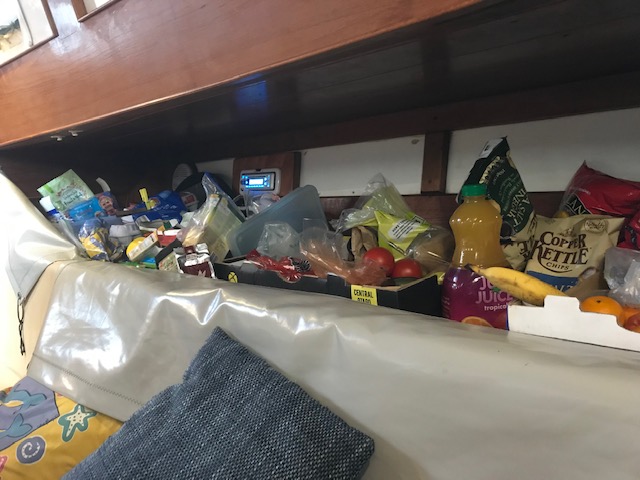
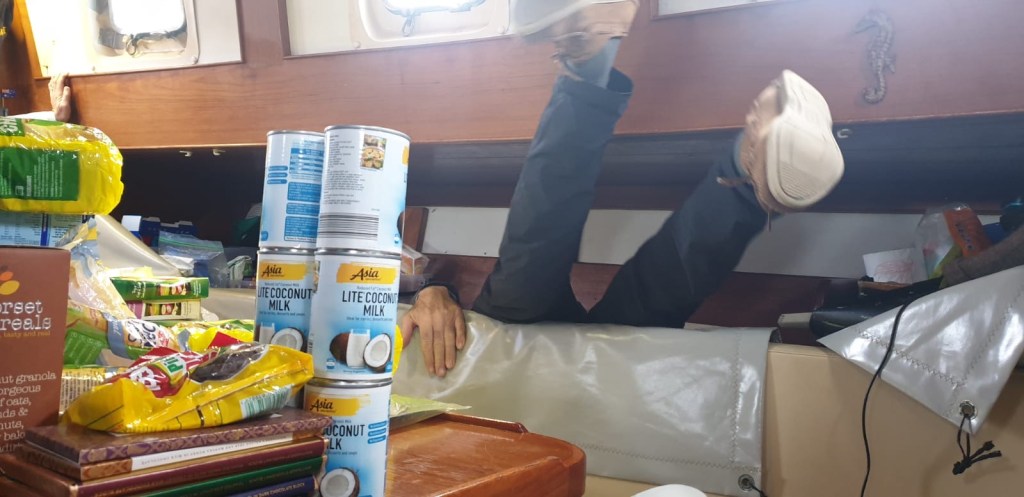
As you can see from the photo, I’m setting up the saloon more like a pool room and less like a sailing boat.  And whilst the fresh fruit and commonly used food items are readily at hand, the bulk of the pantry is in lower lockers and in the big freezer. Including some of the fish caught down the West Coast and in Fiordland – some of which is on the menu tonight.  Along with chips and salad of course.  Doh!! there I go talking about food again?!
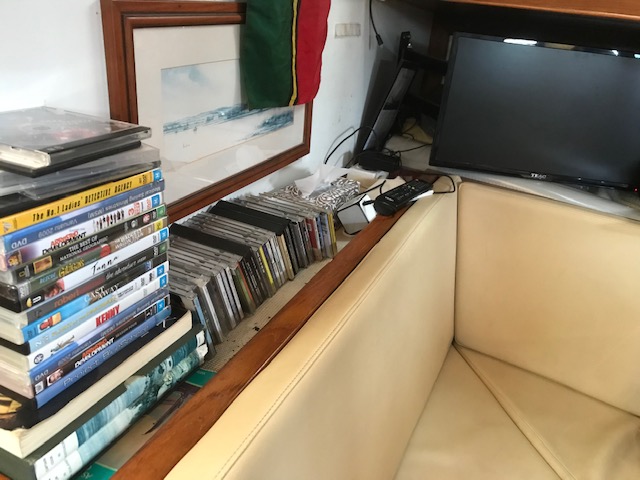
Getting comfy … setting it up like a pool room
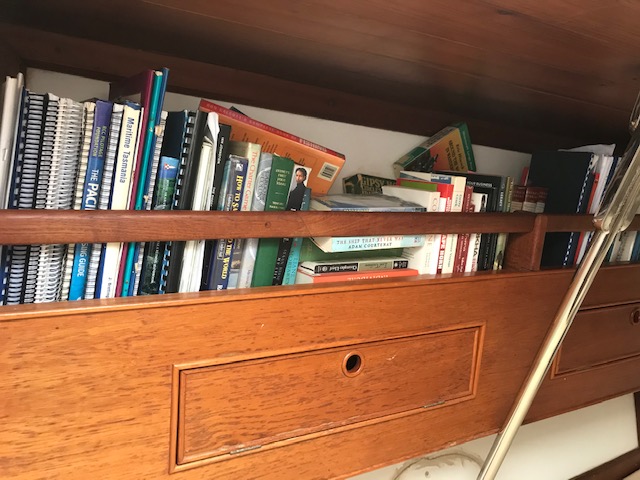
Still plenty of books to re-read in the library
Fresh stuff you can see, but there’s plenty more in the lockers below … and in the freezer
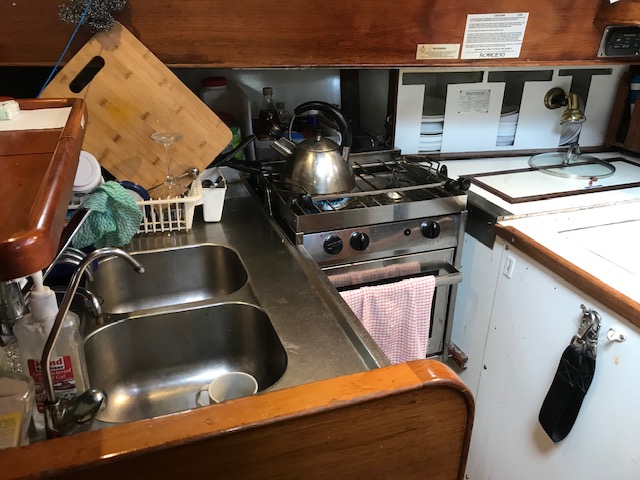
Keeping it tidy !

And now it’s dark, it’s started raining again.  But there’s no doubt, they do need the rain in these parts.  It’s actually been a bit too dry these past few months and the rain is most welcome

Smooth seas, fair breeze and like someone turned off the tap

Rob Latimer
So, It’s Come to This

Mana Marina (near Wellington)

Saturday 28 March 2020

If yesterday was a slow news day aboard the good ship Chimere, I’m not quite sure how to describe today.  Maybe a No-news day.

Although if a TV sit-com like Seinfeld can be made, ostensibly about “nothing”, then there must be some ounce of drama I can extract from the past 24 hours that is worthy of being shared.  We’ll see…

I was going to say that I haven’t left the saloon all day.  Choosing to binge-watch, in a sloth-like manner, the Australian TV series “The Kettering Incident”; between bouts of eating and listening to the ABBA Collection, CD 3 and 4.  But that wouldn’t be quite true.

Those dark grey clouds that rolled over last night around sundown, which I mistakenly described as, “… big and threatening clouds, but then little came of it” … well as it turned out, quite a bit came of it.

The clouds came over last night, but it was early this morning that the weather really took a turn for the worst.
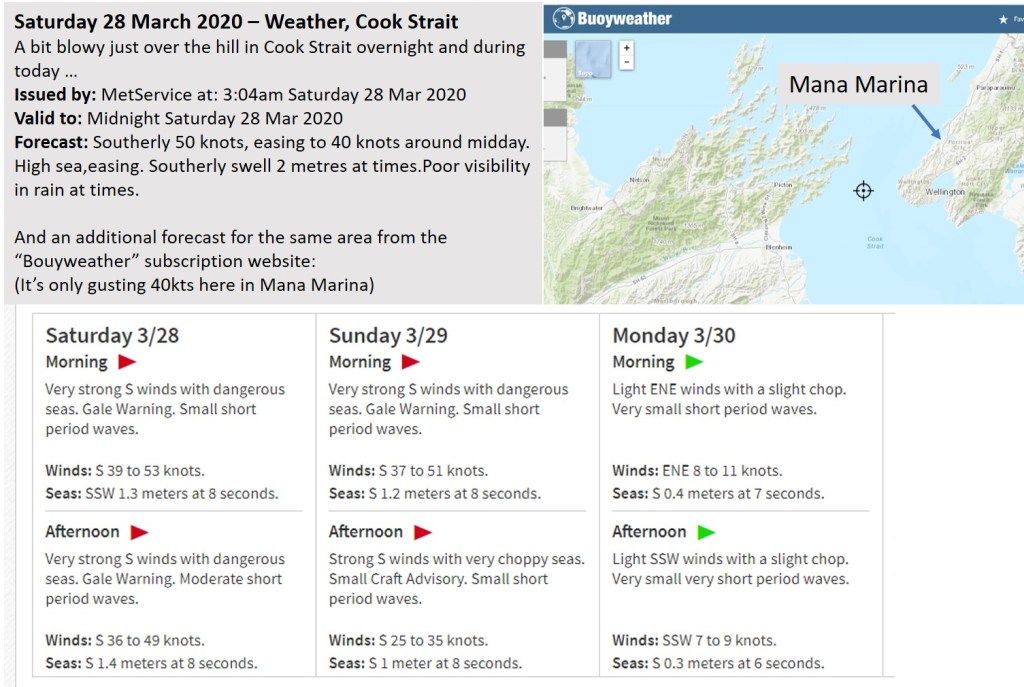
The weather forecast was for Cook Strait, just 10 miles away, resulting in gusts at Mana of up to 40 knots

Having looked at a weather forecast a few days ago, in preparation for what turned out to be my false-start-voyage home, I knew we were in for a few days of bad weather.  (Weather I had planned on shelter from at anchor before setting out into the Tasman Sea)  But the 50 knot Storm Warning that was issued for Cook Strait very early this morning, came as something of a surprise; not to residents of Wellington of course, that’s how the place got its name after all … “Windy Wellington”.

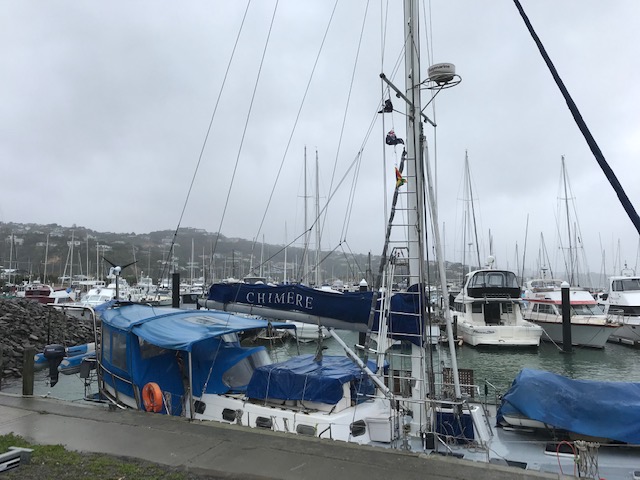
A grey kind of day, but still safe and secure
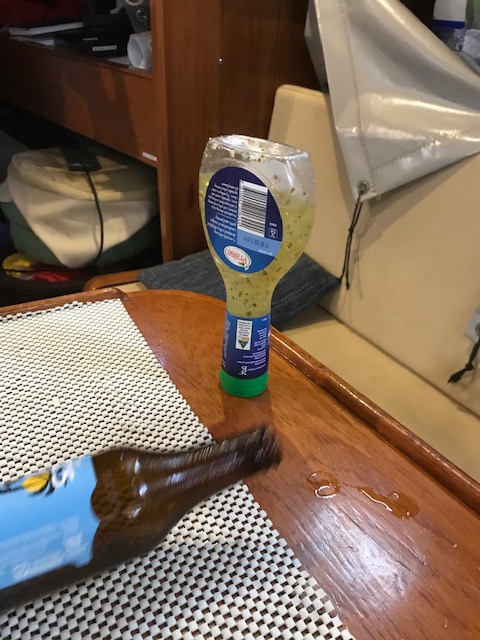
The wind was heeling Chimere so much the “anchorage” failed the Inverted Brown Bottle test. It did however pass the Inverted French Dressing Bottle test.

You see, after resigning myself to staying tied up at the sea wall – snuggly attached with four strong lines – for as long as it takes, I really didn’t think there was much point in regularly downloading the latest weather reports.

But in the midst of the howling wind and driving rain around 3:00am this morning, that had me rolling to the edge of my bunk, I thought I’d get a couple of forecasts, just for fun.   In summary, it read…

Issued by: MetService at: 3:04am Saturday 28 Mar 2020, Valid to: Midnight Saturday 28 Mar 2020

Forecast: Southerly 50 knots, easing to 40 knots around midday. High sea,easing. Southerly swell 2 metres at times. Poor visibility in rain at times.

Storm warning: Issued at: 3:04am Sat

Three Day Outlook: Southerly 35 knots with very rough sea, easing Sunday morning 25 knots and Sunday afternoon 15 knots. Moderate southerly swell easing Sunday.

It wasn’t just the heeling of the boat, and the noise of the rain on the deck that woke me, it was also the flapping of the halyards against the mast that was really the final straw.   Halyards are those special ropes that run up the mast and back down again, enabling you to lift – with the aid of a winch – all sorts of things … sails, poles, dinghies, you name it.   

The noise of halyards flapping against a mast, particularly in the middle of the night when you are trying to sleep, is a special kind of sound.  “Special” in a … Chinese-water-torture-kind-of-way, as opposed to the special melodic, soothing, of rain on the deck, or waves lapping the hull. 

In some instances, the halyard-sound is a fast, staccato … “ting-ting-ting-ting” … suggesting a thin cord, easily silenced with a restraining string, lashed back to a shroud, or by tightening the halyard some more, maybe on a winch.  Then there’s the … “tong … tong … tong … tong” … sound that speeds up and slows down in time with force of the wind.  This belongs to the thicker halyards, and can emanate from high up the mast, even though you might already have attached a restraining line low down.  If the wind is strong enough, it’ll stir even the tightest halyard into acoustic action.

This “tong tong” noise often comes into play when the wind reaches a particular speed.  You start out thinking you can ignore it, because you feel the wind die off.  You’re almost back to sleep again.  It’s warm under the covers.  Your head is heavy on your soft pillow … then, the wind picks up again and you’re just hanging out, waiting, waiting, sure enough … “tong … tong … tong … tong…” 

Despite the cold and rain outside, the desire for peace finally wins out.   Something in your, (by now fully awake), mind snaps and you are tipped over the edge.  You may not articulate the words, but like Popeye the Sailor Man, pushed to breaking, the sentiment is the same … “That’s all I can stands, cuz I can‘t stands n’more!” …

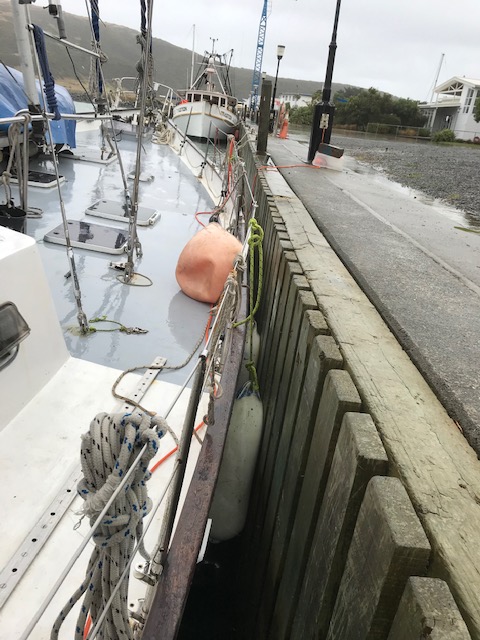
Well, I reached that moment in the wee hours this morning, resulting soon after in me climbing about one third up the mast-ladder, with a length of rope between my teeth as I kept a good grip with both hands.  Fortunately, the rain had slackened a little, but the howling wind made up for it, heeling the boat and squeezing the string of fenders along the starboard side like cheese slices in a boat-wharf sandwich. 

The fenders were so squashed … like cheese slices in a boat-wharf sandwich

Fortunately, there was no one to see my crimes against fashion, fully decked out as I was in boxer shorts, slippers and a red wet-weather jacket, but gee it was chilly.  Heeling over so much, there was also a need to lift the fenders higher so that the wooden toe-rail didn’t run the risk of touching the vertical wooden boards of the sea wall.  This turned out to be a little harder than you’d expect, with the constant force exerted by the wind on the boat leaving little room to budge the rubber fenders.

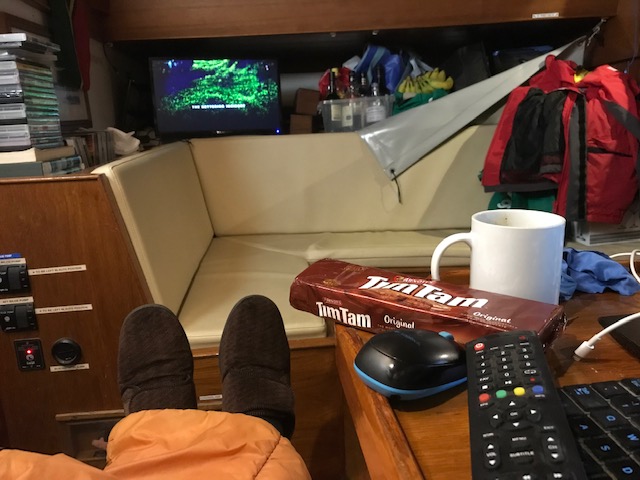
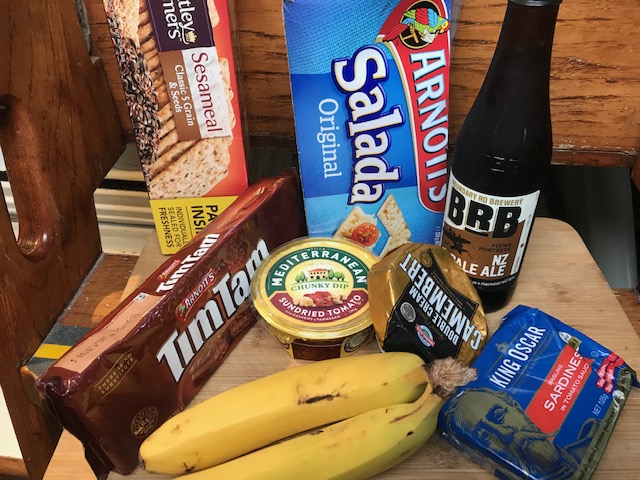
All silenced on deck, I returned to the saloon fully awake, thinking a hot Milo drink accompanied by a few Tim Tam chocolate biscuits would be just the thing.  Can’t just sit here and eat them in silence, I thought, so what about cranking up the flat screen DVD player in the corner.  It was then that I put on the first disc of the sci-fi thriller, “The Kettering Incident”.

The 3-Disc Set was given to “Chimere” for Christmas, by friends Liz and Murray Ogden.  Its significance stemming from the fact that Kettering was one of the places we stopped at during last year’s Tasmanian voyage, while Liz and Murray were onboard.  Having already been spooked from watching the series, the simple mention of the word “Kettering” was enough to put Liz and Murray into a state of heightened awareness.  All the more so, when we had trouble with our autohelm at the time and in seeking assistance from a local chap, he first asked … “did it happen in the d’Entrecasteaux Channel, near Kettering?” … the fault presumably being attributed to an unusually large magnetic deviation in the region.  (Insert spooky music here)

So, I finally got around to watching the first episode, and by 5:30am I’d watched the second.  It was then time to go to bed, but by 10:00am I started binge-watching episode after episode, wrapped in a sleeping bag, while the wind and rain kept up its thing all day outside. 

I’m not proud of myself.  But I can say that I only have two episodes to go.  So it’s not as if I haven’t achieved at least something today. 

I’m not proud of myself, but I am now just 2 episodes short of finishing the series.

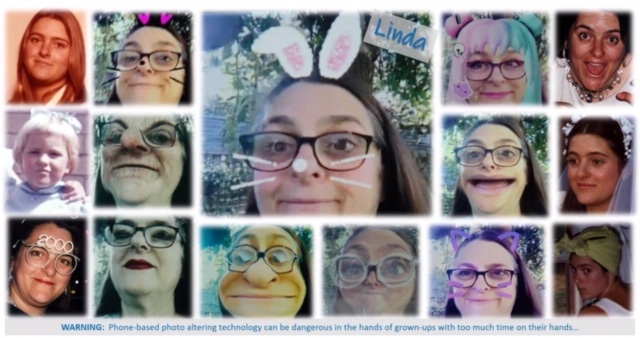
To mix it up a bit, there was a, “how’s it going call” … from local friend Gary and cousin Keith, (which were greatly appreciated) plus a long video call from Linda as she took me around the home backyard (and front yard … it was a long call) in Ringwood North – showing me the green grass, (what needs mowing) the new vegetable seedlings, the flowers and the warm sunshine.  Linda even found a face-altering feature on the phone that makes you look funny.  Naturally, I couldn’t resist turning them into a fun-collage, (or is that a montage) interspersed with “real” photos from the distant past.   

As the warning says … “Phone-based photo altering technology can be dangerous in the hands of grown-ups with too much time on their hands”

So, it’s come to this … Milo, Tim Tams and day-time DVDs …

Just for fun, I’m still looking for sailing crew on the various websites devoted to the task, but the odds are very much against me finding any suitable candidates, (at least in the next 4-5 weeks)  as I adhere to the sound advice from my friends at NZ Customs to, “… be careful about recruiting on Facebook …”  

Smooth seas, fair breeze and so, it’s come to this

Rob Latimer
A Slow News Day Aboard

Mana Marina (near Wellington)

Friday 27 March 2020

It’s hard to believe that it’s exactly a week since John and I sailed into Mana; the conclusion to our five-day jaunt nearly 500 miles from Milford Sound along the west coast of the South Island.

Certainly, a lot has happened since then, with new lessons in patience and stillness, being among them.

This morning I received a call from John – my long time mate and sailing buddy, who has been on a roller coaster ride since learning Sunday night – just 5 days ago – of his father’s sudden death.  The funeral was on Wednesday, in Northland, and you can just image the challenge of complying with the new “crowd and gathering regulations”, when his 92-year-old father had 9 kids, over 60 grandchildren and more than 50 great grandchildren.  But in the end it seemed like it was a fitting and appropriate send off to a man who had left such a mark on the world.

After rain and howling wind all night here at the marina, it was a surprise to be greeted by a warm and sunny morning, and hardly a breath of air.  Seemed it had all blown away.

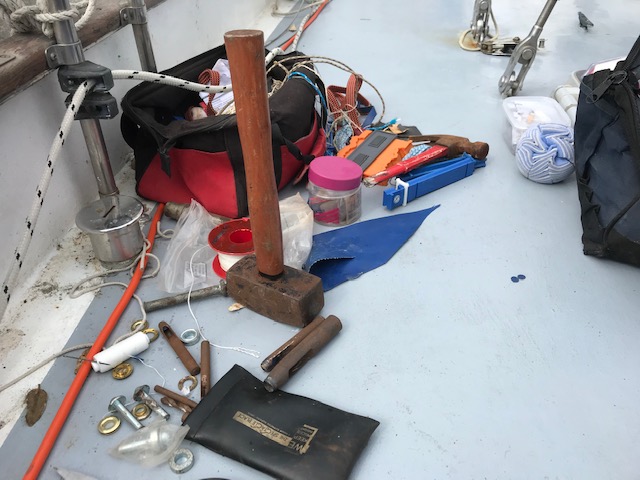
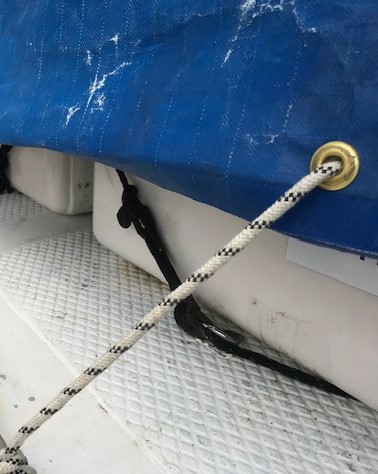
Trying to make good use of my time I decided to finally put some metal eyelets in the daggy old truck-tarp that covers the deck-boxes, under the boom.  I also cut nice neat strings, of suitable length for each grommet, so as to make the task of tying it down much easier in the future.

The sail repair bag holds all the tools to attached metal eyelets
Looking far more presentable.

In amongst all this was the occasional … “g’day”, “hi” and “morning” … to the regular walkers, some with dogs on leads, who have this section of path on their circuit. 

One older bloke … he was probably my age as it turns out … said… ”I saw you went past D-Urville Island.  Saw it on AIS.”   “Yes, that’s right, that would have been this time last week”, I replied … Just goes to show, you can’t hide.

Give it time and I’m sure I’ll be able to log the movements of each person, letting them know whether they are early or late … if their dog’s looking better groomed since yesterday … and exchange the latest news about them and their family’s isolation routine.

Naturally, everyone has their story, and so it’s been interesting to hear how things are playing out at a micro level.  I hardly need to watch the news, I get the latest from the chatty folk that stop.

A car drove close to the edge of the sea wall around lunchtime, slowing briefly as the door opened and a man leaned out … “I’m goin’ to the supermarket.  Need anything?” … It was the man from yesterday who’d offered me his car … “No, I’m good, thanks for asking though”, I yelled, as he gave me a wave and drove off, with a … “sweet as bro” .

Cousin Keith broke his home-isolation to drive by as well.  Parking at a respectable distance, he hopped out of the car and we talked about this and that for half an hour, before he headed off to get some “fizzy drinks” … for him and Christine’s Friday evening routine

Cousin Keith and wife Christine, doing a good of keeping an eye on me , despite having to remain housebound themselves

Still trying to be useful, I sewed some tie-tabs on the sail bag that is attached to the boom.  The bag itself is supported by light cords, called “lazy jacks”,  that run to a pully part way up the mast, then back down to the base of the mast where they can be tightened or slackened as needed.

The tie-tabs are to help close the bag, in a fashion, because the zip is not as “functional” as it used to be.   Tie-tabs will be quick and easy to attach each time the sail is dropped; helping to protect it, and at the same time keep everything looking neat and tidy… and to quote Captain Jack Aubrey … “Right Christian like!”

It’s great to have friends and family in contact from time to time, I really appreciate it.  Also the care and support given to Linda back home.  Apparently more vegetables are being  planted in the garden, and the weather in Melbourne is good.  Maybe it’s time to finally get some chooks!

Sewing tie-tabs on the sail bag will enable easy closure without having to fiddle with the zip
They were big and threatening clouds, but then little came of it.

The afternoon brought some big threatening clouds, but surprisingly, not a lot of rain.  And I refuse to say what I cooked for dinner, and thank you to the kind soul for a copy of Jo Seagar’s wonderful Featherweight Cheese Puffs… but I’m more the … “extra gluten with that please …”, kind of guy.

Smooth seas, fair breeze and a slow news day aboard

Rob Latimer
Go, or No Go! … NO GO bro

Mana Marina (near Wellington)

Thursday 26 March 2020

Yesterday, all systems were GO … for leaving today.  I’d made a booking with New Zealand Customs.  They’d kindly agreed to come here, rather than expect me to sail around to Wellington Harbour  And after completing the planned formalities at 12:15pm tomorrow, I had undertaken that by 1:00pm (1300 hours that is) I would sail away on the high tide; the first small step in the process of getting home.

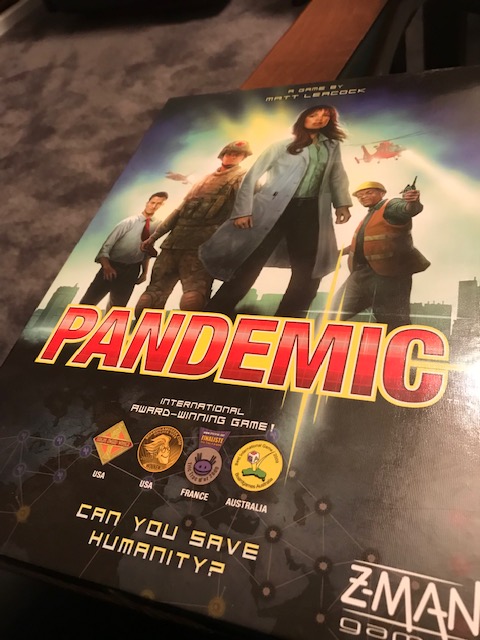
Who thought this was a good idea for a board game ? That could never happen …

That was how it was meant to play out, but as you can see, the top of the page says that I’m still located in Mana Marina

As explained in yesterday’s blog, “Decision Time”, the unfolding COVID-19 “situation” has precipitated changes to my sailing plans, with the only remaining options being to:

  1. Sail back to Melbourne as soon as possible, or
  2. Find a way of securing the boat here and then flying home while I could.

After weighing everything up, I decided to pursue the “sail home” option and since I didn’t like the idea of doing it by myself, my online crew-hunting started in earnest on Monday morning. 

By Monday night, after too much web-crawling and social networking, I had two guys lined up.  They held Fijian passports, but I was assured they both also had New Zealand and Australian residency.

Trouble was, they didn’t.   One didn’t even have permission to still be in New Zealand.  This was pointed out to me by the New Zealand officials, with the warning that … “ it was the captain’s responsibility etc etc”

Anyway, the older of the two guys seemed totally confident that he had permanent Australian residency, and the documentation he provided seemed to be convincing enough for him to be allowed to leave the country.

Trying to smile into the sun after discovering I won’t be going anywhere

All was looking good – I had one man set to go, and if I was careful and patient, I was confident we could sail Chimere home, just the two of us.  

In completing the official, documentation side of things, I lodged my Australian Arrival Notification Form with Australian Border Force and a short time later received a response.  And I quote … “… crew member ________ does not hold a current valid Australian Visa”

Well that’s going to be a problem then isn’t it … bro

Good thing we are in an age of fast communications, because in a very short space of time, I was able to convey the news and instead of catching the bus from Auckland to Wellington, my ex-crewmember now re-booked on a bus going back up to Northland.

What started out as being a promising solution to the next leg of the journey, ended up being a sudden and abrupt return to be resigned to sitting this out, like everyone else.

Perhaps the final word should come from the New Zealand Customs official when he wrote … “A word of advice – please be careful about whom you recruit via Facebook, and perform your due diligence on them.”

Suddenly, there was a lack of urgency about anything.  The national “lock down” was starting at midnight, I wasn’t going anywhere, and finding new crew now seemed an impossibility.  I was back to being beached … beached as bro!

As I was about to prepare dinner, Gary gave me a call and invited me around to his and Theresa’s home for dinner. “Kind of a pre-lock down dinner” said Gary.  It was a great night, which set me up for a good night’s sleep after they’d dropped me back around 11:30pm

So, rather than a busy morning meeting my new crewmember and attending to final departure tasks, I was instead sleeping in, dragging out breakfast and contemplating whether I’d sit in the cockpit to drink my coffee or remain in the saloon.

In the end I made the more adventurous decision to sit on the coach house outside and observe the world and the few folk out for a walk  … which you are still allowed to do, even though most people are now expected to remain in their home.  At the time I penned the following …

I’ve now pushed Chimere right up into the corner … out of everyone’s way

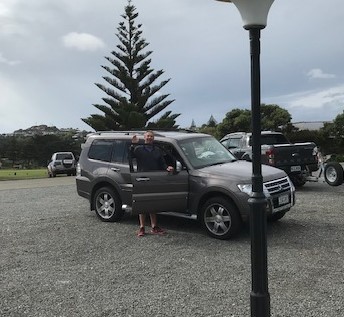
“… and so the morning of the first day – of New Zealand’s lock down.  The sun came up.  That’s always a good start.  I slept in.  Had breakfast.  Had second breakfast.  Thought about going back to bed.  Had a coffee.  Said hello to a random guy walking past.  The distance from the side of the yacht to the gravel where he was standing being more than the stipulated 1.5 metre minimum … “I was intending to leave back to Australia today” I said as an opener.  “Now you stuck here?” he replied … “yep” says me … “well mate, have my car if you need it, or want to store anything, it’s just over there in the carpark.  I’m on A Row on a wee launch, but if you need the car, it’s yours”

That’s my kind of “lock down” … and the sort of generosity and openness that I used to say was “typically New Zealand”, or Australia too for that matter. And what you hope will emerge more and more from this “foreign viral land” into which we have all now been thrust.

Instead of sitting in a marina berth, as I had been for the past few days, I’m now against the  Cruising Club sea wall.  This was to facilitate an easy get-away after customs clearance.  Well, that won’t be happening, so I moved myself back along the wharf, out of the way … where no one can see me and I can fly under the radar … at least “out of the way” is pretty accurate, because very little is happening anywhere.  The marina, the cruising club office, most things – they are all closed.

After moving the boat further back, I then tidied up a few ropes around the deck and thought … “wouldn’t it be fun to sleep in a different bunk each night” … and this is only day 1?!

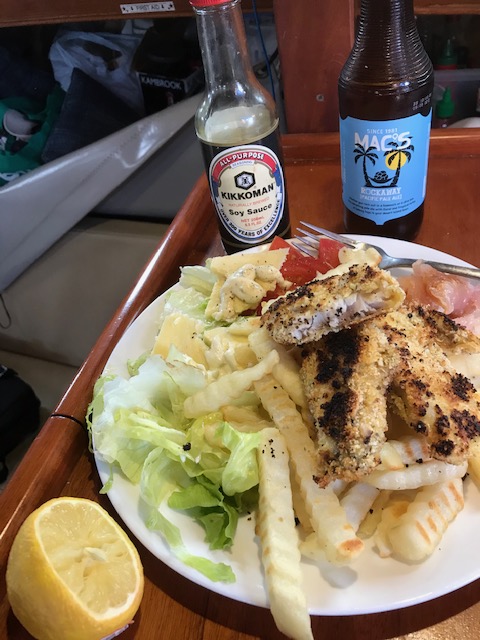
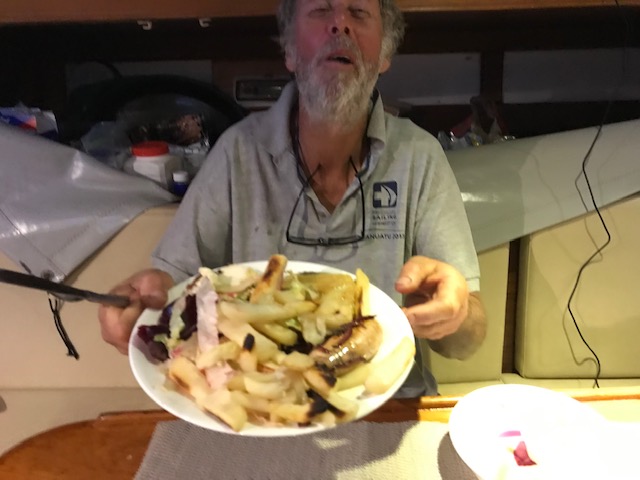
For lunch I cooked up a big serving of fish … still got plenty in the freezer … plus chips and salad.  I even stooped to taking a photo of it.  Then I had a nap, before slipping into a 90 minute Skype Sundowner Session with Mike and Robyn Clarke back in Melbourne – next best thing to being there!

It tasted as good as it looked
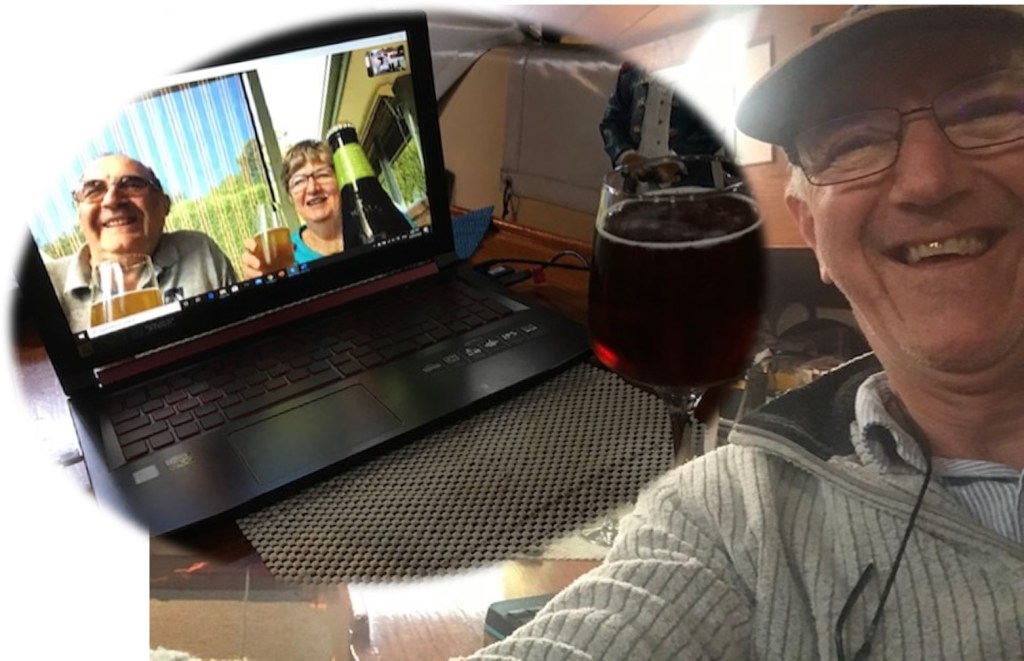
Skype Sundowner Session with fiends Mike and Robyn who are serving isolation time in Melbourne after their recent holiday … in New Zealand. This photo was taken just before Robyn said … “Now children, I’m going to teach you about fractions…”, then proceeded to to fill the glass stage by stage … “one quarter” … “one half” … “three quarters” … FULL” … “Now, children, in reverse …” at this point the glass was progressively sculled and held up each time … “three quarters” … “one half” …”one quarter” … “EMPTY” … Reaching for the bottle to fill the glass again … “now, lets recap …” at this point we all fell about laughing and Robyn left the screen briefly for a rest stop.
Getting ready for my Skype Sundowner Session at six with Mike and Robyn … never done this before, so I need to be prepared

Couldn’t bring myself to cook dinner, so I had tinned peaches, banana and ice cream.

I really am starting to run out of things to write.  Hope something interesting happens tomorrow.  I’m really out of material.

Now, I definitely am ready for sleep.

Smooth seas, fair breeze and Go, or No Go! … NO GO bro

Rob Latimer
Sun goes down on Chimere and the first day of “lock down”
Up in the corner of the wharf.

Decision Time

Mana Marina (near Wellington)

Sunday 22, Monday 23, Tuesday 24 and Wednesday 25 March 2020

If Saturday’s blog was titled “Rest and Recreation”, then the blog of the past four days could be titled anything but.  I settled on “Decision Time” because that’s essentially what has been happening as information was received and processed, and a suitable response made.

I was already aware that no friends or family would be coming over to join the adventure.  This included crew who had booked to help sail Chimere back to Australia.

Annette, Martyn and Gary moved aboard Sunday evening, with the plan being to sail for 7-10 days over in the Marlborough Sounds, rather than to Opua in Northland as was previously arranged.  It was thought that by sailing locally, it would give us time to re-assess things and for me to find a new crew to essentially sail straight back to Australia as soon as possible.

The “before” shot of the voyage that never was. Gary isn’t in “isolation” at the bow, I think we were all just hanging on because of the wind

That plan was rapidly set aside as we sat down for dinner on Sunday night when John received a phone call to say that his elderly father had just died.  He had been found, presumed drowned, near to where he and members of the family live, in Northland.  It was naturally a massive shock, and I’ll include my Facebook post from Monday (23/3)  morning to explain things further …

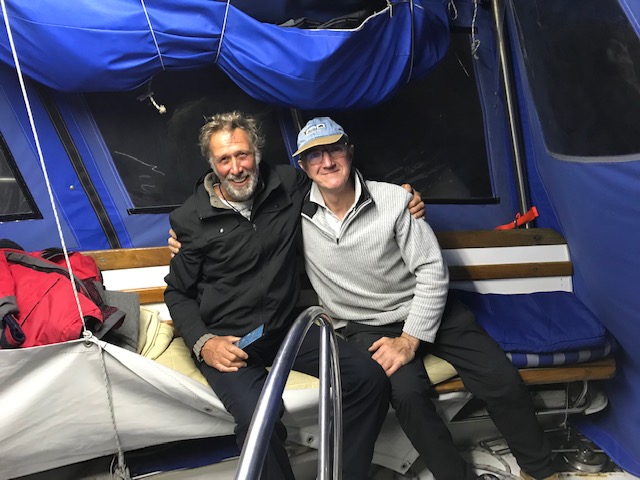
As we started dinner John got a call to say his father had just passed away. A couple of hours later we were saying an emotional farewell – after two months aboard together – so that John could join his family

(Facebook Post, Mon 23/3/20)

Coming Home

Thank you again to everyone for your kind and supportive comments

There’s definitely something about ignorance being bliss. A state John and I had enjoyed for the past couple of months – as we’d sailed around the stunning waters of New Zealand, a world apart from the unfolding global pandemic madness elsewhere.

At least that was until we returned to port … and “civilisation”… on Friday

Yesterday afternoon, (Sunday) instead of continuing north to Opua, as planned, we (that is, myself, John and the new crew of Annette, Martyn and Gary) decided to spend the next 7 – 10 days sailing Marlborough Sounds, just 20 miles across Cook Strait. This would have kept us close to “base” and at the same time enable me to (hopefully) find crew to assist me in sailing back to Melbourne in early April (from Wellington)

We were planning to leave Mana Marina this morning, (Monday) after fueling up – having already re provisioned over the past two days, with all five of us aboard. We were having dinner in the saloon, excited by the prospect of what lay ahead.

Then, John received a phone call to say that his father had only just passed away, suddenly and unexpectedly. It was naturally devastating news and so please uphold John and their whole family in your thoughts and prayers.

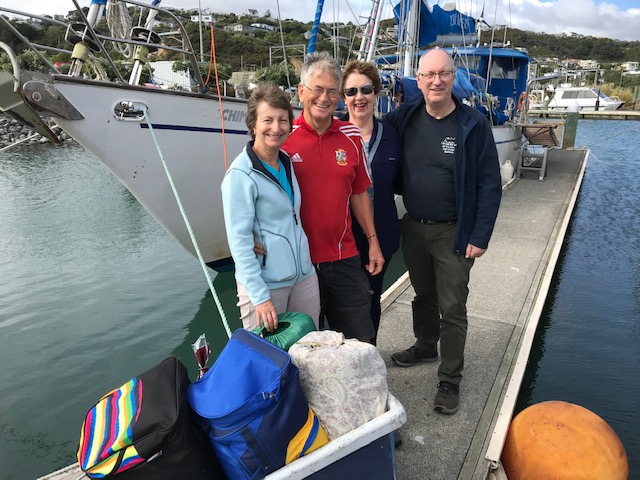
Soon after hearing the news, Annette, Martyn and Gary quietly and respectfully returned ashore to Gary and his wife Theresa’s home in the nearby suburb of Whitby.

John and I then said our emotional farewells a short time later, as he departed to assume his family responsibilities and face what lay ahead; having been picked up by his sister Sarah, who’d driven down from Otaki, just north of here

The boat was then very quiet, but the decision was then made, I’ll sail back to Melbourne as soon as possible, hopefully in the next few days, once I can find suitable crew. “Suitable crew” would seem to be limited to Aussie passport holders, already in New Zealand, who want to return to Australia – and who also know something about sailing

Again, your encouragement and support has been really appreciated. Please now uphold John and his family at this really difficult time.

Smooth seas, fair breeze and coming home

Rob

There wasn’t even time to up-pack the bags! But true to form, Annette, Martyn, Theresa and Gary were amazingly supportive and understanding

Flights out of New Zealand, and into Australia were filling up and likely to stop before too long.  After initially reserving a seat on Qantas, with a view to leaving Chimere here at the marina, I reverted to remaining on board because there were no long term berths available, meaning that I’d need to be here for when my time in this temporary berth is up. 

The option of lifting Chimere out of the water and up onto the dry was also considered, but there was only one driver, he was apparently over 70 and confined to home, and in any case the marina office and everything else was closing for the foreseeable future.

My key focus then turned to sailing home to Melbourne – Westernport – as soon as possible. 

The search for a new crew, therefore began almost immediately.  But of course, I couldn’t recruit just anyone.  They needed to be permanent residents of Australia, who already happen to be in New Zealand … and who also knew something about sailing – a real advantage. 

Added to this was the new, and half-expected, additional limitation based on the NZ Government’s decision to “Lock Down” the country to all transport, travel and non-essential service in 48 hours.  So, assuming I could find crew, they would need to be on board Chimere before midnight Wednesday 25th, that’s today

In amongst my crew web-search and social networking, Gary kindly drove me to the bank and the supermarket yesterday – just briefly, you understand, but that was enough to bring me around to what has become the new reality for most, and now for me.  I’ll start at the bank …

… the lady wearing rubber gloves at the entrance to the closed doors of the Westpac bank naturally wanted to know my business.  I started explaining that I needed to change some Australian cash, and … “you from overseas?”, she interrupted … “yes, I came on a yacht two months ago, into Picton…”, I started … “can you prove it?” she demanded … “yes, I have my entry form here, it’s dated 5 February…” I started again … “we’re not accepting overseas currency, you’ll need to use the ATM if you want cash”,  to which she pointed to her left, my right, to the ATM that was on the wall between us.    

I somehow got the feeling she wasn’t really interested in seeing my yellow Picton entry form, from 5 February.  And while she took up the new task of verbally castigating an elderly man, (probably close to 90)  who’d walked in off the street, starting with  … “you’re supposed to be at home in isolation!”   “That’s where I’m going”, he feebly replied … I decided that a swift cash withdrawal from the ATM was a pretty good option after all.

The visit to the supermarket was slightly more uplifting.  The shelves seemed reasonably well stocked and there were signs here and there asking you to … “respect the needs of others by only buying what you need”.  It was curious that none of the foam hand sanitizer dispensers at the entrance worked, or were empty, and there was a definite tension in the air.  No sound of a cough anywhere, although I did notice one guy near me cough out loud, but I think he got away with it … at least that time. 

Walking around picking this and that off the shelves, looking at the concerned faces, the masks, and then being corrected by security for having placed items on the empty conveyor belt at the check-out, before the previous customer, 3 metres or more away, had paid and walked away … I started to think “I’ve been at sea too long … or maybe not long enough”.

And there was this funny sensation in my throat as I thought about the risk of getting sick, the concern of everyone else around me getting sick and then each person looking at the other wondering … “are you sick??”  … maybe my throat is feel a bit sore.  Or maybe I’m just imagining it.     

Back, safely aboard Chimere without incident, my crew-search quest continued, while at the same time I made inquiries with NZ Customs to gain clearance and notified the Australian Border Force of my intentions.

Again, all I needed was a crew, but by late Monday, with no interest, I’d become resolved to remaining here, aboard in the marina for as long as it takes.

Then, in the early evening on Monday I received a simple Reply on the “Sailboat Hitchhikers and Crew Connection” Facebook site, saying simply … “I’m keen” … from a Fijian national who also holds both Australian and New Zealand residency.   He was going to bring a friend, but that didn’t work out, so as of now, my new crew member is on a bus coming down from Northland – about 12 hours away – and will be on the boat around 9:00pm tonight.

So, in short, the current plan will see me completing the NZ Customs clearance formality here at Mana Marina tomorrow morning around 11:00, before heading out on the high tide, as I start the journey home to Westernport.

I am extremely grateful to the NZ Customs for kindly agreeing to visit me hear to do the formalities, rather than require me to travel all the way around to Wellington.

In the meantime, I’ll fill Chimere up with diesel, top up the water tanks – although the water maker is now fully operational – and attend to final matters aboard, planning and online.

Thank you to everyone for your support your encouragement and your prayers.  Sorry that communication has been non-existent from me since John and I arrived last Friday.  I’ve now been dragged into the “new world” and have been a bit pre-occupied.

I hope to maintain some form of ongoing communication, on this website.  Not likely to be any more pictures for a while, but with the assistance of Matt Latimer, I should be able to get a short message up from time to time via satphone email.

Smooth seas, fair breeze and decision time

Rob Latimer
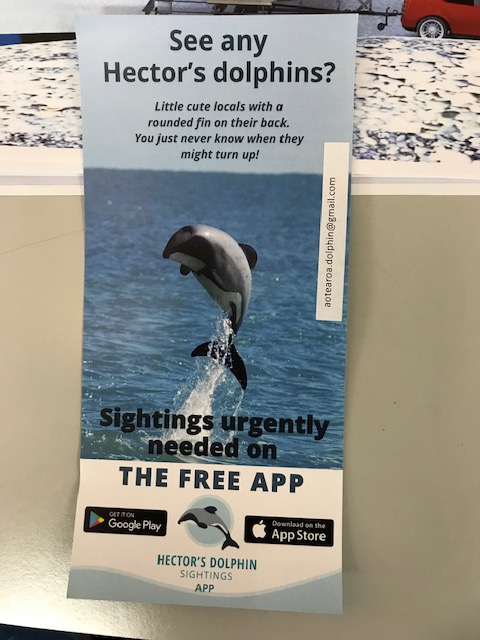
Initially I had to talk to the receptionist through a glass window, now the marina office is closed completely, but I couldn’t help taking a photo of this brochure … a memory of the lazy cruising life just 4-5 weeks ago and the playful Hectors Dolphins in Akaroa and Banks Peninsular

Rest and Reflection

Mana Marina (near Wellington)

Saturday 21 March 2020

John and I woke to the restful calm of the marina berth. 

We’d successfully made it to Mana, ahead of time, despite having to wait out the weather for a day in Milford, and 18 hours at Westport.  Must be something in that.  Where there’s a choice, it’s better to wait for kindly weather before heading out, rather than forever bash into it; the difference between “Cruising” and “Racing”

Around 10:30 we were joined by our new crew … Annette, Martyn and Gary, plus Gary’s wife Theresa.

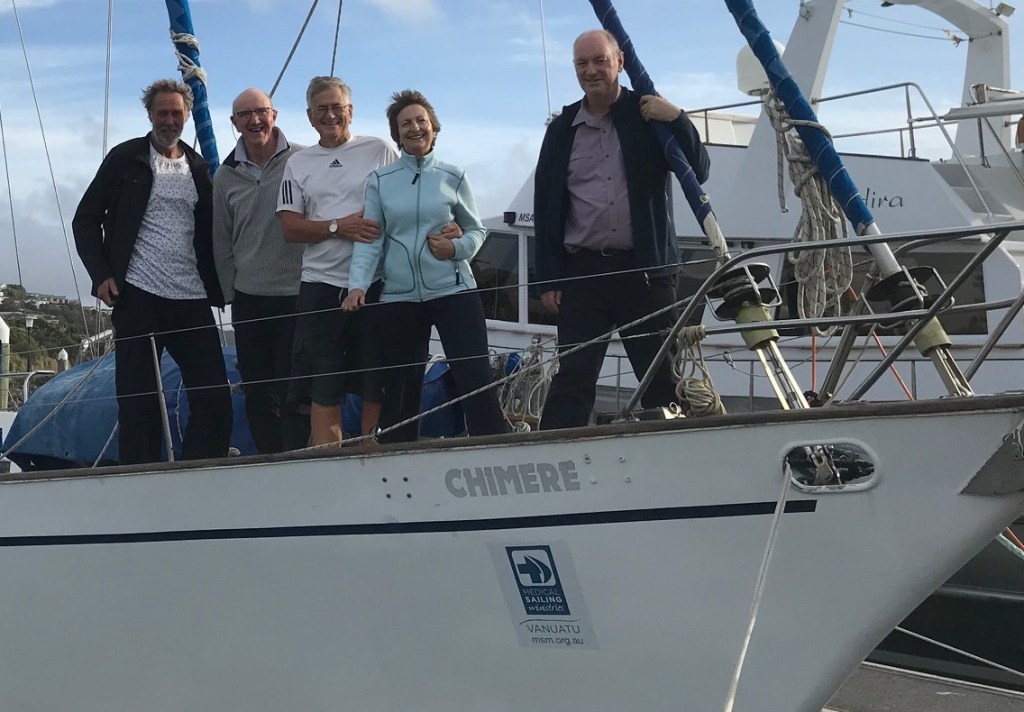
I’d first met, (wife & husband team) Annette and Martyn, while doing work with Medical Sailing Ministries Inc in Vanuatu.  Annette had spent a month aboard Chimere in 2017, helping out with conducting the National Oral Health Survey.  Travelling to some very remote places, under often trying conditions.  At the time, Annette’s powers of endurance and resilience were sorely tested and all times her cheerful and capable personality shone through.  Consequently, I was very happy to have her aboard.   Whilst I didn’t know Martyn to the same extent, I figured he had to be a decent bloke, given Annette had chosen him to be her husband.

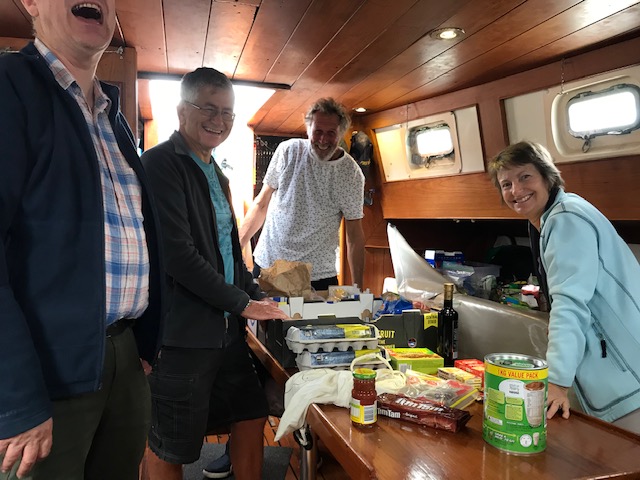
Gary, Martyn, John and Annette begin to plan the pantry and menu for the next 7-10 days

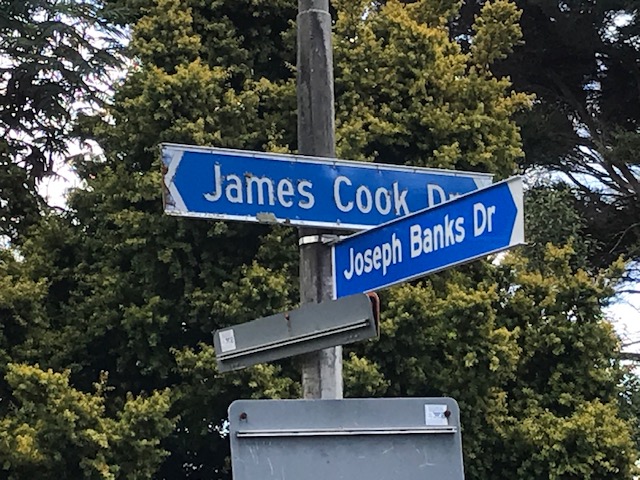
Gary, the older brother of Annette, on the other hand, was a complete unknown … a ring-in.  I’d never met him, but again, by association with Annette, I figured … what could possibly go wrong.  As a brother, he must at least have some of the same positive character traits.  After a few emails, back and forth with Gary, I quickly established that he was keen, enthusiastic and available.  What’s more, he lived in the suburb of Whitby … I kid you not … just down the road from the Mana Marina.  And how more Captain Cookey can you get than Whitby    Surely a “Sign” if ever there was one  (… yes it is, but don’t call me Shirley)

Gary just happened to live in the nearby suburb of Whitby … and what sort of street names would you expect in such a postcode …

For those less familiar with the history of Captain Cook … the original Whitby is a port village in England where in 1746 James Cook started his sailing apprenticeship.  As described in Cook biography by Richard Hough …

“… starting out as an apprentice draper and grocer, James carried out his shop assistant duties before deciding he wanted to go to sea.  His master, Sanderson, acted with remarkable speed and success to bring about this new change of course in James’s life.  First, he obtained the permission of James’s father, then contacted a friend of his in the nearby port of Whitby, John Walker.  Walker was introduced to James, fancied the cut of his jib, and agreed to take him on.  James Cook was bound an apprentice for three years”

So, as a resident of the suburb of Whitby, Gary was always going to make it onboard. 

After a considerable amount of rummaging and sorting, of the existing food stores, we had compiled a comprehensive shopping list for what additional items we thought we would need for our sail north to Opua.

There’s just one more tin of beans … “I’ll get it …”

Gary, Annette, Martin and John then headed off to the supermarket, while I remained aboard to meet a chap by the name of Adam.  A boating friend of my cousin Keith, who had agreed to come aboard around 1:00pm to have a look at a couple of 240 volt switches. 

The switches control two water pumps – one, a low-pressure pump, the other a high – that drive our water-maker system.  After operating for just 30 minutes down at Bluff, back on the 29th February it had suddenly stopped working.  After checking whether the high pressure pump was the problem, Matt and I had kind-of agreed that it was probably an electrical issue; which would need to wait for another time.  In the meantime we’d have to rely on the 1,000 litres in the tanks, and filling up in the Fiords somewhere.

In the late afternoon, I felt very spoilt to be picked up and taken home to dinner, with cousins Keith, Pearl and Pam (Judy would have been there too, but she is currently unwell – no, she just has a cold), plus their spouses … Christine, Murray and Mark – all of whom live nearby. 

With my father, Bill, originally coming from Wellington, Keith, Pearl, Pam and Judy, were the core of what I’d always known– growing up – as … “the New Zealand family”.  Their father Ted, was my father’s brother, who, through circumstances, had returned to New Zealand in 1958, around the time dad settled in Melbourne, following their respective decisions to no longer remain living in Zambia; what was then known as Northern Rhodesia.

Cousin Keith Latimer, who just happens to live down the road , has been a great help with local knowledge and contacts

Consequently, we don’t often get to catch up with this part of the family and so it was great to be able to share time together.

It’s no surprise that the key topic of discussion was the spread of the coronavirus (COVID-19) worldwide, the impact on daily life, and just how far the impact might extend in the future.  Anyone who made the slightest suggestion of a cough, was jokingly looked at sideways, with all of this being in stark contrast to life at sea for the past 2 months

John stayed the night at his sister’s place overnight, while Gary’s wife Theresa kindly volunteered to wash and dry all of our dirty clothes – that’s John’s, mine, and towels etc from Chimere – what a trooper, and a gesture that was greatly appreciated.

As news of the worldwide impact of the COVID-19 pandemic streamed in, it was clear that my plans would have to change.  The blissful bubble of the past two months – where communication was minimal and news was scant – had certainly been burst and some serious decisions would need to be made, soon.

Back on board after a great dinner, it was quiet with John away … maybe he’s the noisy one … I was ready to fall asleep

Smooth seas, fair breeze and rest and reflection

Rob Latimer
PS  Here’s an informative article written recently by a friend and MSM Vanuatu volunteer (2017) John Wright.  John was to fly across to New Zealand (from Australia) next month, to assist me sail Chimere home.  But of course, travel restrictions have put paid to that.   As a former microbiologist, John wrote this brief article for a group in which he is involved in Tasmania…

John Wright back in 2017 during an MSM outreach mission to Vanuatu

Viruses and COVID-19

What are viruses?

Viruses are everywhere. A bucket of ocean water contains more virus particles than the earth’s human population. There are animal viruses, human viruses, plant virus, fungal virus and bacterial viruses. The general virus structure is a core of genetic material (DNA or RNA), surrounded by a protective coat/envelope. Part of the coat is used to attach specifically to cells. Once inside a cell, a virus multiplies and new particles are released to spread the infection. Viruses cannot multiply without cells.

Coronaviruses

Coronaviruses are a family of viruses whose members may infect birds, animals and humans – sometimes only one species, sometimes more. When viewed with a high-resolution electron microscope, the coat/envelope has projections that resemble a crown. The Latin word for crown is corona. Hence the name coronavirus. These projections are responsible for cell attachment prior to entry of the genetic material into the cell. Consequently, viral infectivity may be destroyed by disrupting the coat/envelope with disinfectants such as alcohol, detergent, or by heat and drying out. In humans, antibodies arising from immunization or previous infection may bind to the viral surface and prevent attachment and infection.

The formal name of the coronavirus currently of concern is SARS-CoV-2. In humans it causes COronaVIrus Disease, first detected in 2019 (COVID-19). There was an earlier outbreak of Severe Acute Respiratory Syndrome (SARS) in 2003, hence the new virus is number 2. Coronavirus are among the largest RNA-containing viruses. The particles are 120-160 nm in diameter (a nanometre is one millionth of a millimetre), and their genes are contained in one piece of RNA. It is this RNA which is detected in body fluids by the current ‘gold standard’ diagnostic test.

Infection by SARS-CoV-2

Humans are infected with this virus by the respiratory route – droplets in the air or virus remaining infectious on surfaces. There is preliminary evidence, yet to be confirmed, that children may excrete this virus in their faeces. Details of the human immune response to SARS-CoV-2 are being worked on. Specific immunity can be antibody-based to inactivate virus, or utilise specific T cells (white blood cells) to recognize and kill infected cells. To be immune to infection, one must have been previously infected by the same or a closely related virus, or immunised using molecules/particles that resemble the virus and induce a protective response. People with weaker immune systems, either through age or immunosuppressive drugs, are more vulnerable to severe disease. New diagnostic tests to detect anti-coronavirus antibodies are coming on the market. These tests will be simpler to do than RNA tests, but will only work after the patient has made antibodies.

Drugs and vaccines

Anti-viral drugs prevent virus attachment or virus multiplication in the cell directly. There are some drugs effective against RNA viruses e.g. HIV, influenza virus. None are known at present which are specifically directed against coronaviruses. There are certainly none commercially available. There are some drugs under development from work started during the earlier SARS and Middle East Respiratory Syndrome (MERS) outbreaks. Drugs directed against unrelated RNA viruses are also being tested.

Vaccines induce an immune response in potentially susceptible individuals. Their development has a long lead time. A candidate vaccine is initially evaluated in animals to see if it can stimulate an immune response. If it is successful, then a series of trials with increasing numbers of human patients is required to test the candidate.  An immune response may not be protective i.e. antibody may be made, but not inactivate the virus. The experimental vaccine may have side effects. It may only protect a small proportion of recipients. In animals, but not humans, a virus can be administered directly back to vaccine recipients to test protection. This cannot be done for humans, so trials involving a large number of patients may have to wait for natural infections to occur before protective efficiency can be determined

Other respiratory viruses

A runny nose? It may be caused by a rhinovirus, adenovirus, influenza virus, paramyxovirus, or coronavirus. Most people are familiar with the common cold virus (rhinovirus) and influenza virus. The latter is sometimes compared with SARS-CoV-2. However, the mortality rate for SARS-CoV-2 is higher than for influenza virus. Also SARS-CoV-2 is a new virus, whereas for influenza there is some pre-existing cross immunity in the population, as well as available antiviral drugs and vaccines.

Origin of SARS-CoV-2

The gene sequence of the virus has approximately 90% similarity to those of bat coronaviruses so infected bats may be the virus source. There have been several nasty examples of animal viruses crossing to humans in recent years e.g. HIV,  Marburg virus, Ebola virus, Hendra virus, Nipah virus, SARS and MERS.  There will be more in the future. Australia does not have a Centre for Disease Control (CDC). Many would like to see an ACDC. However, we have one of the best biological secure facilities in the world at Geelong in the CSIRO Australian Animal Health Laboratory (known as AAHL), which is available in an emergency to help with diagnosis and investigation of human diseases.

Trusted sources of information

There are many active research areas now in diagnosis, disease progression, immunity, viral genetic stability, and dynamics of infection through the human population.

Nature magazine has daily updates     https://www.nature.com

WHO      https://www.who.int/emergencies/diseases/novel-coronavirus-2019

Australian Government Health Dept   https://www.health.gov.au

US Centers for Disease Control and Prevention    https://www.cdc.gov/

The newspaper The Guardian has well-researched and readable articles   https://www.theguardian.com/au 

How to protect yourself and others

Check the website of the Australian Government Health Department (listed above). Specifically https://www.health.gov.au/news/health-alerts/novel-coronavirus-2019-ncov-health-alert?utm_source=health.gov.au&utm_medium=redirect&utm_campaign=digital_transformation&utm_content=health-topics/novel-coronavirus-2019-ncov#how-to-protect-yourself-and-others

If necessary copy and paste the above link into your web browser.

Peter J Wright

(formerly Associate Professor of Microbiology, Department of Microbiology, Faculty of Medicine, Nursing and Health Sciences, Monash University)

March 2020

Race to Mana

Mana Marina (near Wellington)

Friday 20 March 2020

Farewell Spit curves around the tip of the South Island, like the beak of a kiwi … the bird that is.  It’s long, thin and extends in an easterly direction away from Cape Farewell for maybe 20 miles or so.  It was dark as we travelled along its full length, keeping about 4 miles offshore, in the deeper water, so as to avoid as best we could any confused sea.

In the end the seas flattened off somewhat as we came into the lee of the southwest swell.  But this was short lived, as we then made our way across Tasman Bay; the lumpy, confused sea, a product of the continued 25-30 knot wind against the usual tidal flows.

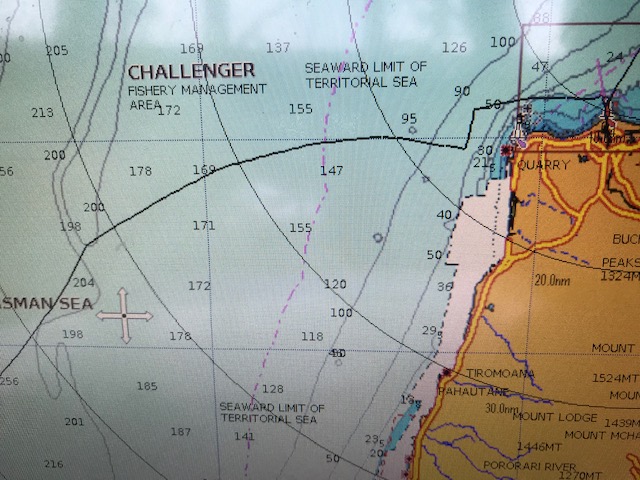
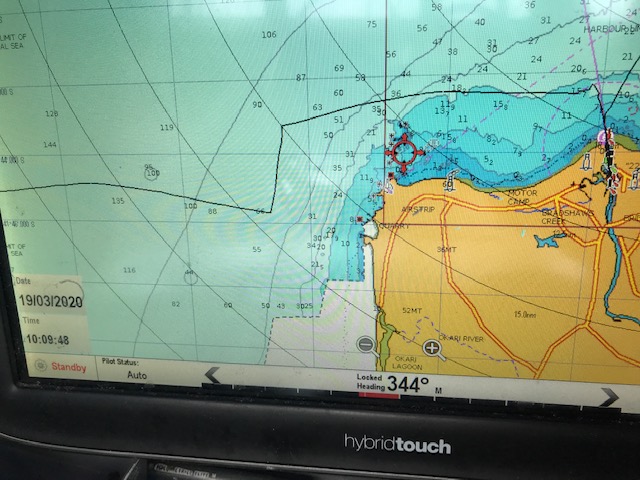
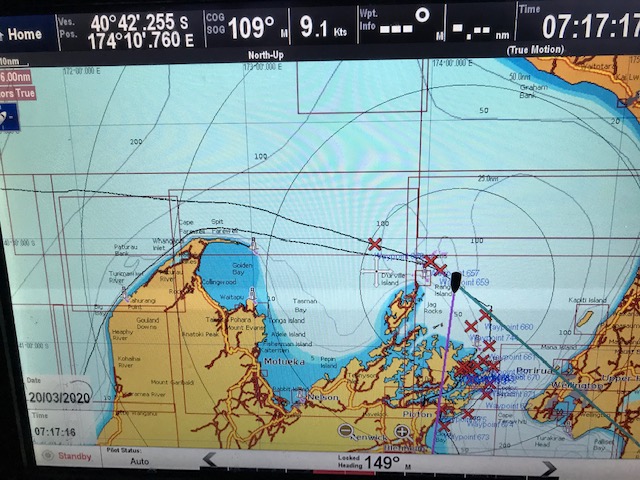
As the screen says, we were doing 9.1 knots when this photo was taken, as we’d just crossed the arrival track from 4 February … that’s the line to the left that disappears off the screen 10 days or so back to Australia
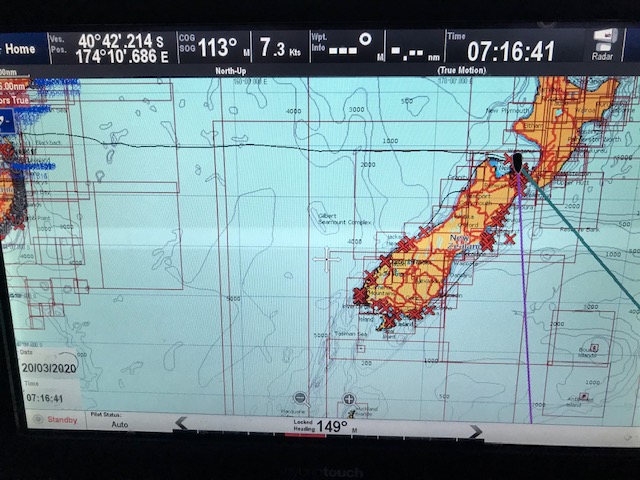
If you look closely you can see the arrival track across the Tasman, and our track around the South Island in a clockwise direction … the opposite way to Captain Cook

John and I maintained a regular watch, alternating around the usual shared-tasks of adjusting sails, discussing course changes, or, as occurred a couple of times musing over how to interpret navigational lights in the distance and how best to respond.

On one of these occasions John emerged into the cockpit after hearing me talking to someone – not just a dream, or a question of madness – but an attempt to raise, what we assume was a fishing boat, who appeared to be aim straight for us about 3 miles away.

It was about two in the morning and after a few minutes, having already turned on our deck lights to illuminate our sails, and tried several times to raise a response with a “All ships, all ships in the Cape Farewell area … this is etc etc “ message, I received an unexpected response from a women at Maritime Radio, asking if all was ok and whether we required assistance. 

“Yes, all good.  Just trying to raise a vessel, who appears to be on a collision course”   I explained. 

Maybe it’s just my camera … but if you look really, really closely, you can see the green nav light on the bow, the red glow of the night light through the toilet deck hatch, and the faint white reflection of a breaking wave to the right … probably you had to be there.

“I can see your vessel on AIS” (Automatic Identification System), she returned, “But I don’t see another vessel, OVER” Then finally finishing off with … “Chimere, if you need further assistance, just call back. OUT”   

In the end, it was reassuring to hear that our AIS signal was being received … by someone.  And we suspected our AIS presence was also displayed on the other vessel’s chart plotter , However, as we’d come to learn, fishing boat skippers tend NOT to reveal their positions on AIS and are often too pre-occupied (catching fish) to bother with the radio … so whether he was anywhere near the chart plotter to see us can’t be guaranteed.  In the end we turned on our radar and had little option but to adjusted our course around him

The entrance to Queen Charlotte Sound and Picton – where we’d entered way back on 4 February, off on our starboard side as we approach Cook Strait
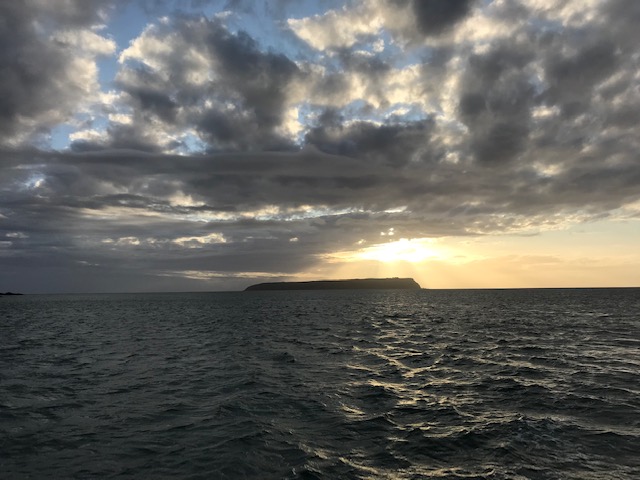
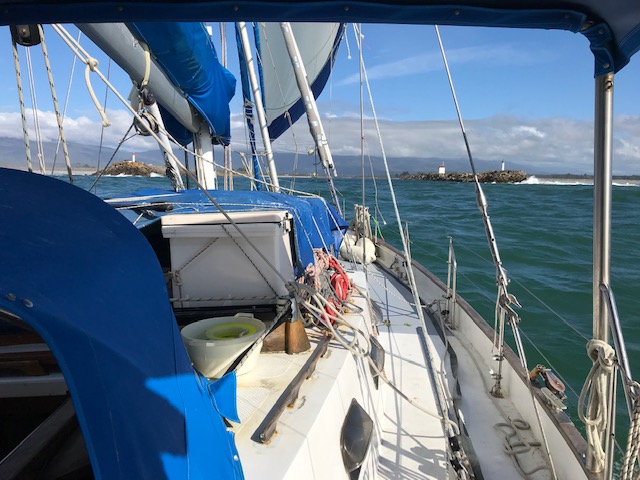
Arrival at Mana Island, as we sit at anchor for 5 hours, waiting for the return of the tide and sufficient depth over the harbour bar entrance
Waiting at anchor in Onehunga Bay, to enter Porirua Harbour

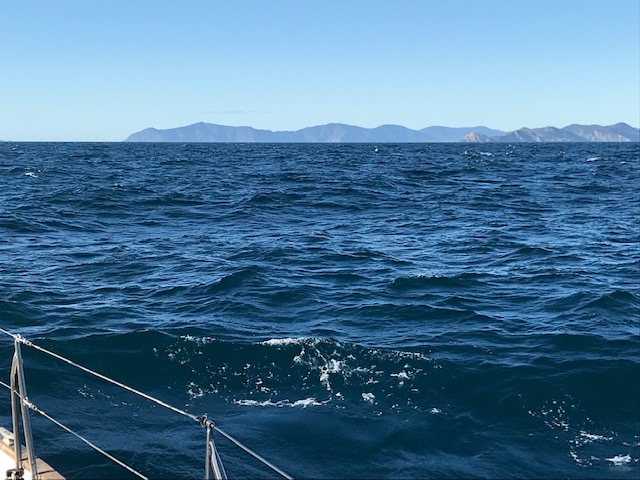
At dawn, we were still racing along, with the outer islands of Marlborough Sounds off to the right and Cook Strait before us. 

The latest weather forecast predicted that south east winds would start coming on the nose around mid-morning, so we hugged the coast of the South Island before setting the 20-odd mile course across the strait to Mana Island and the entrance to Porirua Harbour.

Around this time, we crossed our in-bound track from Australia, way back on the 4 February, having now successfully circumnavigated the South Island.  It was a good feeling, but it seemed we were returning to a very different world to the one we’d left, less than two months ago.

On arrival in the early afternoon, we dropped anchor in Onehunga Bay, just to the side of the Porirua Harbour channel entrance, to await sufficient tide to cross the bar.  We’d been advised that 2 hours either side of High Tide would be fine, based on us having a draft of around 1.8 – 2.0 metres, and so at 7:00pm we retrieved our anchor and made way.

The sun making its final dash for the horizon behind Mana Island, as we up-anchor and enter Porirua Harbour

The approach to the Mana Marina was in two parts.  First, we needed to following the initial lead beacons (which we could see onshore) on a bearing of 100 degrees, then take a hard right to follow a second set of leads on a heading of 171 degrees.  It was then a case of entering the marina breakwater, before making our way to the allotted 18m berth close to the shore and to the right “F02”

All went to plan, despite the disconcerting small numbers displayed on the depth sounder … 3.1m … 2.8m … 1.9m … 1.8m … 1.6m … come on … deeper, deeper … still no feeling of scraping the sand  … before the numbers started to climb again… 1.9m … 2.2m  and so on.

Fortunately, our depth sounder transducer is located around half a metre below water level … which means that even when 1.6 metres is showing on the display panel in the cockpit, the depth of the water is actually around 2.1m.  Still, we were very pleased to have made it safely into the harbour, found our berth and successfully tied up.

There to meet us, waving from the marina walk-way and eager to help grab the lines, were our new crew for the next stage north – Annette, husband Martyn and brother of Annette, Gary … plus Gary’s wife Theresa.

It was also a great thrill to catch up with my cousin, Keith Latimer, who just happened to live in the area, with his wife Christine.  We don’t catch up all that often, but it’s always fun when we do.  Over the years, Keith has done a lot of boating out of Mana Marina, where he also once owned a berth and boat, so his assistance has been invaluable in finding the right people (when necessary) and planning the voyage more generally.

Safe and sound in Mana Marina – Berth F02

For now, it was time to take breath and relax over a few night caps … then catch up some overdue sleep. 

We’d travelled the 230-odd miles from Westport at an average speed of 7.5 knots, which was remarkable given the first few hours yesterday were rather slow, with little wind.   Certainly, it left John and I liking the feeling of travelling at 8-9 knots, rather than 6 knots.  It may not sound much …  but on a percentage basis, 7.5 knots is 25% faster than 6 knots … which all adds up.  Helping us, of course, to better plan around “adverse weather events” … which are the things that cause us to tack … which as I’ve said before, “… gentlemen don’t tack”  

Planning for the voyage north to Opua, along with re-stocking Chimere’s pantry would have to wait … at least until tomorrow … at around 10am.

Smooth seas, fair breeze and Race to Mana

Rob Latimer
Catching the Wind

At Sea, NW Tip of South Island

Thursday 19 March 2020

It was always going to be a lazy start, and true to expectations, we got away around 8:30am after a fantastic night’s sleep tied up to Curly’s giant rubber inflatable vessel, “Protector”. 

Leaving around this time also coincided with Curly having to move his boat off the wharf too, in order to conduct some training exercises

Curly’s boat “Protector” … one very big rubber ducky

As we were saying good-bye to Charly and handing him our completed “Port User Application Form”, (yes, it often costs money to stay overnight – at least where you can’t just drop the anchor) I couldn’t help asking … “Curly, I’ve got to ask … how did you lose your arm?  I’m thinking … working on a cray boat…?”

Curly’s direct response was honest and revealing …  (in the interests of readers, I’ll let you insert the generous sprinkling of expletives where you feel appropriate …)

“Motor bike and alcohol!”  Curly then elaborated, “I was 21 and the bike was a birthday present.  So that’s 42 years ago now.  I wrote off two cars in the accident.  It was the second car that stopped me.”

Paradoxically, Curly then went on to say … “Looking back, losing my arm was the making of me.  I was young and fearless.  But I had a real problem with alcohol.  I was on a bad path, but a year after the accident I stopped drinking and haven’t had a drink since.”  

“Were you already working on cray boats when you had the accident?”,  I asked.  

“Yeah.  And I did for the next 40 years.  Just gave it away last year.  Don’t get me wrong, having one arm has been a real **** pain.  Like when you want to knock a nail in with a hammer, or fly a helicopter.  That’s something I always dreamed of doing – fly a helicopter.  And playing pool.  I was a ****** good pool player.  After the accident a friend made a nifty support thing for the cue, so I could hold it.  But after six months I gave it away.  Wasn’t the same. Time to start something new.  Move on”

Leaving Westport on the high tide
Must be some wind out there somewhere …
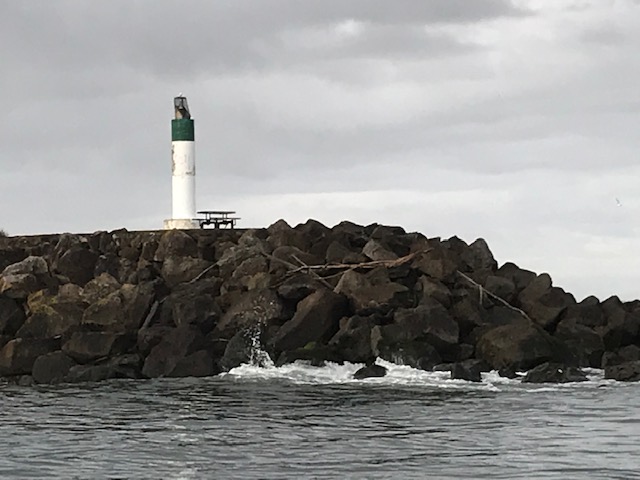
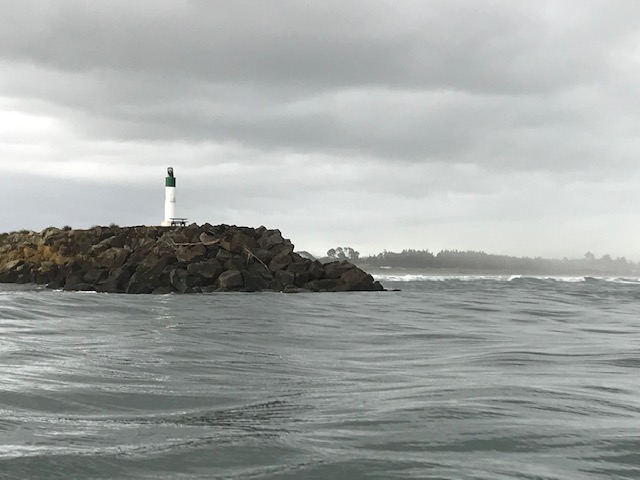
The starboard marker at the entrance to Westport … park bench was a nice touch I thought
Out of the channel it was breaking surf both sides

As we untied the last line, said a final farewell and glided out into the channel, I couldn’t help but reflect on how Curly had chosen to respond to what would have been such a traumatic, life-altering event.  Not just for him, but for his parents and family, the drivers of the other vehicles,  for the whole, close-knit Westport community.  After all, the accident could have led Curly down a very different path – to become angry, depressed and drink even more. 

The West Coast was (is) known for its tough, blokey culture … not to mention the number of pubs in each town … so it must have taken a lot of courage for Curly to swim against the tide, so to speak, and use his loss as a wake-up call;  a chance at a new and more productive life.

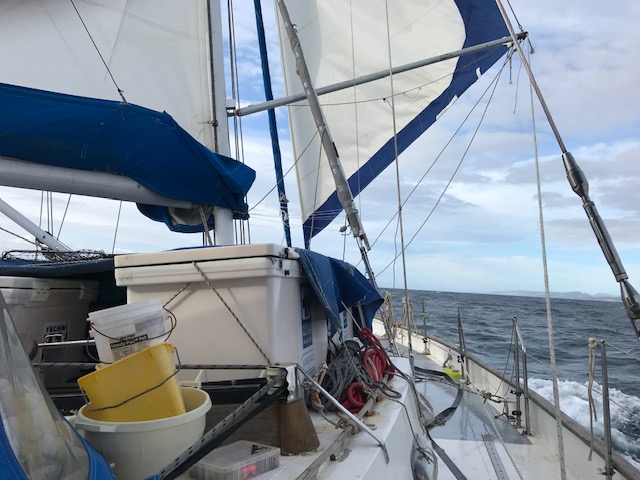
Out at sea and clear of the entrance, the first few hours of the day were grey – the sea and the sky.  There was little wind to speak of and the remains of a southwest swell created a frustrating roll from side to side as we motored on at around 6 knots

Looks like there’s wind, somewhere, but we had to wait a few hours – fortunately it was going our way … or, more to the point … we were going its way …

Then finally, in the early afternoon, the promised 25 knot, southwest breeze arrived up our tails and remained steady all afternoon and evening … pushing us along at a stead 7-8 knots, sometimes up to 9

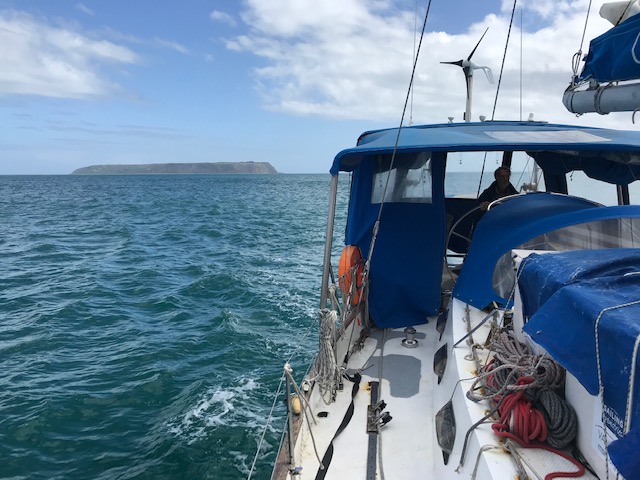
We set the mainsail out to the left and with the aid of the spinnaker pole, set the jib to the right, then watched the green and hilly (for Australians, you can still read – “Mountainous”) landscape just two miles off our starboard side. wizz past, with the Cape Farewell light off our bow by 9:00 pm.

In the afternoon it came out sunny, with a handy breeze from behind

John cooked up his signature-dish of bacon and eggs for lunch, plus tomatoes we’d bought at Westport and a little time after caught a good sized Kawaii.   

John the hunter …

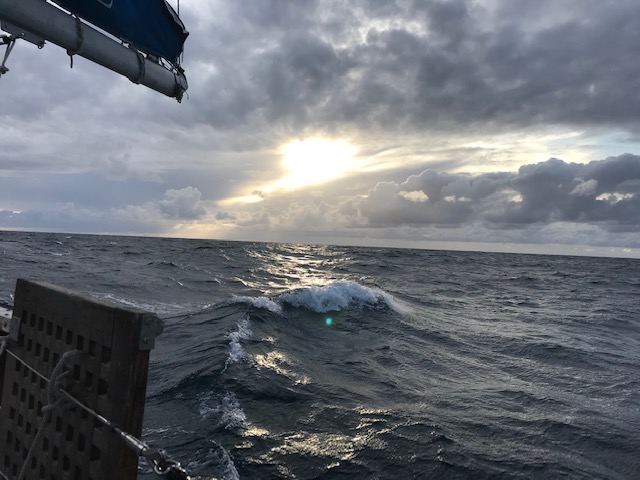
As the sun set and darkness once more surrounded us, we could tell we were still surging along by the sound of the parting waves either side of us as we carved our path down the face of each advancing swell. 

Our speed was now regularly over 8 knots, sometimes more than 9, despite having reefed the jib.  We found ourselves making new calculations as to how far we might get … up and around Farewell Spit and across Tasman Bay … before things changed and the forecasted headwinds began blowing through Cook Strait in around 15 hours. 

So a new plan was hatched.  Instead of stopping at anchor somewhere tomorrow night, a short-sail from Mana Marina in Porirua Harbour, then completing the final hop on Saturday … we would instead make a dash directly for Mana – as fast as we could.  At our current rate we estimated that we might actually make it to Mana Island in the early afternoon of tomorrow.  It will then be a case of waiting till the high tide in the evening – but still in daylight –to make it safely over the bar at the entrance.   Once in Porirua Harbour, it would be just a short mile or so up to Mana Marina; where we’ve been able to book a berth.

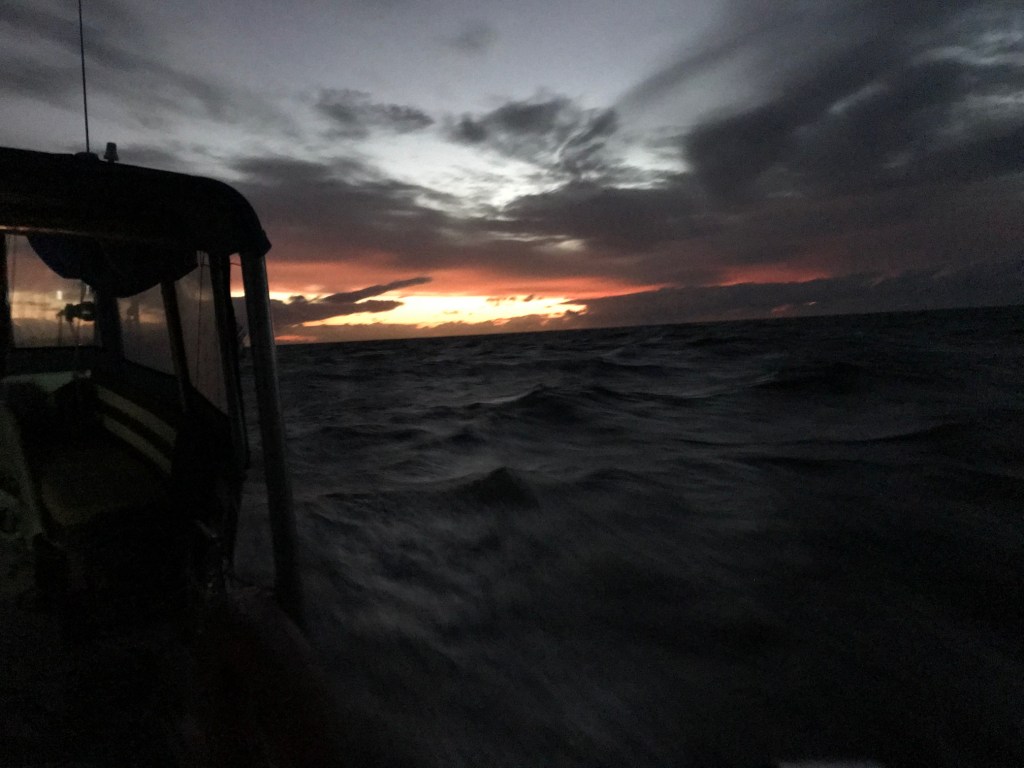
Sunset approaches with the wind racing us along at 8-9 knots
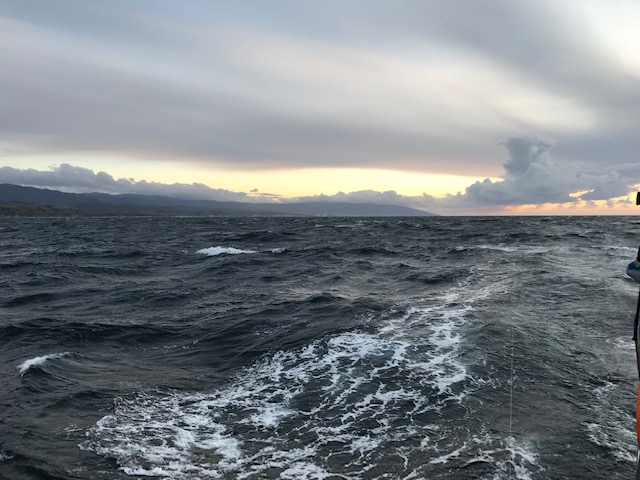
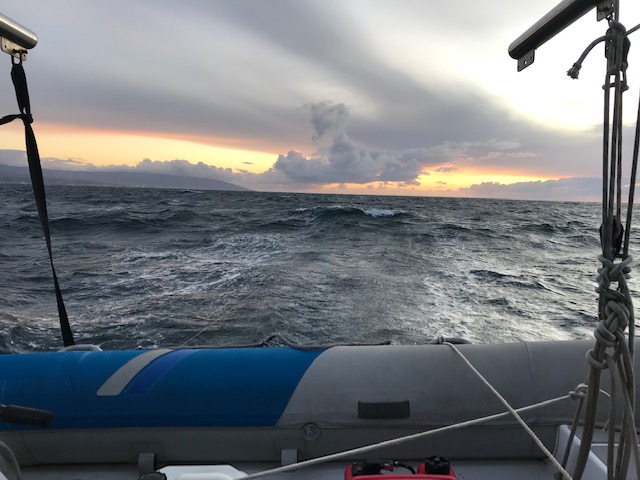
The view out the back …
You can see the fishing line out the back … we are just about to reel it in for the night.

For now, we are adjusting our course around to the east, as we run parallel to Farewell Spit.  As the night wears on, and into the dawn, we’ll be crossing Tasman Bay.  Then past the northern tip of D’Urville Island and laying a course southeast for the final 47 mile leg to Mana 

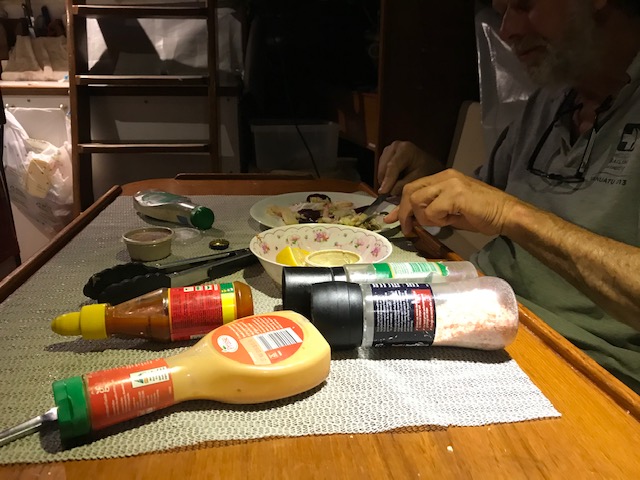
Tonight’s meal utilised some of the tuna, caught yesterday, in company with some frozen chips bought in advance from the Westport supermarket – baked in the oven.  Plus a side salad and a range of dressings.  John even cooked up the roe from the salmon he landed this afternoon.  Although I can ’t say I got through all of mine … even if it IS an ideal source of Omega 3, or whatever?!

Fish AND Chips … this time we’ll have some … tuna
Dinner at sea is not always this civilised … but when the wind is from behind, we mostly have a stable table … if it wasn’t for the rolly swell. In any case, might as well accept that nothing will stand up for long and lay it down.
Gone for another day as we surge on in darkness

Smooth seas, fair breeze and catching the wind

Rob Latimer
Westport Haven

Westport, West Coast NZ

Wednesday 18 March 2020

After a long dark night taking turns on watch, the dawn arrived … eventually. Greeted by calm-ish seas, (with a persistent rolly southwest swell coming up from behind) and a light breeze, requiring us to rely mostly on the motor for progress

One curved ball in the forecast was the prospect of the wind strengthening after lunch, but from the north east – roughly the direction we were heading – then coming in strong from the opposite direction (our way again) tomorrow morning.   We were therefore faced with a decision … whether to plug on for a second night, with the likelihood of better winds in about 18-24 hours, or, head for the coast and drop in at the coastal seaport of Westport; presumably named because it’s a port on the west coast?!  

I’d already spoken to fishermen further south about getting into this port, and whilst their language about a couple of other places on the West Coast can’t be repeated here, they DID say the Westport bar (and we’re not talking about a pub in the main street) and entrance was OK, so long as you went in close to high tide and there wasn’t a big sea running.

In the end it was a pretty easy decision to make … we would aim for Westport.  Maybe we could buy some butter at a local supermarket, and at the same time check out their stocks of toilet paper.  Based on what I’d heard about panic buying in Australia, who knows, we could finance the trip by filling the holds with the stuff and cleaning up, so to speak, when we get to Australia!  What could possibly go wrong.

Our course back to the coast was supposed to take around 5-6 hours, landing us just north of Westport, so we could simply hang a right and follow the leads across the sandbar and into the channel, that is essentially the Buller River with a rock wall either side.  Unfortunately, the northeast wind came in just a little early, or perhaps we didn’t aim high enough up the coast … in any case, our landfall fell a few miles south of the port entrance, meaning that we had to throw in a couple of tacks, to round the ironically named Cape Foulwind; ain’t it the way.  All this took an extra hour or so, which in the end worked out perfectly for the high tide over the bar.

We made the decision to head for the coast and seek shelter in Westport from the forecast headwinds
Just a few miles short and along comes the wind change, on the nose with lumpy seas Arrrr, resulting in us having to tack around the aptly named Cape Foulwind and into the Westport harbour
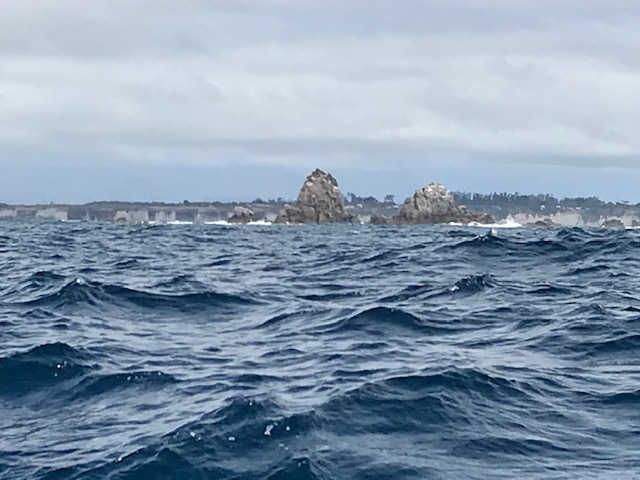
Cape Foulwind, Westport … not a place to linger …
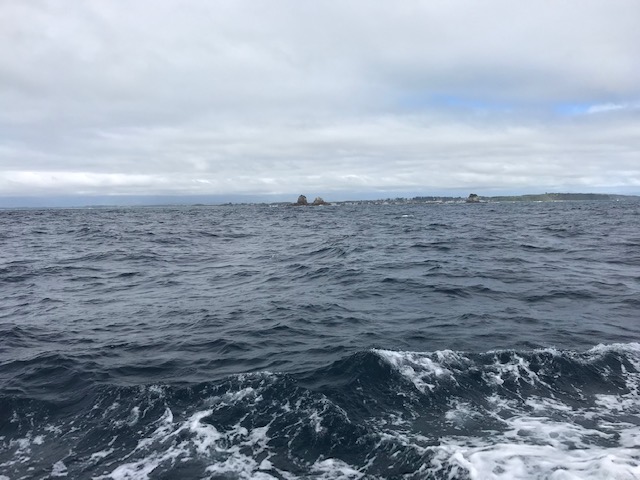
Westport in the distance, behind Cape Foulwind

As we travelled along the coast, we discovered that in places we had internet and phone coverage up to 20 miles off-shore, which enabled us to look up information about Westport, and also Mana Cruising Club and Marina; our eventual destination near Wellington

In relation to Westport, the website content under the heading “Current Port Information”, had further links concerning River Status, Tides and Bar Status, then in bold letters stated … “IMPORTANT! – Please make contact before attempting to cross the Bar by calling …” followed by detailed colour pictures of the onshore lead markers and confirmation that the shallowest part of the bar was 3.1m + or – 50mm on 26/2/2020.

So naturally we gave the number a call and pretty quickly were talking to Curly, the semi-volunteer, semi-official Westport Harbour Master.  Curly seemed pretty confident that we could get in OK and explained … “Better wait till around 4:00 o’clock.  Give me another call when you’re a mile off and I’ll come down to the breakwater and guide you in.”

Finally, the leads for the Westport harbour entrance begin to line up
Not far now … surf to the left, surf to the right, but here in the channel we ended up with a minimum of 4.3 metres of water … plenty for us
Instant Calmer … inside the Buller River, Westport
Tied up next to Curl’s 60 foot over-sized zodiac dinghy … we put fenders out, but I don’t know why, Curly’s boat was one big fender
Originally built as a tender, tow boat for the NZ Americas Cup team. Now Curly owns it as his “toy” and re-named Protector

“Is there somewhere we can tie up?”, I asked, knowing it was a small harbour basin and probably already full of fishing boats.

“You can raft up next to my boat.  That’s the best ticket.  Just come alongside and I’ll meet you there.  It’s a 60-foot-long, oversized zodiac rubber ducky.  Second boat on the right as you come in.  With an orange stripe”

Pretty quickly we got to meet Curly in person, and sure enough, he was there in his car on the breakwater to guide us in and check we could see the fluro-lead markers on shore and were straight on the line.  Then he was there to take our lines as we tied up next to his … no joke … 60-foot-long, oversized zodiac rubber ducky.      

Curly, a man about 60-ish, did have curly hair, (as it turned out), was a retired cray fisherman with 40 year’s experience.  With the demise of Westport as a prominent commercially viable port, Curly took on the role of Harbour Master in what we gather was indeed a semi-volunteer role.   “Otherwise they were going to close the Port”, Curly explained

To keep himself entertained in retirement, he’d only recently bought what he called his “toy” … which was purpose-built many years ago as the tow-boat for the NZ America’s Cup defence team.  It was a well-equipped unit, which Curly uses as … his toy … but also to catch the odd crayfish, take friends and family out and also mount rescues, when called upon to do so.

“I’m what the authorities call … a vessel of interest”, Curly explained, “so if they have a problem in the area, a rescue, what have you, they get onto me.  The vessel is well suited to it, and I know the area, cos I’m a local, born and bred”

Curly needed to name the boat when he assumed ownership and came up with the name “Protector”, which seemed very suitable.

“We already did one rescue, here beyond the bar a mile or two.” Said Curly.  “A guy on one of those sit-on kayak, paddleboard things.  There was an offshore wind and he kept falling off it when he tried to paddle back into the waves.  See, he should’a gone on an angle to the waves.  Anyway, it was late in the day and I got a call from the helicopter rescue, asking whether I could go out.  The guy had called 111 on his cell-phone, from the kayak. And within a short time, it got through to me.  Well I went out, and based on where he’d launched and what I figured his drift would be over a couple of hours, we found him in a real short time.  Nearly ran the bugger over we were so close”

In the interests of this blog’s G-Rated readership, I’ve left out the expletives, but they were colourful, well placed, inoffensive and above all, expressive.  Clearly, Curly was a local “identity”, with a big heart and a wonderful attitude to life.

“Better get home, me missus is taking me out to dinner”, continued Curly, as he made moves to go.  “My wife and I worked together on the cray boat for 18 years, then she got pregnant and stayed at home.  We’ve got two girls, one age 11 and the other just gone 18 – she’s just started studying medicine at Otago University.   Well. She thinks she’s doing medicine, but you’ve got a couple of thousand students all doing a general introductory health degree, then just a very small few make it through to finally do medicine.  She’s got it all planned out.  Good on her. 

But occasionally I whisper in her ear … $4 million dollars … cos that’s how much this silly old, uneducated dad made from working on a smelly old cray boat”, finished Curly with a hearty laugh

As Curley made his way around the outside of his boat, walking on the float pontoons, we was careful to keep a grip on the handrail of his boat with his left hand, because his right arm was missing.  I suspect the result of an accident years before.  I’m guessing it had something to do with cray pots and fast-moving lines and ropes aboard a fishing boat … but I couldn’t bring myself to ask.  We’d respectfully shaken hands with our left hands, on meeting, he could tie the lines and do everything else just like normal … it wasn’t an issue for him, so it didn’t seem right to ask.  But clearly, Curly had a lot of interesting stories to tell.

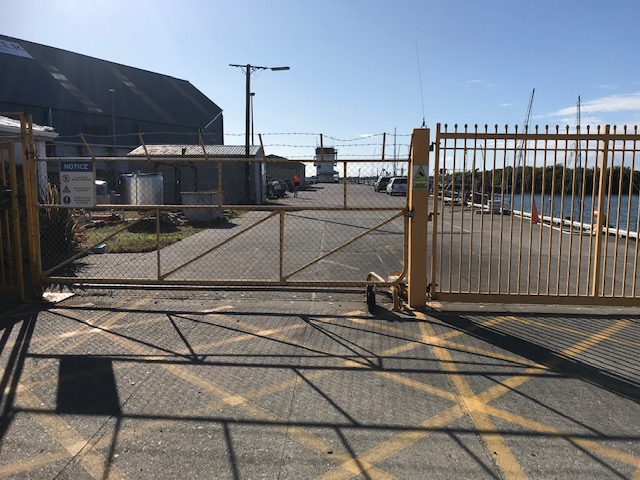
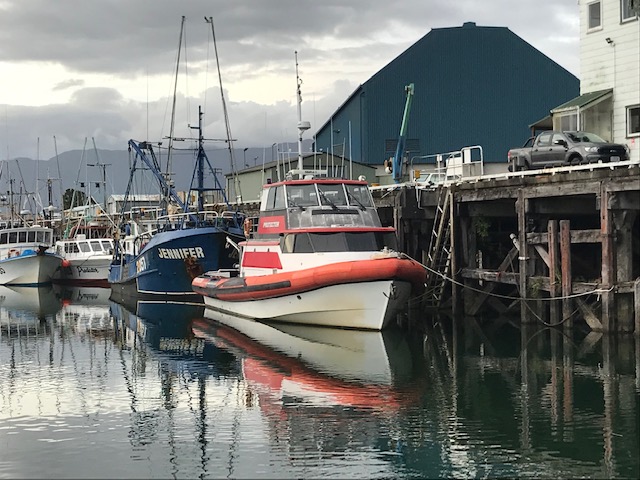
Once everything was tied up and secure, John and I walked up town to check out the local sights.  Past the fishing boats, past the once-bustling wharf-sheds and industrial looking facilities and through the “security” gate. 

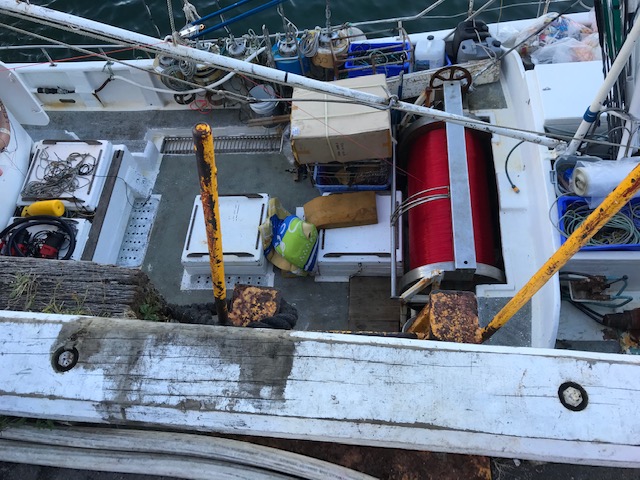
Looking down onto the deck of a long-liner fishing boat. When I say “log liner” I mean it … that reddish looking thing is 35 km of 2.5mm fishing line, which is set in 5km lengths with thousands of hooks, using squid as bait. There was a young lad on the wharf, a deckhand, reeling it on, one 5km drum of line at a time

Whilst the gate looked the part, painted yellow and attached to a high mesh fence, Curly had pre-warned us in a way, when he said … “If you have trouble getting through the gate, just press 1 2 3 4 RESET on the keypad” 

Suffice to say, we didn’t have any trouble with the gate.  I don’t think anyone does, because it’s either never locked, or can’t be locked.  I’m guessing the latter.

The “security” gate …

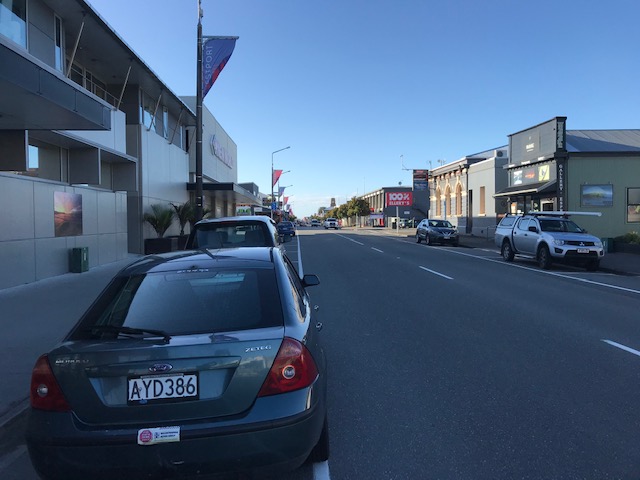
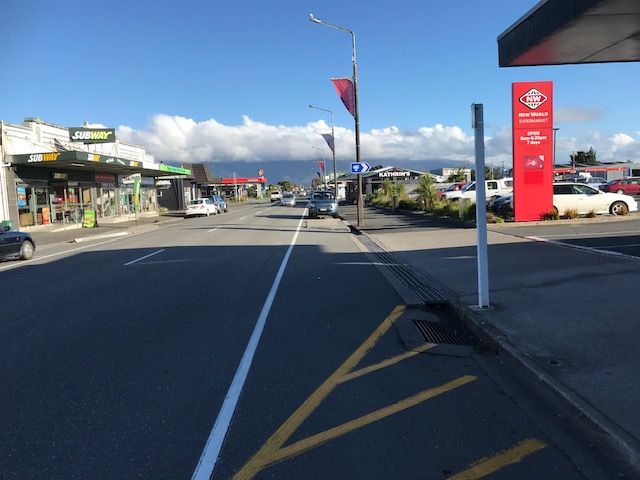
Up town, John and I walked, what would have to be the longest main street of any country town, ever.  It just went on and on. And even when we’d got to the supermarket, there was more main street with shops either side, almost as far as you could see.

Looking one way down this incredibly long main street …
… then looking the other way
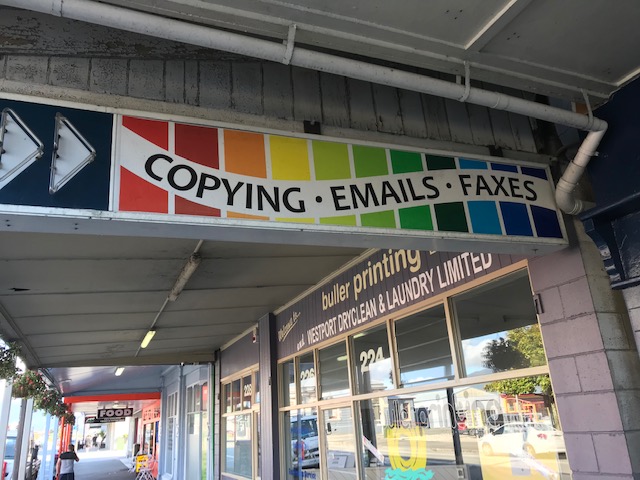
Copying, emails and faxes !
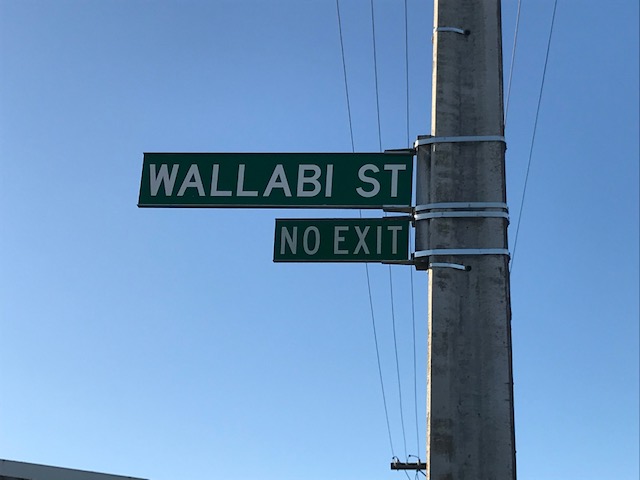
If you’re into rugby you’ll see there’s no respect for the Australian team here … that’s not how you spell Wallaby
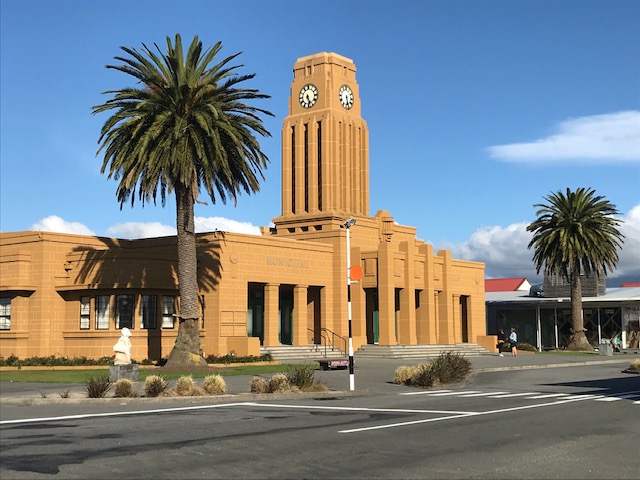
Looking like it belongs in Cairo … complete with palm trees, this is the impressive council building, built in the 1940s … in the main street

Inside the supermarket, I was keen to see for myself whether the panic buying of selected items – common in parts of Australia – had spread across the Tasman.   Well, if it had, we weren’t able to detect it.  That said, a week earlier the regional newspaper DID have a story about the reported sighting of a moose in Fiordland on page one, with an article about a global virus pandemic thingy on page 5 … so maybe I need to visit a few more supermarkets before coming to a definitive conclusion.   

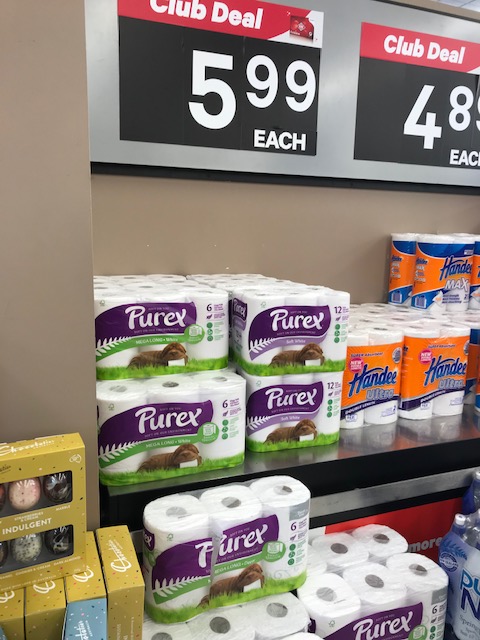
Clearly no supply issues here
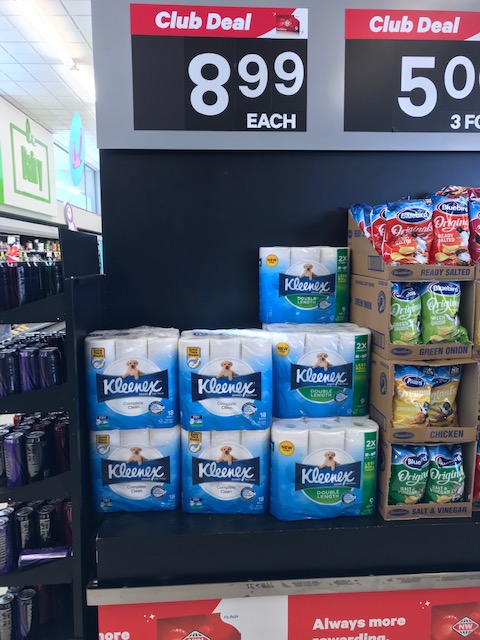
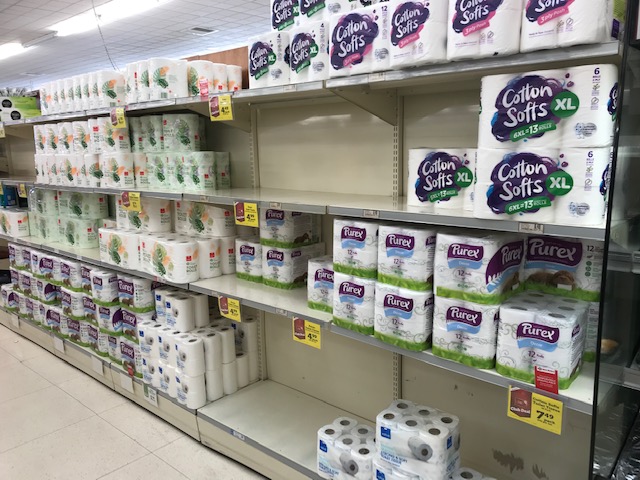
Remember when supermarkets implored you to buy more toilet paper …
A few gaps on the shelves, but Westport is still Number 1, for your Number 2s

Back onboard, it was re-heated spaghetti bolognaise for dinner, topped off with ice cream and fruit – recent purchases from the Westport supermarket (not the spag bol … that’s going to be around for another day or two I suspect)

Soon after dinner it was bed time at a very still and serine “anchorage”.    

Smooth seas, fair breeze and Westport haven

Rob Latimer
You’ve read the words, now …

… see the video.

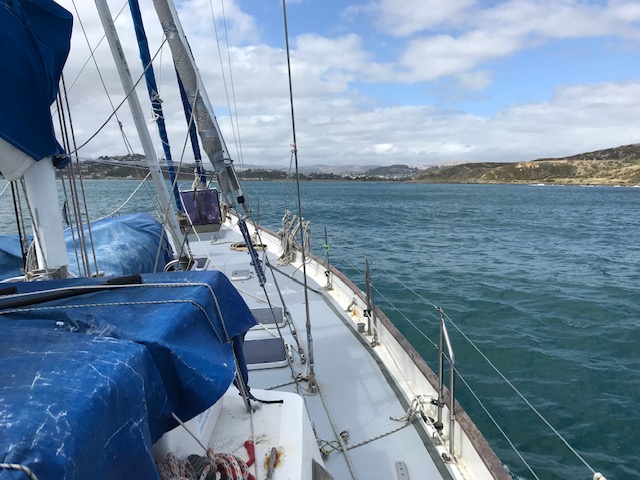
For regular readers of this blog, you’ll know that Dean, Sandy and daughter Samantha, joined the NZ2020 voyage of re-discovery, on the Picton to Akaroa leg … what seems like months ago now, but was really only the middle-part of February.
Dean did an amazing job of producing a 20 minute video, (compiled from hours of material recorded at the time, to be sure) which he has uploaded at the above link for all to enjoy.
It was a great thrill for me to see of course, kind of makes me want to go back there!

ENJOY !!

Design a site like this with WordPress.com
Get started