Tautuku Peninsular – North Side
Friday 21 February 2020
As our second night at sea approached, engine-assistance to maintain our speed had definitely come to an end, with the strengthening nor-east wind from behind causing us to shorten sail … once, twice, three times over the course of the afternoon … and still our speed seemed to increase every time.
Despite the strength of the wind at around 25 knots, it was a comfortable ride, the swell from behind was well behaved and predictable, with only the occasional “rouge” wave doing extraordinary things to drop a few splashes our way.
The evening therefore started with a double reefed main out the port side, with around half the jib set, also poled out the port side.
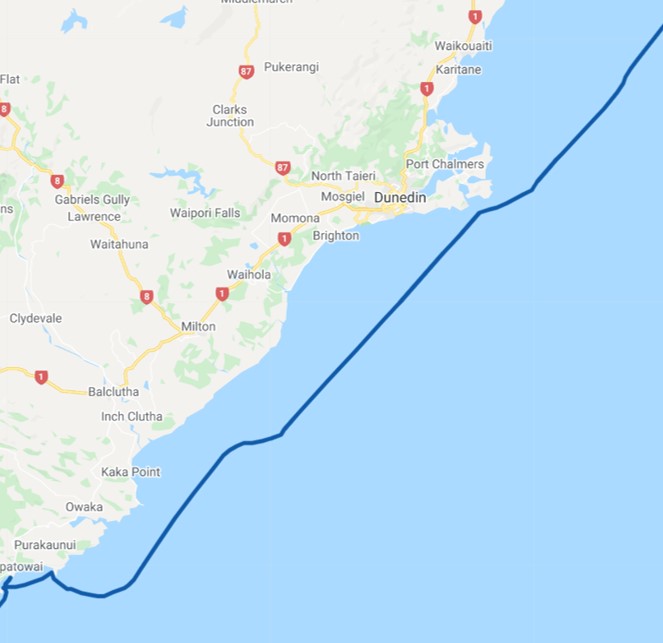
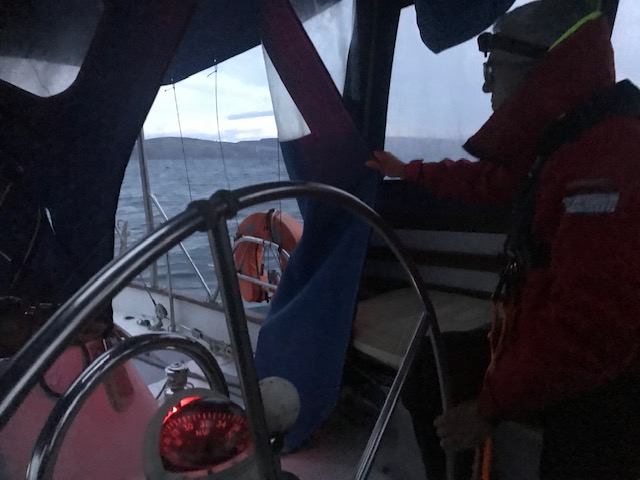
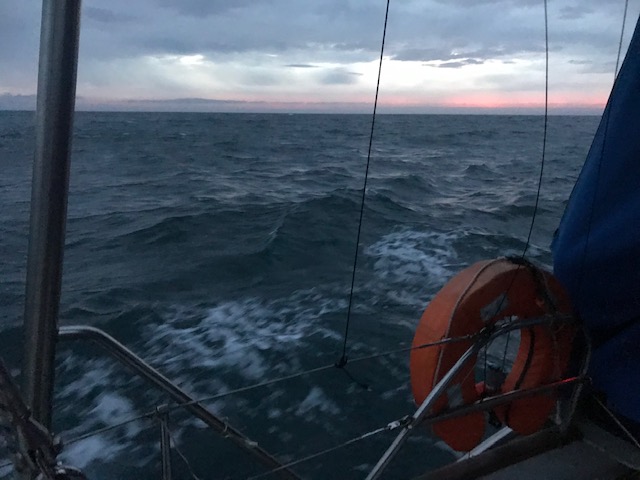
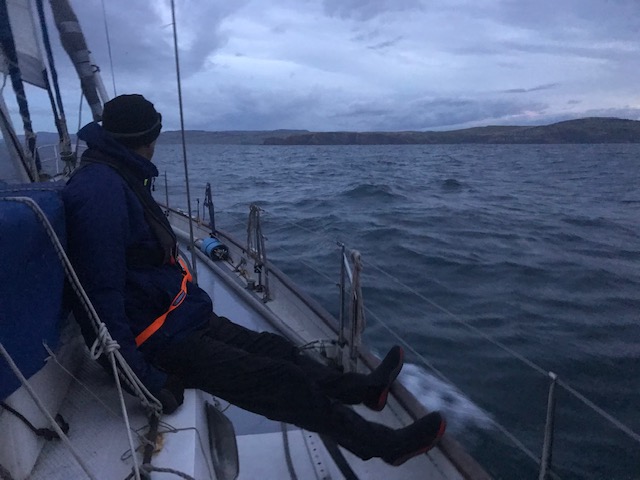
We were doing around 8 knots as Dunedin slipped by on our starboard side and our race to Stewart Island before the arrival of tomorrow’s big blow looked assured.
Prudence dictated the downloading of another weather forecast, on the SatPhone, in the early evening and after some calculations of distance, expected speed and weather-front-arrival-times, I came to the conclusion that:
1. We were NOT likely to reach Stewart Island before the arrival of the weather front
And
2. If we travelled further than Tautuku Peninsular, 75 miles south of Dunedin’s Cape Saunders, then we would have no suitable anchorage in which to shelter when the big blow hit; leaving us in exposed waters meeting the gale head on
It’s not that Chimere and her crew weren’t up to beating to windward and bashing into rising seas, when called upon to do so. But given the choice, of comfort, verses discomfort, we were starting to err on the side of retreating early in order to fight another day.

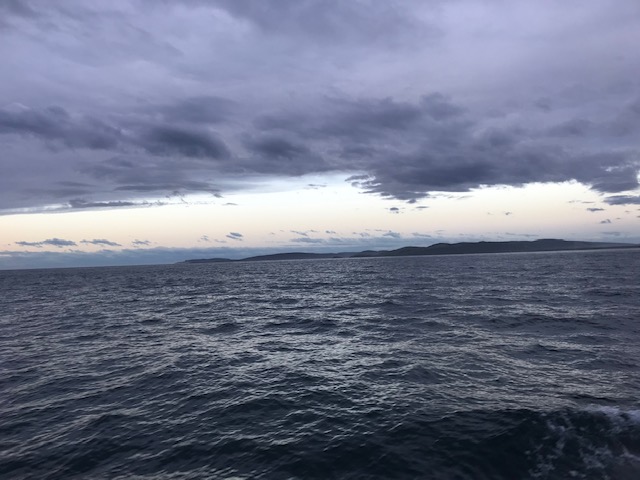
So, the decision was made … we would aim for Tautuku Peninsular, where the cruising guide suggested we could find shelter, first from the current nor-easter, then from the south west gale when it arrived mid-morning.
The dilemma we faced, however, was that at our current speed we would likely place us 30 miles south of Tautuku by morning. Reaching the sheltered anchorages of Tautuku would require us to drastically reduce speed, more than halving it to 3-4 knots.
We started by pulling down the double-reefed mainsail – a task in itself, at night in a following sea. We were still doing 6-7 knots. This was followed by a progressive reduction in the size of the jib till it was little more than the size of a table cloth for a card table. Still we were doing 5-6 knots, increasing to 7 knots down the face of the advancing waves. The reality was, our coach-house and the boat itself was acting like a sail, pushing us along at a handy speed regardless of the sails.
It was a strange sensation, trying to reduce the speed of the boat, when every instinct to that point being about going faster at almost every opportunity.
In the end we decided to head further out to sea, thereby increasing the distance covered, with the plan being to curve back to the coast at Tautuku Peninsular, where our arrival would coincide with sun rise; unfamiliar, rocky headlands, bays and inlets not being places to muck about in in the dark.
One amusing thing at the change of shift around 3:30am, saw me climb the companion way to take over from Carsten who’d been on watch around 12 midnight, only for him to say …
“Wollen wir die Fock jetzt auf die andere Seite nehmen?”
We were both a bit blurry-brained, and wanting to hear the question properly, I inquired politely … “what’s that?”
“…oh, I am speaking German, sorry … will we take the jib to the other side?”
I wish I could do that.
Our plan worked a treat and after reaching Long Point a bit further north at 6:30am, we pottered down the coast, finally dropping the anchor behind Rainbow Isles which, whilst not mentioned in the cruising guide for the area, gave a good level of protection from the north east wind and swell.
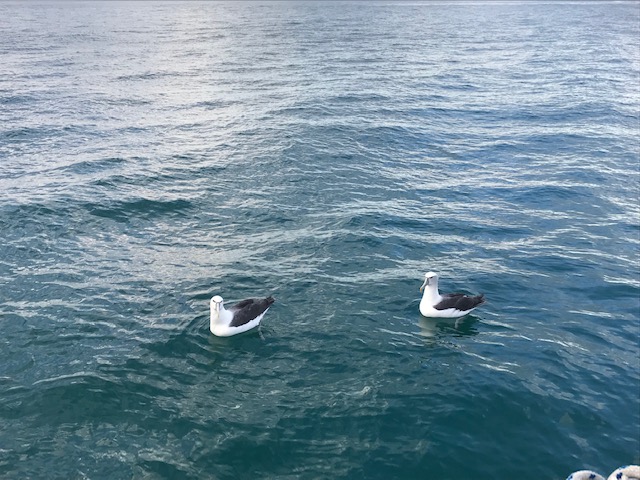
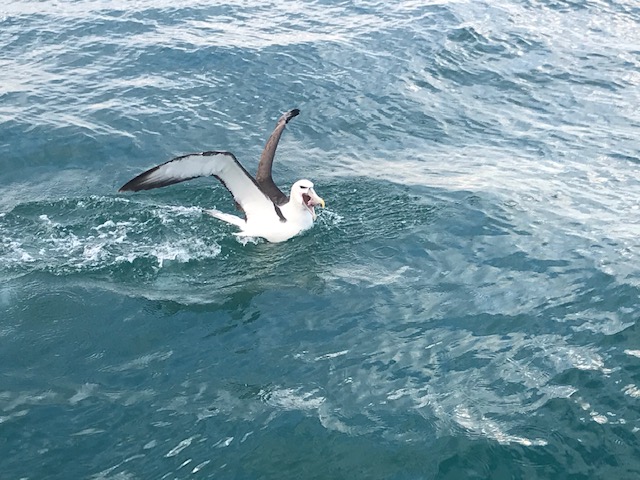
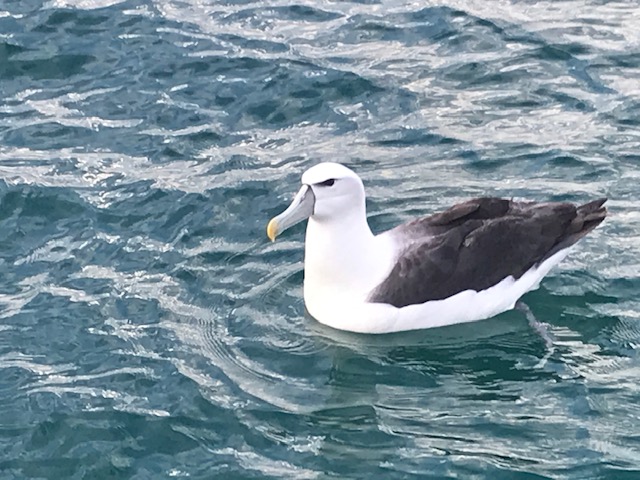
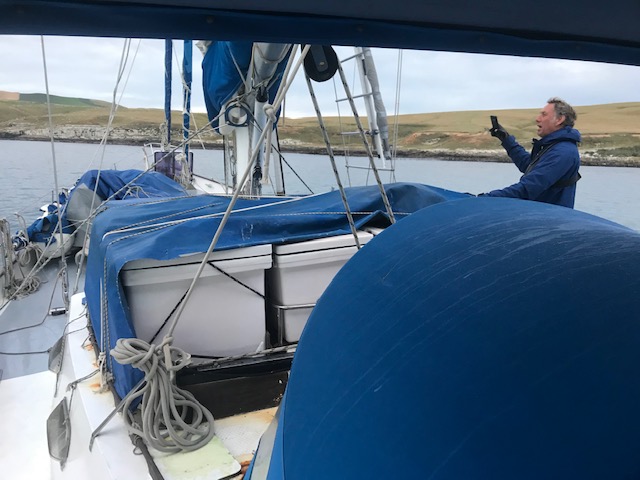
Soon after dropping anchor we were greeted by two large albatross which paddled around our stern in the hope of a feed. This came as a bit of a surprise, because you expect seagulls and ducks to come scavenging … but these things were enormous, just beautiful creatures, their wings all folded up inside and clearly marked plumage.
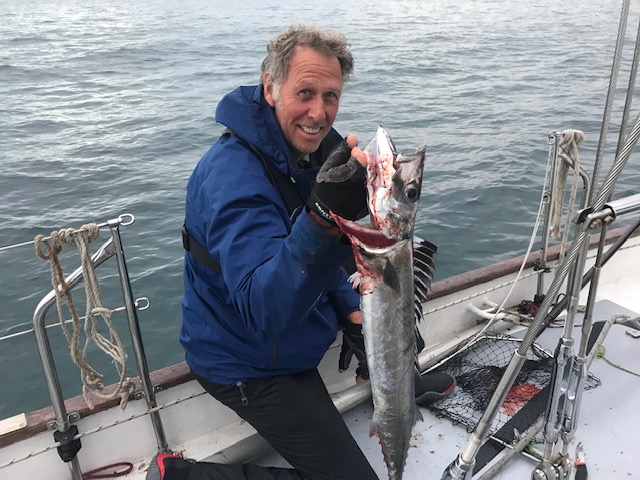
As it turned out, the efforts of the albatrosses were rewarded, with John catching the very first fish of the voyage, as we passed across a local bay in the early dawn.
On the topic of food, special mention needs to be made of the pears and plums put aboard two weeks ago up in Blenheim from the backyard trees of friends Simon and Jenny. We are still eating them and we even stewed some of the riper plums, which were absolutely delicious!
After breakfast at around 9:00am we all went to sleep, me waking around 1:00PM to Carsten diving over the side for a “bracing” swim. It was sunny, the wind had died away, and we began to wonder whether we had made the right call … slowing down and actually stopping, when conditions remained so apparently favourable.
Then it hit us.
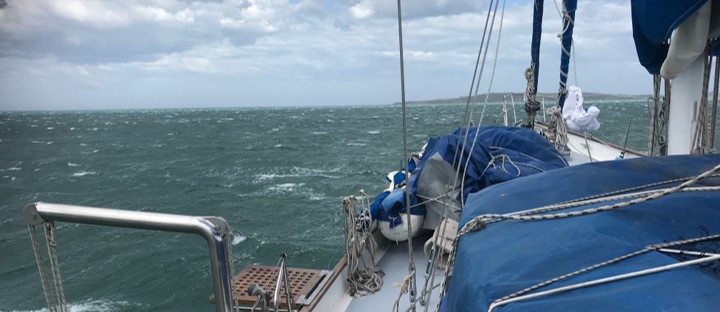
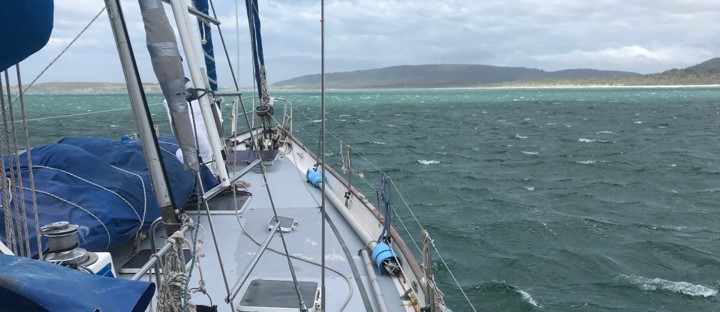
Carsten was still below getting dressed and I was hanging stuff on the line, taking advantage of the warm breeze and sunshine, when all of a sudden, the air went cold. What’s more, at the far end of the bay, a wall of raised spray and spume could be seen heading our way. All of a sudden very little blue water could be seen, it was simply a mass of white caps as far as the eye could see and all around a howling gale, which our newly fitted wind machine recorded peaking at 46 knots.
Whereas the small Rainbow Isle were previously off our bow, now it was off our stern, the anchor and chain working overtime to resist the new forces at play.
“Time to go, get the engine started!,” I called to John. And pretty soon we were steaming our way the 2 miles across the bay to what was now the sheltered place to be.
Back at anchor once more, the sun returned after a couple of hours, the new wind flattening the worst of the nor east swell, making for a reasonably comfortable spot; despite being alarmingly close to a nearby cliff.
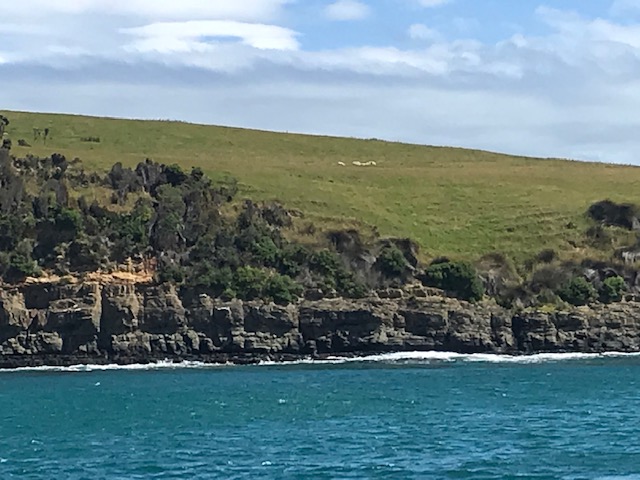
John resumed fishing again and backed up his earlier effort, with a small lemon shark.
After a long-overdue shower, I went back to bed again for another rest, waking to find John watching a cooking video on “how to prepare and cook lemon shark” … what have we come to?!
In the early evening the wind died off considerably and after an amazing meal of fush, and you guessed it … chups … talk turned to … “how long are we going to be here?”
After analysing more weather forecasts, it was decided … we’ll be up at 2:00am and away by 2:30am tomorrow morning, with the hope of arriving at Oban, Stewart Island around mid-day; there being a brief opening in the weather if we hold close to the coast and stay in the lee of Stewart Island as best we can.
Smooth seas, fair breeze and Whoa back, slow down girl!
Rob Latimer
 NZ2020
I must have misunderstood. I thought you were in NZ. Now you tell me you are heading to the Oban roads, just round the corner from your place! Chimere in Ringwood North, what a ‘Surprise’!
LikeLike